
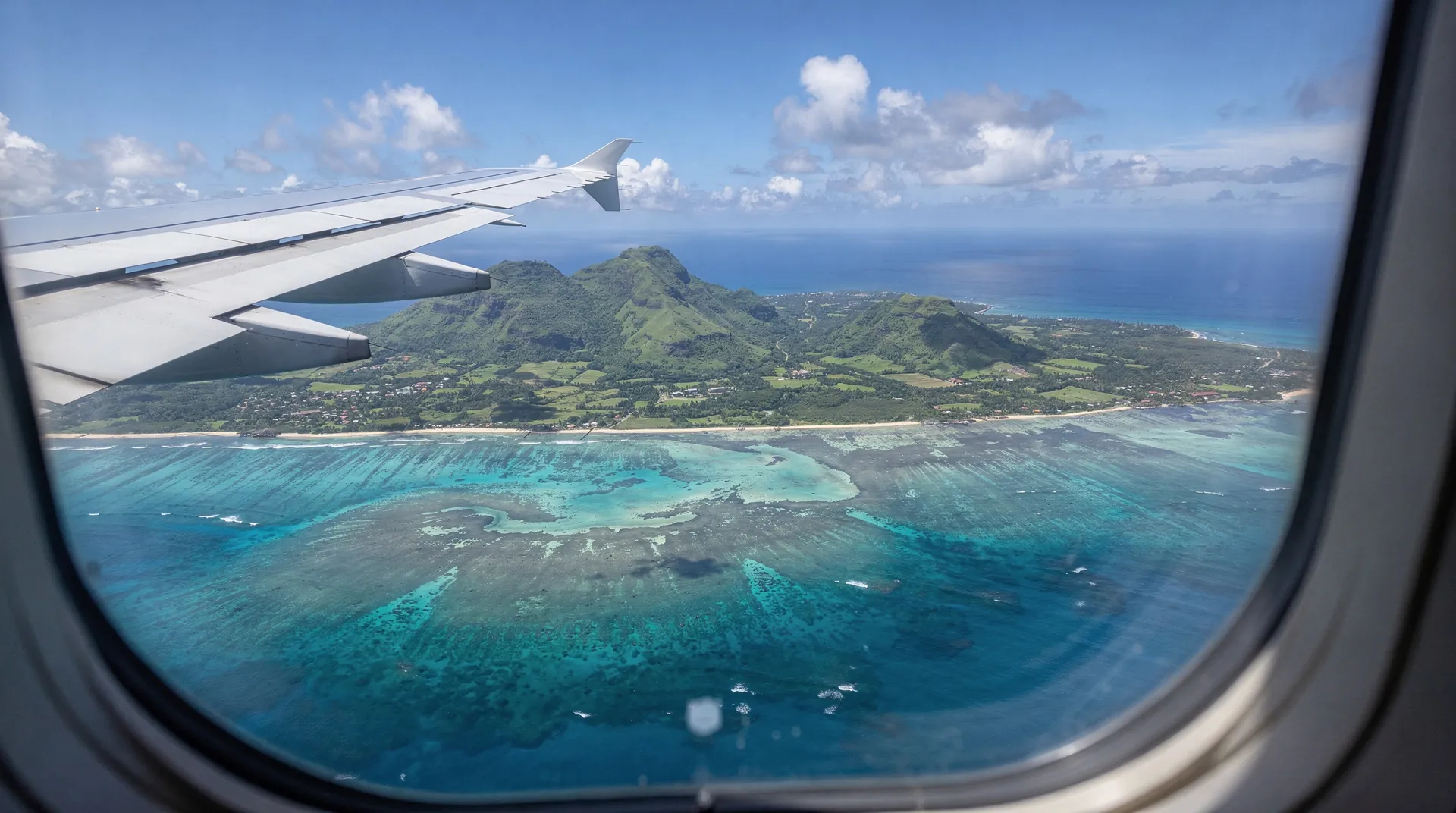
First trip to Mauritius: the complete beginner's guide
Updated: April 2026
First trip to Mauritius: everything you need to know
Mauritius is one of those destinations you hear about for years — photos of turquoise lagoons, white sand beaches, a unique cultural mix, Creole cuisine. And then one day, it’s decided: you’re going. Congratulations. You won’t be disappointed.
But between deciding to go and the plane taking off from Paris, there’s a fair bit of planning to do. This guide is built for travelers on their first trip to Mauritius who have every beginner’s question in mind. To round out your planning, also read our article on common mistakes first-time travelers make — better to see them coming before you leave.
At a glance
| Where to stay for a first trip | Grand Baie or Trou aux Biches (north), easy and well set up |
| Budget for 2 people, 7 nights | roughly 2,900 to 5,200 euros, flights included |
| Recommended length | 7 days minimum, 10 days ideal |
| How to get there | direct flight Paris–Mauritius (about 11h) or with a stopover (14–18h) |
| Best time to go | May to November, avoiding January–March (cyclone season) |
| Getting around | car rental recommended, otherwise day-rate taxis |
When to go to Mauritius?
The ideal season: May to November
The most recommended window for a first trip is May to November, peaking in enjoyment during May-June and September-October. Our complete guide to Mauritius weather breaks down conditions month by month for every region of the island.
May-June: Pleasant temperatures (24-27°C during the day), calm blue seas, rare rain. This is often the connoisseurs’ favorite window: not too hot, not too crowded, prices still reasonable before the summer peak of July-August.
July-August: Mauritius’s high season, largely because it coincides with French school holidays. The weather is cool and dry (22-25°C), excellent for outdoor activities. Prices run 20-40% higher and the sights are busier. The beaches are at their best but more crowded.
September-October: An excellent window. The dry season is winding down, the weather is beautiful, the sea is calm. Prices ease slightly compared to summer. Snorkeling and diving are outstanding during this period — underwater visibility is at its best.
December-April: The hot, humid season (28-32°C), with more frequent rain, especially from January to March. Cyclone season (risk of cyclones, mainly January-March) can disrupt a trip. Conditions are still often very good, though, especially on the west coast. December is very popular (Christmas, New Year) and very expensive.
Recommended length
7 days: The minimum length for a real taste of Mauritius. Our 7-day itinerary guides you day by day to see the essentials without rushing.
10 days: The ideal length for a first visit. Enough time for beaches, excursions, culture and a few unplanned moments. Our 10-day itinerary is our top recommendation for first-time travelers.
14 days: For full immersion, including a side trip to Rodrigues (the sister island, 600 km away). See our 14-day itinerary for this deeper trip.
How to book your trip
Direct flight or connection
Direct flight: Air Mauritius and Air France run direct flights from Paris CDG to Mauritius (MRU). Duration: about 11 hours. More comfortable, less risk of lost luggage or a missed connection. Price: 600-1,200 euros round trip depending on season and how far ahead you book.
Flight with a stopover: Emirates (via Dubai), Qatar Airways (via Doha) and Turkish Airlines (via Istanbul) often offer competitive fares with a 2-5 hour layover. Total travel time: 14-18 hours. Sometimes 30-40% cheaper than direct, but more tiring.
Booking tip: Book 3-6 months ahead for the best fares, especially around French school holidays. Tickets for July and December-January sell out fast.
Going independent or through a tour operator
Independent: Book the flight yourself (Skyscanner, Google Flights), the accommodation yourself (Booking, Airbnb, hotel websites directly), and arrange activities on the ground. Flexible, often cheaper, but requires more planning. Our Mauritius budget guide helps you work out costs for each category.
Through a tour operator: Tour operators offer flight+hotel packages with group rates that can be very competitive, especially for all-inclusive deals. Less flexible but simpler to arrange.
Advice: For a first trip, going independent with a well-chosen hotel (not all-inclusive) delivers a more authentic experience at the same price. All-inclusive tends to keep travelers stuck at their hotel and makes them miss the real Mauritius.
Where to stay: recommended areas
For a first visit: the north
Grand Baie and its surroundings (Trou aux Biches, Mont Choisy, Pereybere) are ideal for a first visit. Plenty of restaurants and activities within walking distance, easy connections to the rest of the island, a lovely beach nearby, a lively atmosphere without being overwhelming. Our guide to where to stay in Mauritius covers every area with its pros and cons.
Accommodation: From a simple B&B at 50 euros/night to a five-star resort at 500 euros/night, the whole range is available. For a first trip, a 3-4 star hotel in the 80-150 euros/night range for two is a good target. Our guide to hotels in Mauritius offers a selection of the best places.
Based on your priorities
Beach and watersports: Flic en Flac (west coast, ideal for diving and sunsets) or Belle Mare (east coast, wild beaches and a deep lagoon).
Luxury and privacy: Le Morne or Bel Ombre (southwest coast, prestige resorts in a secluded setting). Our guide to where to stay for luxury covers the most exclusive properties.
Local authenticity: Mahébourg (southeast, an authentic fishing town) or the guesthouses in the interior.
With family: Trou aux Biches and Belle Mare are particularly well suited to children thanks to their safe lagoons. Our guide to where to stay with a family points you to properties with kids’ clubs and family-friendly facilities.
As a couple: Our guide to where to stay as a couple identifies the most romantic places to stay in each area.
Formalities and documents
Passport and visa
Passport: Valid for at least 6 months after your planned return date. Check the expiry date carefully — it’s the most common mistake, and it can lead to being denied boarding.
Visa: French nationals don’t need a visa for tourist stays in Mauritius of up to 90 days. On arrival, a free residence permit is stamped into your passport.
Documents to carry on arrival:
- Valid passport
- Return ticket (or proof of onward travel)
- Accommodation address
- Possibly proof of sufficient funds (rarely asked for in practice)
Travel insurance
Essential to protect your investment and your health. Check that your policy covers medical expenses abroad (minimum 150,000 euros), medical repatriation, and trip cancellation. Compare offers from your bank, your home insurer and specialist travel insurers — prices and coverage vary considerably.
Getting around once you’re there
This is a question nearly every first-time traveler asks: should you rent a car? The answer depends on your travel style, but our with-or-without-a-car comparison comes down clearly in favor of renting for anyone who wants to see several regions.
| Option | Pros | Cons |
|---|---|---|
| Rental car | Total freedom, access to out-of-the-way spots, convenient for families | Driving on the left to get used to, parking sometimes limited |
| Day-rate taxi | Zero stress, a driver who knows the roads | Pricier over several days, less spontaneity |
| Public bus | Very cheap, an authentic experience | Slow, network sometimes confusing for a first stay |
For a first trip of 7 to 10 days with several regions to see (north, west, south), renting a car remains the best value option. Check that your driving license is accepted as-is or whether you’ll need an international permit.
Language, time difference and connectivity
Mauritian Creole is the everyday language, but French is very widely understood and English remains the official language of administration — you’ll never be stuck for lack of language. On the time front, Mauritius has no major time difference from France (2 or 3 hours depending on the season, no jet lag to worry about). For currency, always keep some rupees in cash for small purchases and tips, even though cards are widely accepted.
On safety, Mauritius remains a very safe destination for a first trip: common-sense precautions (don’t leave valuables visible in the car, be careful in isolated areas at night) are more than enough.
Budgeting for a first trip
Overall estimated budget
For two people, 7 nights, on a “moderate” trip (3-4 star hotel, varied restaurants, activities):
- Round-trip flights (2 people): 1,200 to 2,400 euros
- Accommodation (7 nights x 80-120 euros/night): 560 to 840 euros
- Car rental (7 days x 35-45 euros/day): 245 to 315 euros
- Meals (lunch + dinner x 7 days x 2 people): 400 to 700 euros
- Activities and entry fees: 300 to 500 euros
- Miscellaneous (shopping, tips, unexpected costs): 200 to 400 euros
- Estimated total: 2,905 to 5,155 euros for two people, 7 days
To trim the budget: book flights well ahead, choose small local restaurants over touristy ones, favor guesthouses over hotels. Our complete Mauritius budget guide covers every money-saving tip in detail.
The currency: the Mauritian rupee (MUR)
1 euro is worth roughly 47-50 rupees (check the current rate before you leave). Euros are widely accepted in tourist areas, but paying in rupees is always the better deal for you (a better implied exchange rate).
Exchanging money: At the airport on arrival (decent rate), at banks (best rate), at official currency exchange offices. Avoid hotels (poor rate). ATMs (Visa and Mastercard) work everywhere and dispense rupees.
The first few days: what to expect
On arrival
Sir Seewoosagur Ramgoolam Airport (SSR) is in the southeast of the island, at Plaisance. Small, modern and efficient. Immigration is quick (30-45 minutes outside of peak times), and baggage claim is well organized.
If you’ve booked a car, the rental agencies are in the arrivals hall. Pick up the car, check its condition, and ask for a physical road map — always handy as a backup to your GPS. For travelers without a car, our airport transfer guide covers every option for reaching your accommodation. The simplest solution is to book a private airport-hotel transfer ahead of time — a driver waiting for you outside, a fixed price with no haggling.
If you take an unbooked taxi, negotiate the price before getting in. Expect 1,200 to 1,800 rupees for a transfer to the north (Grand Baie), 400 to 600 rupees to Mahébourg.
Getting a local SIM card
Prepaid SIM cards from Emtel and My.t are sold right at the airport on arrival (a few euros for 5-10 GB of data). It’s far cheaper than European roaming and lets you use Google Maps, book restaurants and stay in touch. Especially essential if you’re renting a car. A handy alternative if your phone doesn’t make it easy to swap SIMs: an eSIM for Mauritius activates in minutes, even before you leave France.
Your first meals
For your first meal in Mauritius, look for a small local spot rather than a flashy tourist restaurant. A hot dholl puri from a street stall, a fish curry served over rice at a beachside restaurant, a briani at a traditional Mauritian restaurant — that’s where you’ll instantly understand why Mauritian cuisine has such a good reputation. The golden rule: wherever Mauritians are queuing, the food is good.
What surprises first-time travelers
How small the island is: Mauritius is smaller than expected. Distances look short on the map, but traffic (especially around Port-Louis) can slow things down considerably. Always allow more time than your GPS suggests.
The cultural diversity: Mauritius has an exceptionally rich identity. Hindu temples next to mosques, next to Catholic churches. Indian markets, Chinese restaurants and French bakeries on the same street. This diversity is one of the island’s great riches — take the time to notice it. The markets and cultural festivals are the best places to experience it.
The heat: Even traveling during the austral winter (May-October), days can be very hot (28-32°C). Sun protection and hydration are non-negotiable.
The Mauritians: The people of Mauritius are generally very welcoming, curious about visitors and proud of their country. Don’t hesitate to strike up a conversation — the best addresses, stories and tips will come to you unprompted.
The cost of activities: Excursions and watersports can eat up a significant share of the budget. Île aux Cerfs, catamaran trips, introductory dives — cost them out ahead of time to avoid unpleasant surprises.
The must-dos you shouldn’t miss
Whatever the length of your stay, here are the five unmissable experiences of your first trip to Mauritius:
The northern beaches (Trou aux Biches or Mont Choisy): The turquoise lagoon, ideal for your first swim in Mauritius in calm, shallow water.
The central market in Port-Louis: The capital and its colorful market, the best way to grasp the full diversity of Creole culture.
Chamarel: The Seven Coloured Earths and the waterfall — the island’s most photographed natural wonders, set in tropical forest.
Île aux Cerfs: The postcard beach that alone justifies the trip — turquoise water, white sand, a paradise atmosphere. Book the catamaran excursion with lunch to Île aux Cerfs for a full day with a seafood meal on board.
A catamaran trip or swimming with dolphins: The at-sea experience that will stay with you as one of your best travel memories.
Choosing the right itinerary for your first trip
Depending on how long you’re staying and what you’re after, several itineraries are available:
For 5 days, our 5-day itinerary makes the most of every hour to cover the essentials in a short stay.
For a classic week, our 7-day itinerary is the benchmark — balanced, complete, with the right pace for a first visit.
If you’re traveling with family, our family itinerary tailors each stop to kids’ needs with safe beaches and family activities.
For a honeymoon or a romantic trip, our honeymoon itinerary features the island’s best romantic spots.
If you’d rather explore on your own without a fixed plan, our road trip itinerary traces a free-form loop around the island, region by region.
Have a great trip to Mauritius!