
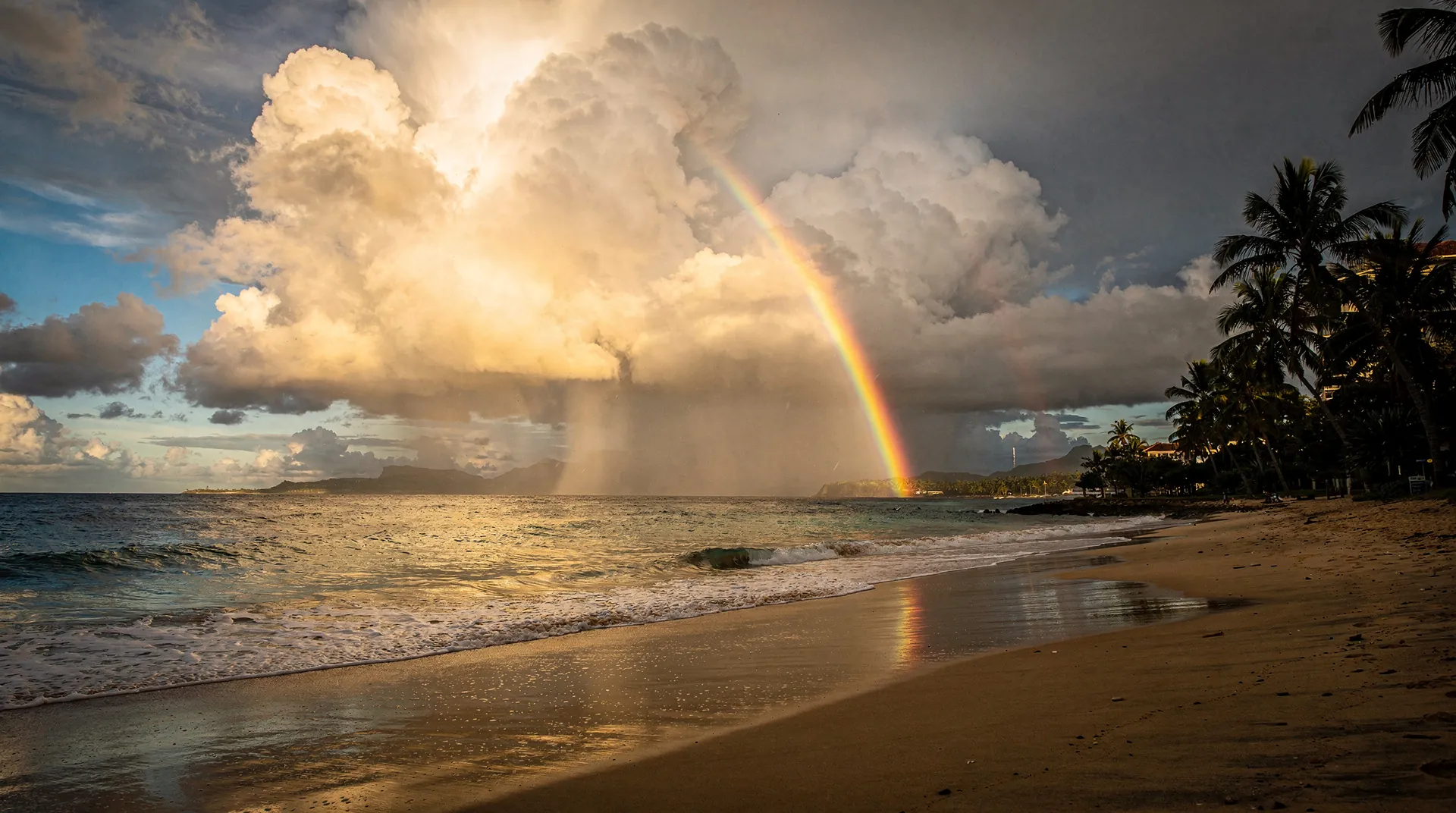
Weather in Mauritius: complete climate guide
Updated: August 2026
When is the best time to visit Mauritius?
May to November offers the most pleasant weather, with little rain and mild temperatures between 22 and 28°C.
Quick summary
| Best period | May to December, avoiding January-February |
| Driest season | May to October (southern winter) |
| Hottest and most humid season | November to April (southern summer, possible cyclones) |
| Sunniest area | west coast (Flic en Flac, Le Morne) |
| Sea temperature | 22 to 29°C depending on the season, pleasant year-round |
Understanding the climate of Mauritius
Mauritius enjoys a tropical climate tempered by the trade winds of the Indian Ocean. Located at 20° south latitude, it experiences two clearly distinct seasons: a hot, humid summer from November to April, and a mild, dry winter from May to October. This climatic duality makes it a year-round destination, but conditions vary significantly depending on when you visit.
The island’s topography plays a major role in how rainfall is distributed. The central plateau, which rises to around 800 metres, captures most of the rain brought in by the south-easterly trade winds. The east coast therefore receives more rainfall than the west coast, which benefits from a drier, sunnier microclimate thanks to a foehn effect from the mountains. That’s why Flic en Flac and Le Morne on the west coast are almost always sunny, even when Belle Mare on the east coast is under clouds.
Mauritius’s two main seasons
The southern summer (November to April)
Mauritian summer corresponds to winter in the northern hemisphere — which can throw off travellers who leave “in European winter” and find themselves in full tropical heat. This is the hot, humid season, marked by high temperatures, heavy humidity and the risk of tropical cyclones.
Daytime temperatures range between 27 and 33°C on the coast, sometimes topping 35°C during the hottest days of January-February. Nights stay warm, rarely dropping below 23°C on the coast.
Rainfall is plentiful, particularly from January to March, with tropical downpours that are often intense but generally brief (30 to 60 minutes). Relative humidity can reach 80 to 90%, making the heat feel oppressive at times. The sea is warm, reaching 27 to 29°C, which makes it an ideal time for snorkelling and diving despite sometimes unpredictable weather.
This is also cyclone season. For everything you need to know about cyclones and the associated risks, see our complete guide to cyclones in Mauritius.
The southern winter (May to October)
Mauritian winter is the season most travellers prefer, and for good reason. Cool and dry, the weather is pleasant, with coastal temperatures between 22 and 28°C. The south-easterly trade winds blow steadily, cooling the air and making the heat more bearable. Nights can be chilly on the central plateau, sometimes dropping to 15°C, but stay mild on the coast (18 to 22°C).
Rainfall is light, especially on the west coast, which benefits from being sheltered from the wind. Skies are generally clear, with plenty of sunshine. The sea cools slightly, to between 22 and 25°C, but remains pleasant for swimming.
This is the ideal time for hiking, kitesurfing, sailing and outdoor activities — see our hiking guide to Mauritius to make the most of the trails in the best conditions.
Detailed monthly temperatures
The table below shows average coastal temperatures (in Celsius):
- January: min 24°C / max 30°C — sea 28°C
- February: min 24°C / max 31°C — sea 29°C
- March: min 24°C / max 30°C — sea 28°C
- April: min 22°C / max 28°C — sea 27°C
- May: min 20°C / max 26°C — sea 25°C
- June: min 18°C / max 24°C — sea 24°C
- July: min 17°C / max 23°C — sea 23°C
- August: min 17°C / max 23°C — sea 22°C
- September: min 18°C / max 25°C — sea 23°C
- October: min 20°C / max 27°C — sea 24°C
- November: min 22°C / max 29°C — sea 26°C
- December: min 23°C / max 30°C — sea 27°C
Note: these temperatures are for the coast. The highlands (Curepipe, Vacoas) are consistently 4 to 6°C cooler. If you’re planning hikes or a visit inland, pack an extra layer.
Rainfall and sunshine
Annual rainfall by area
Annual rainfall varies enormously across the island — it’s one of the most important things to understand when choosing where to stay.
- Central plateau (Curepipe, Vacoas): up to 3,500 mm per year — the wettest area
- East coast (Belle Mare, Trou d’Eau Douce): 1,500 to 2,000 mm per year
- North coast (Grand Baie, Trou aux Biches): 1,000 to 1,200 mm per year
- West coast (Flic en Flac, Le Morne): 700 to 900 mm per year — the driest area
Monthly rainfall on the north-west coast (the main tourist area):
- January: 160 mm (15 rainy days)
- February: 140 mm (13 days)
- March: 130 mm (12 days)
- April: 90 mm (9 days)
- May: 60 mm (7 days)
- June: 45 mm (6 days)
- July: 50 mm (6 days)
- August: 40 mm (5 days)
- September: 35 mm (4 days)
- October: 45 mm (5 days)
- November: 70 mm (7 days)
- December: 110 mm (11 days)
Sunshine
Mauritius enjoys generous sunshine all year round. In winter (May-October), the west coast gets an average of 8 to 9 hours of sunshine a day — outstanding. In summer (November-April), sunshine drops to 6-7 hours, but tropical showers are usually followed by quick clear spells. It’s very rare to get a full day without sun, even in January.
Humidity and how it feels
Relative humidity is higher in summer (75 to 85%) than in winter (65 to 75%). Combined with summer temperatures, it can make the heat feel oppressive, especially in poorly ventilated inland areas.
On the coast, sea breezes considerably ease this sensation — which is why the beaches of Flic en Flac or Grand Baie stay pleasant even in January. Travellers planning inland excursions (inland markets, highlands) in summer will find the heat more taxing.
The trade winds: prevailing winds in Mauritius
South-easterly trade winds blow across Mauritius for much of the year. They’re particularly strong from June to September, with gusts reaching 40 to 60 km/h on the east coast.
Impact by area:
The east coast (Belle Mare, Palmar) is exposed to the trade winds and can see choppy conditions in winter, with waves and strong wind that make swimming difficult on some days. On the plus side, it’s a paradise for kitesurfers and windsurfers.
The west coast (Flic en Flac, Le Morne) is sheltered by the mountains and offers calmer conditions — the sea is generally still even in the depths of winter. This is the coast to favour for families and holidaymakers looking for calm waters year-round.
The north coast (Grand Baie, Trou aux Biches) sits in between — less exposed than the east, slightly windier than the west, but pleasant overall year-round.
Regions and microclimates: where to stay by season
The north coast
Grand Baie, Trou aux Biches and Cap Malheureux enjoy generous sunshine and moderate rainfall. It’s an ideal transition zone for a well-balanced holiday. Good year-round, excellent from September to November.
The west coast
From Flic en Flac to Le Morne Brabant, the west coast has the island’s best microclimate for beach holidays. Sheltered from the trade winds by the central mountain range, it gets the least rain and enjoys sunny days even when the rest of the island is cloudy. Recommended year-round, ideal in winter if you’d rather avoid the wind.
The east coast
Belle Mare, Palmar and Mahébourg get more rainfall and are more exposed to the trade winds in winter. In return, the lagoons here are spectacular (the deepest and bluest on the island), and the beaches are often less crowded. Ideal from November to March when the trade winds ease off.
The central plateau
Curepipe, Vacoas and the Hautes Plaines form a cooler, much wetter area. Clouds often cling to the peaks. Ideal for hiking and exploring the coloured earth of Chamarel or the nature parks. Not recommended for beach holidays.
The south
The south coast, from Gris-Gris to Blue Bay, has varied microclimates. Blue Bay with its lagoon is pleasant year-round. The Gris-Gris and Souillac coast is windier and exposed to ocean swells — stunning scenery, less ideal for swimming.
Months to approach with caution
January and February carry the highest combination of risks: peak heat, oppressive humidity, heavy rainfall and the highest cyclone risk. These months coincide with peak tourist season (European school holidays around All Saints’, Christmas and New Year), meaning high prices for less favourable weather. Paradoxically, this is when many French families travel, driven by school holiday dates.
July is popular with French tourists (summer holidays), but it’s one of the windiest and coolest months. The east coast can be difficult for swimming, and nights are chilly. Still, the weather stays stable and sunny on the west coast.
Summary: which month to choose based on your priorities
Excellent months: May, September, October — the perfect balance of pleasant weather, low rainfall and reasonable prices. October is often named the best month of the year.
Very good months: April, June, November — slightly windier or hotter, but generally excellent.
Good months: March, July, August, December — some trade-offs (wind, relative cold, rain or crowds), but a great holiday is still very achievable.
Tricky months: January, February — best suited to travellers willing to accept the risks of cyclone season and humid heat, in exchange for sometimes very attractive rates.
For an even more detailed breakdown based on your travel style (beach, diving, hiking, kitesurfing, budget, honeymoon), see our guide to the best time to visit Mauritius.
How weather affects activities
Beaches and swimming: at their best from May to November on the west coast, and from October to March on the east coast. The beaches of Mauritius are accessible year-round on the west coast. To enjoy the lagoons with a guided trip, catamaran outings leave Grand Baie every morning for the northern islets: book a catamaran outing from Grand Baie.
Diving and snorkelling: good visibility year-round, at its best from July to November (30 to 40 metres). Our snorkelling and diving guide covers the best sites by season.
Hiking: ideal from June to September, when temperatures are cool and trails are dry. Our hiking guide gives conditions by season.
Kitesurfing and sailing: June to September on the west coast at Le Morne, with steady trade winds.
Road trips: possible year-round, but more pleasant in winter when it doesn’t rain in the middle of a day of sightseeing. To plan your route, see our Mauritius road trip guide.
Hiking: the trails of Le Morne Brabant are best tackled from May to September. Book a guided hike to get the historical context and avoid getting lost on the plateau: see guided hikes on Le Morne Brabant.
Whale watching: August, September, October — humpback whales pass off the coast of Mauritius during their migration.
Weather and your budget
The season has a significant impact on accommodation and flight prices. In high season (July-August and December-January), hotels charge rates 30 to 100% higher than in low season. To optimise your Mauritius budget, travelling in May or September is the best compromise: excellent weather and reasonable prices.
Whatever period you choose, Mauritius has a gift for moments of pure beauty. The light is unique at every hour of the day, sunsets on the west coast are spectacular, and the warmth of the Mauritian welcome never goes out of season.
Month-by-month seasonality table
| Month | Weather | Tourist crowds |
|---|---|---|
| January | Hot, humid, frequent rain, cyclone risk | High (end-of-year holidays) |
| February | Hot, humid, peak cyclone risk | Moderate |
| March | Hot, still unsettled | Moderate |
| April | Transition, drier | Moderate to low |
| May | Dry, mild, excellent | Low to moderate |
| June | Dry, cool, windy in the east | Moderate (school holidays) |
| July | Dry, cool, very windy | High (French summer holidays) |
| August | Dry, cool, windy | High |
| September | Dry, sunny, excellent | Moderate |
| October | Dry, sunny, often cited as the best month | Moderate |
| November | Transition, still pleasant | Moderate |
| December | Hot, rising humidity | High (end-of-year holidays) |
What to do depending on the day’s weather
Even during the most favourable months, a tropical shower can pop up midday — it’s part and parcel of any tropical island climate. These showers are usually brief (30 to 60 minutes) and followed by clear spells. Always keep a backup plan handy: a museum or cultural visit in Port-Louis, a spa and wellness session, or a shopping trip. Our guide to things to do when it rains lists the best options so a passing shower doesn’t cost you a day of your holiday.