
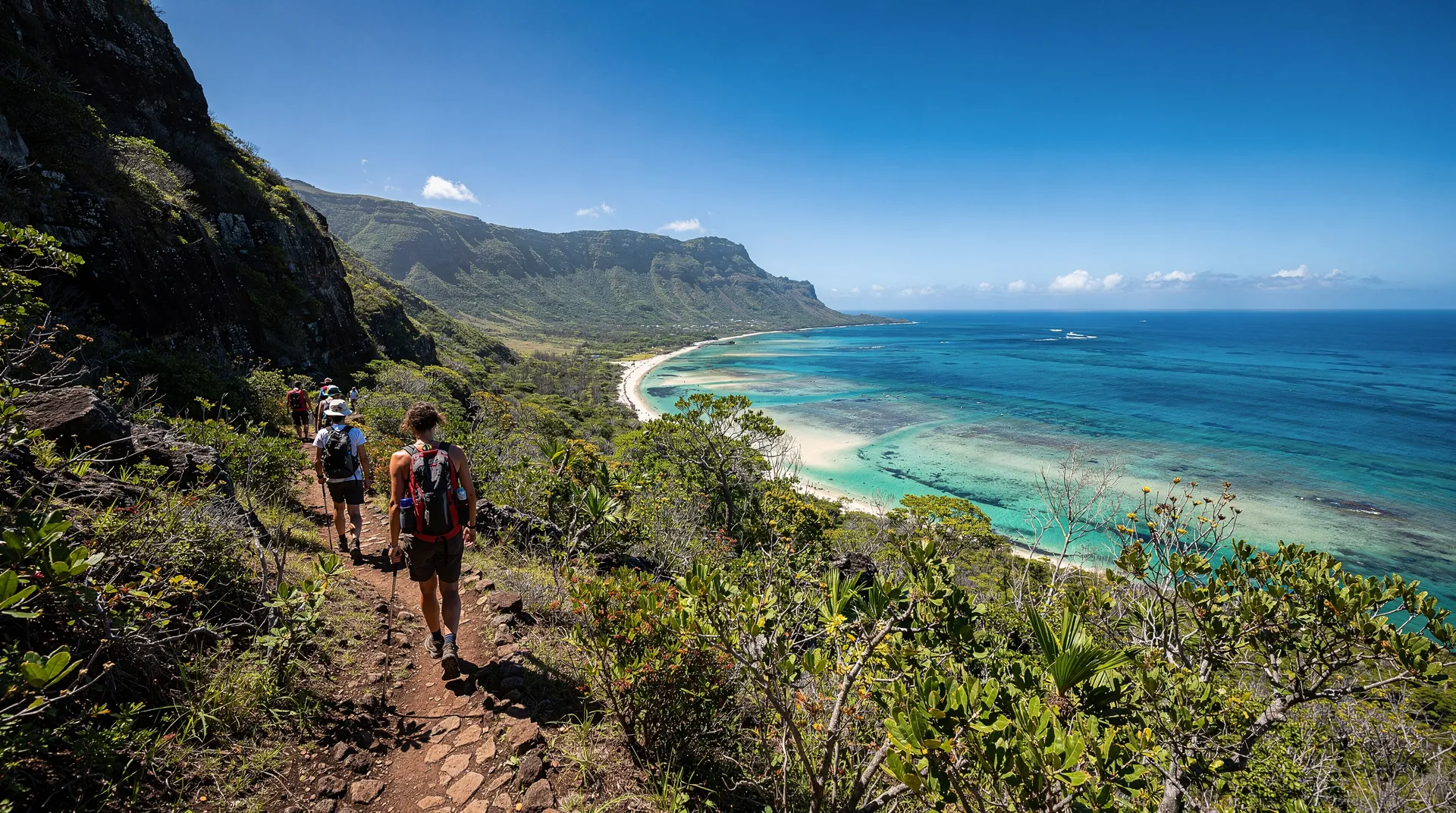
Hiking in Mauritius: Le Morne, Black River Gorges and the 7 Waterfalls
Updated: August 2026
Can you hike without a guide in Mauritius?
Some marked trails are accessible on your own (Black River Gorges), but for Le Morne Brabant and the 7 Waterfalls, a local guide is strongly recommended for safety and orientation.
Hiking in Mauritius: discovering the island differently
Mauritius is often associated with beaches and lagoons, but the island hides a mountainous interior of remarkable, wild, and well-preserved beauty. Hikers will find a surprising variety of trails here: dense tropical forests, rocky peaks with panoramic views over the entire lagoon, waterfalls hidden in the jungle, and deep gorges carved out by millions of years of volcanic activity.
Hiking is one of the best ways to discover the real nature of Mauritius, far from the hotels and touristy beaches. It’s also a chance to spot endemic birds found nowhere else on earth, marvel at spectacular basalt formations, and realise that Mauritius is much more than a beach destination.
To reach the trailheads, a car is essential. Our guide to renting a car in Mauritius will help you organise your transport. Most hiking sites are located in the south-west of the island, not far from the Chamarel area and Black River Gorges National Park.
At a glance
| Where | Mainly the south-west of the island: Le Morne, Black River Gorges National Park, the 7 Waterfalls (Henrietta) |
| Budget guide | Free (self-guided Black River Gorges) up to 3,000–5,000 rupees for a private guided hike |
| Time needed | From 2 hours (easy trails) to a full day (the Black River Gorges GR, the ascent of Le Morne) |
| Getting there | A car is essential to reach the trailheads, outside of tours sold with transport included |
| Best time | May to November (dry season), early morning; avoid heavy rain or cyclone warning days |
Le Morne Brabant: the symbolic ascent
Overview and history
Le Morne Brabant is the most iconic peak in Mauritius. This rocky massif, 556 metres high, rises at the south-western tip of the island, overlooking the turquoise lagoon that surrounds it on three sides. Listed as a UNESCO World Heritage Site in 2008, it carries a poignant history that explains its status as a place of national remembrance.
In the 18th and 19th centuries, runaway slaves (the “maroons”) took refuge in the cliffs and caves of Le Morne Brabant to escape their masters. The massif, with its vertical cliff faces and difficult access, offered near-impenetrable natural protection.
According to legend — whose historical accuracy is debated but which has become part of Mauritian collective memory — when a troop of soldiers climbed towards the summit in 1835 to announce the abolition of slavery, the refugee slaves who saw them approaching believed it was an attempt at capture and chose to jump to their deaths rather than surrender. This tragic and symbolic event turned Le Morne into a place of commemoration and reflection for all Mauritian communities.
The Ascent
Difficulty: Hard (some very steep, exposed sections, with safety cables) Duration: 3 to 4 hours round trip Elevation gain: around 400 metres Summit altitude: 556 metres Best time: May to November (dry season), early morning to avoid the heat Starting point: Car park at the foot of the massif, accessed from the main road at Le Morne
The climb up Le Morne is technically demanding and is nothing like a gentle stroll. The trail begins on an accessible forest path, but the last 200 metres involve scrambling over bare rock, aided by steel safety cables. This is not a hike for anyone with a fear of heights, or without a decent baseline level of fitness.
You can book a guided hike in Black River Gorges National Park with a certified guide who will ensure your safety and enrich your visit to this UNESCO-listed site.
Guide mandatory since 2018: A local guide is compulsory for the ascent of Le Morne. This rule serves two purposes: hikers’ safety (several serious accidents occurred before the rule was introduced) and cultural respect for the site (guides raise visitors’ awareness of the history of the maroon slaves). Licensed guides wait at the foot of the trail from the early morning hours. Expect to pay 500 to 800 rupees per person for a group, or 1,000 to 1,500 rupees for a private guide.
What you’ll see from the top: The view from the summit plateau and the viewpoints along the ridges is absolutely spectacular. On a clear day, you can see the entire lagoon of Le Morne with its shades of turquoise, the coast up to Rivière Noire in the north, the south coast as far as Souillac, and sometimes even the outline of Réunion on the horizon. Photographers can’t believe their eyes — it’s one of the most breathtaking panoramas on the island.
Recommended gear: Closed hiking shoes with non-slip soles (absolutely essential — sandals or flip-flops are dangerous and have caused several accidents), at least 1.5 litres of water per person, SPF 50 sunscreen, a hat, light gloves for the scrambling sections, and a charged phone.
The Le Morne area is also known for its spectacular beaches and watersports. After the effort of the climb, a swim in the lagoon at the foot of the massif is a well-earned reward.
Black River Gorges National Park
Overview
Black River Gorges National Park is the largest national park in Mauritius, covering around 6,574 hectares in the south-west of the island. It is the green lung of Mauritius, home to most of the island’s remaining native forest — forest that has disappeared elsewhere under pressure from sugar cane clearing.
For hikers, the park offers a network of well-maintained trails totalling more than 60 km, ranging from easy plateau walks to serious hikes descending into the gorges. It’s one of the few places in Mauritius where you can walk the marked trails alone without a guide — though a trail map remains essential.
The park’s proximity to the Chamarel area makes it easy to combine a morning hike in the gorges with an afternoon visit to the Coloured Earths and the Chamarel Rum Distillery — a very full day out in the south-west of the island.
The main trails
Pétrin–Plaine Champagne Trail (easy level)
- Duration: 2–3 hours round trip from the Pétrin visitor centre
- Elevation gain: minimal, relatively flat terrain on the plateau
- What you’ll see: filao and cryptomeria forests, views over the gorges from the viewpoints, endemic birds (Mauritius bulbul, Mauritius kestrel), typical plant formations of the Mauritian highlands
- Ideal for: families with children aged 8 and up, and anyone in reasonably good health with no particular sporting fitness
Gorges Trail (moderate level)
- Duration: 4–5 hours round trip
- Elevation gain: around 300 metres, descending into the gorges and back up
- What you’ll see: the gorges themselves with their vertical basalt formations, dense native forest with striking epiphytes, two accessible waterfalls, endemic wildlife
- Ideal for: regular hikers, nature and photography enthusiasts
Grande Randonnée (full GR loop) (hard level)
- Duration: 6–8 hours, a loop starting from the Pétrin centre
- Elevation gain: 500 metres cumulative
- What you’ll see: the full circuit of the gorges, exceptional views over the lagoon and Le Morne, quiet areas of primary forest, wildlife
- Ideal for: experienced hikers in good physical condition
Pétrin visitor centre: This is the recommended starting point for all trails. Trail maps are available free of charge. The centre is open daily from 9am to 5pm, with forest rangers on hand to advise you and inform you about trail conditions.
Admission: Access to the trails is free. The park is open every day, including public holidays.
Wildlife and plant life in the park
The national park is a sanctuary for several iconic Mauritian species, some of which were on the brink of extinction in the 1970s and 80s:
Mauritius kestrel (Falco punctatus): Almost extinct in the 1970s (only 4 known specimens remained in 1974), this endemic bird of prey was brought back from the edge through decades of conservation work led by the Durrell Wildlife Conservation Trust. The population now exceeds 500 individuals. The park is the best place to spot one — watch for the small reddish-brown falcons gliding above the gorges.
Mauritius bulbul (Hypsipetes olivaceus): An endemic bird whose melodious, distinctive song accompanies hikers through the native forest.
Echo parakeet (Psittacula echo): The rarest parakeet species in the world, once close to extinction, is now regularly seen in the park thanks to a captive breeding and reintroduction programme.
Mauritius fruit bat (Pteropus niger): These large fruit bats (with a wingspan of up to 80 cm) are easily spotted at dusk as they leave their roosts to forage for food. A spectacular sight.
The plant life is equally remarkable: from endemic orchids to tree ferns, from native palms to pandanus, the native forest of Black River Gorges is a botanical treasure that specialists compare to the primary forests of the Seychelles.
The 7 Waterfalls (Tamarin Falls)
Overview
The Seven Waterfalls (or Tamarin Falls) are a series of seven cascading falls set in the forest of Henrietta, in the centre-east of the island. It’s one of the most spectacular hikes in Mauritius, rewarding the physical effort with dense tropical forest scenery and natural freshwater pools perfect for swimming. The atmosphere of this deep forest, with its vines, giant ferns and birdlife, is a world away from touristy Mauritius.
Important note on access: Access to the 7 Waterfalls is private — it goes through the Henrietta sugar estate that surrounds the property. Organised excursions are available (the simplest option), or it’s possible to arrange access directly with the estate. Since 2023, the estate has required all visitors to go through organised tours with certified guides for safety reasons.
You can compare offers and book your hike to Tamarin Falls (7 Waterfalls) online with hotel transport included, or opt for the hike-plus-picnic package at Tamarind Falls for a full day out in nature.
The hike
Difficulty: Moderate to hard (depending on how many waterfalls you aim for) Duration: 4 to 6 hours for the first 3 waterfalls (the most accessible ones) Elevation gain: 300–400 metres (gradual descent through the forest) Best time: July to November (the waterfalls are fed by the previous season’s rains, so flow is strong but not dangerous)
The hike descends from the Henrietta plateau. The trail first crosses the sugar cane fields bordering the estate, then gradually plunges into native tropical forest. The vegetation quickly becomes dense — giant bamboo, tree ferns, tangled vines — and light filters through the canopy in diffuse rays. You reach the first waterfalls after around 1.5 hours of walking.
Each waterfall is different: the first is tall and narrow, the second wider and set in a steep-sided ravine, the third has a large natural pool that’s ideal for swimming. The higher waterfalls (5th, 6th, 7th) require sustained fitness and more time.
Swimming: The natural pools at the foot of the first waterfalls are ideal for swimming — the cool, clear fresh water is an extraordinary reward after the effort of the descent. Take care not to jump into the pools without first checking the depth.
Guide mandatory: The trail is unmarked and it’s very easy to get lost in this dense forest. A local guide is absolutely necessary — it’s also a requirement of the estate. Guides can be found at the entrance to the estate or through local tour operators. Expect to pay 600 to 1,000 rupees per person, with the guide included in organised excursions.
Other notable hikes
Le Pouce (812 m)
The third-highest peak in Mauritius, recognisable by its distinctive “thumbs up” shape visible from Port Louis. Accessible from the Long Mountain district or via a dedicated car park at Moka. The climb is steep but rewarded with an exceptional panoramic view over the capital, the west coast, and on very clear days, as far as Réunion. Duration: 3–4 hours round trip. Level: moderate to hard.
Pieter Both (820 m)
The second-highest peak in Mauritius (820 metres), recognisable by the perfectly round rock sphere perched at its summit — a fascinating geological curiosity whose origin is still debated among scientists. Accessible from Moka. The upper part of the climb is very exposed and technically tricky — an experienced guide is essential. Duration: 4–5 hours round trip. Level: hard.
Montagne du Rempart (777 m)
Accessible from Médine or Bambous. Spectacular views over the west coast, Tamarin, the lagoon and Le Morne. Less well-known and less crowded than Le Morne, it’s a great alternative for hikers looking to avoid the crowds. The trail crosses several different microclimates depending on altitude. Duration: 3–4 hours round trip. Level: moderate.
Corps de Garde (720 m)
Accessible from Phoenix or Vacoas. 360° views of the island, allowing you to see both the east and west coasts at once on a clear day. Well-marked trail, accessible without a guide for experienced hikers who can read a map. Duration: 2–3 hours round trip. Level: moderate.
Montagne Lion (480 m)
Visible from Mahebourg, this lion-shaped mountain is one of the symbols of the south-east coast. The climb offers spectacular views over the Mahebourg lagoon, Blue Bay and the south-eastern islets. Accessible from the town of Mahebourg with a local guide. Duration: 2–3 hours round trip. Level: moderate.
Gear and preparation
Essential gear
Closed hiking shoes: Absolutely non-negotiable. Sandals or flip-flops are dangerous on rocky trails, slippery in the forest, and exposed on the ridges. A twisted ankle in the Black River Gorges forest can turn a great hike into a real problem.
Enough water: Minimum 2 litres per person for a half-day, 3 litres for a full day. Stream water is not safe to drink without treatment (there’s a notable risk of leptospirosis).
Sunscreen and a hat: The sun is intense, even in the forest and on exposed ridges and summits. Don’t wait until you feel the heat to apply it — sunburn in the mountains can creep up on you.
Suitable clothing: A breathable T-shirt, light trousers (to protect against stinging plants and insects in the forest). Avoid jeans, which absorb moisture and become heavy and uncomfortable on the climbs.
A light rain jacket: Storms can roll in quickly in the Mauritian mountains, especially in the afternoon. A lightweight rain shell in your bag can save an entire day.
A charged phone: For navigation (GPS) and to call for help in an emergency. Bring a power bank if your phone’s battery life is limited.
Essential safety tips
Start early: Always begin your hike before 8am to avoid the heat of the day (particularly gruelling from November to April) and to have enough time to finish before sunset (around 6pm–6:30pm in winter, 6:30pm–7pm in summer).
Never hike alone: Mountain rescue services in Mauritius are limited and response times can be long. Always go in a group or with a guide. Leave your route and expected return time with someone you trust.
Weather: In the event of heavy rain, strong winds or an approaching cyclone, cancel the hike. Trails become dangerous and slippery, and rivers can rise very quickly (flash floods can be fatal).
Flash floods: If your hike follows rivers or valleys, pay close attention to water levels and changes in water colour (cloudy water = heavy rain upstream = risk of an imminent flood). If in doubt, turn back immediately.
For general safety in Mauritius, see our Mauritius safety guide, which also covers precautions to take in the mountains and in nature.
Hiking guides and agencies
Recommended guides
Yukonwalks Mauritius: Guided hikes for all levels, with experienced French-speaking guides. Specialists in Le Morne and Black River Gorges. Private tours available.
Mahogany Adventures: Excursions combining hiking and nature, with a strong focus on biodiversity conservation. Naturalist guides available who greatly enrich the experience with their knowledge of endemic flora and fauna.
Domaine des 7 Cascades: For the Tamarin waterfalls, the official operator of the Henrietta estate. Booking required, with organised departures several times a week.
Vertical World Mauritius: For fans of climbing and technical hiking (via ferrata, waterfall abseiling). A niche activity that’s not yet well developed in Mauritius but is growing.
Price guide
Hotels often offer organised hiking outings — ask your concierge. Expect to pay 1,500 to 3,000 rupees per person on average for a full-day guided excursion, with hotel transport included. For private hikes (a guide just for you), prices range from 3,000 to 5,000 rupees depending on duration and difficulty level.
Hiking and other activities
Hiking fits naturally into an active holiday itinerary in Mauritius. A few popular combinations for full days out:
Hiking + Beach: Finish a morning of hiking with an afternoon on the beaches of the south-west coast — Le Morne, Bel Ombre or Souillac are all less than an hour from the south-west hiking sites.
Hiking + Quad biking: Combine a morning hike in the gorges with a quad biking tour in the hills of Chamarel in the afternoon — two radically different ways to discover the island’s interior in a single day.
Hiking + Chamarel: Black River Gorges National Park and Chamarel are right next to each other. A half-day hike in the morning followed by a visit to the Coloured Earths and the rum distillery in the afternoon makes for a perfect day in the south-west.
To plan your full itinerary, our 10-day Mauritius itinerary works the best hikes into a balanced circuit alternating beaches, culture and nature.
Hiking is arguably the best way to discover the real face of Mauritius — its endemic forests, rocky peaks, wildlife and hidden waterfalls. A side of the island that’s often overlooked by travellers who stick to the beaches and hotels, and one that leaves memories every bit as strong as the best days at sea.
Quick comparison: which hike should you choose?
| Hike | Level | Duration | Guide required |
|---|---|---|---|
| Pétrin–Plaine Champagne Trail | Easy | 2–3h | No |
| Corps de Garde | Moderate | 2–3h | No (marked trail) |
| Montagne du Rempart | Moderate | 3–4h | Recommended |
| Le Morne Brabant | Hard | 3–4h | Yes, mandatory |
| 7 Waterfalls (Tamarin Falls) | Moderate to hard | 4–6h | Yes, mandatory |
| Pieter Both | Hard | 4–5h | Yes, strongly recommended |
| Grande Randonnée (Black River Gorges GR) | Hard | 6–8h | No, but a map is essential |
If you’re still torn between different outdoor activities for your stay, our page on top activities and watersports in Mauritius and our north/south comparison of the island can help you build a balanced programme between mountains and lagoon.
Hiking with family: what you need to know
Not every hike featured here is suitable for children. The Pétrin–Plaine Champagne trail in the national park is the best suited to families with children aged 8 and up: flat terrain, a reasonable duration, and viewpoints that captivate younger visitors. Corps de Garde, being well marked, suits teenagers used to walking.
On the other hand, the ascent of Le Morne Brabant and the 7 Waterfalls, with their scrambling sections and slippery forest trails, are not recommended for children under 12, even with a guide. For a less physically demanding family outing, our family activities guide to Mauritius offers equally memorable alternatives, and our Mauritius with family guide details the precautions to take depending on your children’s age.