
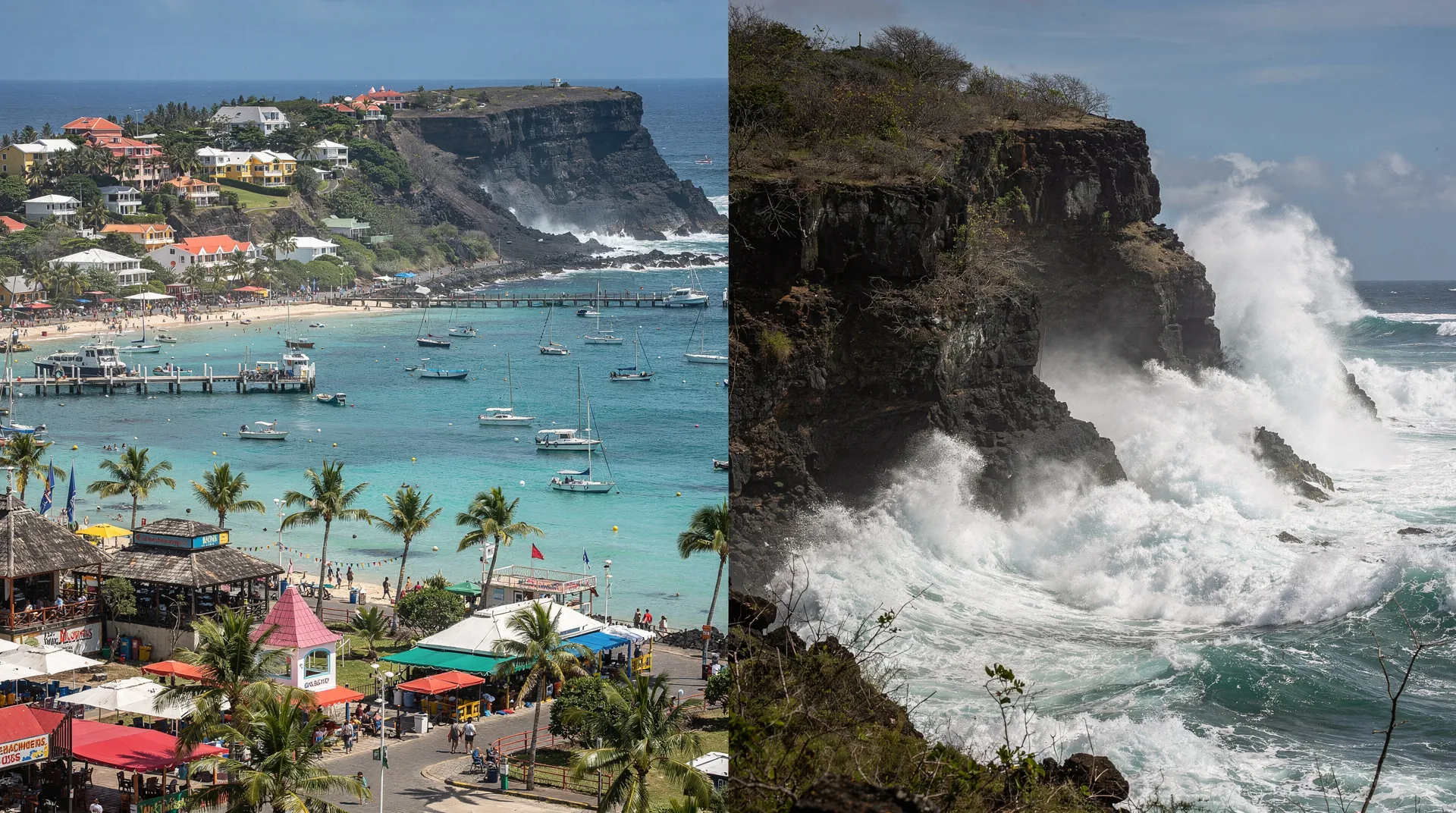
North vs south of Mauritius: touristy vs authentic compared
Updated: August 2026
Is the north or south of Mauritius better suited to my trip?
The north (Grand Baie, Trou aux Biches) is more touristy, livelier, with more accessible beaches and water sports. The south (Mahebourg, Blue Bay, south coast) is more authentic, wilder, cheaper and less crowded. Ideal if you want to get away from the tourists.
North and south Mauritius: two distinct worlds
In Mauritius, the north-south axis matters just as much as the east-west axis for understanding the island and choosing the right destination. While the east coast contrasts with the west coast in landscape and atmosphere (our east-west comparison covers these differences), the north and south of the island differ fundamentally in their relationship with tourism, authenticity and pace of life.
The north — mainly Grand Baie, Trou aux Biches, Mont Choisy, Cap Malheureux — is the stronghold of Mauritian tourism. This is where the big hotel chains set up first, where restaurants catering to every language have flourished, and where catamaran excursions leave each morning loaded with holidaymakers. It’s also where you’ll find the highest concentration of freely accessible beaches, tourist shops and travel agencies.
The south — Mahebourg, Blue Bay, Souillac, the south coast as far as Gris-Gris — is a different island altogether. Less photographed for brochures, less visited by package travellers, it draws those who like things real, preserved and local. Its landscapes are sometimes more spectacular than the north’s, and its authenticity comes at the cost of less tourist convenience.
At a glance
| Criteria | North | South |
|---|---|---|
| Atmosphere | Touristy, lively, nightlife | Authentic, calm, local pace |
| Accommodation budget | Higher, huge choice | 30 to 40% cheaper on average |
| Transport | Frequent buses, no car needed | A rental car is nearly essential |
| Best time | Year-round, slightly drier | Year-round, slightly windier |
| Best for | First trip, families without a car, boat trips | Snorkelling at Blue Bay, tight budgets, cultural immersion |
Weather: advantage north
Weather is an objective factor that clearly favours the north of the island year-round. The north of Mauritius is the driest part of the country — around 1,000 to 1,200 mm of annual rainfall on the north-west coast. Even during the rainy season (December to March), the north statistically gets less rain than the south or centre of the island.
The south of the island is more humid and windier, particularly under the influence of ocean currents sweeping the island’s southern tip. The Gris-Gris coast is often battered by sea spray, and the sea there is rarely calm. This feature adds to the site’s wild beauty but limits beach activities. For detailed climate data by area, our Mauritius weather guide is the go-to reference.
The north, by contrast, enjoys plenty of sunny days even during the austral summer. Water temperatures are mild and consistent (25 to 29 degrees depending on the season). This is one reason first-time visitors to Mauritius are often advised to pick the north for their first trip.
Beaches: quantity in the north, quality in the south
The north: a high density of public beaches
The north of Mauritius is blessed when it comes to beach access. Mont Choisy, Trou aux Biches, Grand Baie, Pereybere and Cap Malheureux run one after another along about twenty kilometres of coastline, each with its own character.
Trou aux Biches is often cited as the finest beach on the north coast: fine sand, a calm, shallow lagoon that’s perfect for children, shade from casuarina trees, a handful of hotels and restaurants without the area feeling overrun. Grand Baie is livelier, with jet skis and boat trips — less peaceful, but more energetic. Pereybere is popular with local families on weekends.
These beaches are walkable from accommodation in the north, a real advantage for travellers without a car or with young children. Our guide to the best beaches in Mauritius covers every spot in detail.
The south: wild beauty and the marine park
Blue Bay is the south’s trump card: its lagoon ranks among the most beautiful in the Indian Ocean, and its protected marine park is one of the island’s best-preserved coral reefs. It’s not the biggest or busiest beach, but it’s probably the finest for snorkelling and diving. More than 50 species of coral and around a hundred species of tropical fish can be spotted there.
The south coast itself — from Mahebourg to Souillac — isn’t ideal for swimming. The sea there is often rough, with currents that non-swimmers need to respect. South coast beaches like Riambel are little known to tourists and completely peaceful, but require a car to reach. For the best beaches for families, the guide compares the different coasts.
Activities: the north is more accessible, the south more natural
North: sea excursions and water sports
The north is the kingdom of catamaran excursions. Boats leave every morning from Grand Baie for the northern islets (Gabriel, Plate, Coin de Mire) for days of snorkelling, swimming and seafood lunches on board. These catamaran trips are very well organised, suitable for all levels, and offer great glimpses of marine wildlife.
Book ahead to secure a spot: see catamaran trips from Grand Baie to the northern islets.
Motorised water sports (jet ski, water skiing, parasailing) are available in Grand Baie. Kitesurfing and windsurfing are also practised here, though the spots aren’t as renowned as Le Morne.
For boat trips to see dolphins, the north offers a few excursions, but Tamarin (west coast) remains the reference for swimming with dolphins.
South: nature, history and adventure
The south offers a fundamentally different kind of activity. Hiking in the Black River Gorges — reachable from Mahebourg with a 30-minute drive — opens onto the island’s most spectacular wild scenery. Our Mauritius hiking guide covers the most remarkable trails in this area.
A visit to Ile aux Aigrettes (a nature reserve with giant tortoises and restored endemic species), the Rochester Falls, the Mahebourg historical museum recounting the 1810 naval battle (the only French naval victory of the Napoleonic era), and exploring the wild coast toward Souillac and Gris-Gris make up a cultural and natural programme with a richness the north simply can’t match.
Chamarel and its Seven Coloured Earths, technically in the south-west, is easy to visit from a southern base in half a day. It’s one of the island’s most spectacular natural sites. Our guide to Chamarel covers every site in the area. If you’re not renting a car, an organised excursion combining Chamarel, Grand Bassin and the south is the most practical option: see day trips in the south.
Accommodation and budget
The north: wide choice across every price range
The north is where the accommodation offer is broadest. From hostels in Grand Baie to 5-star resorts in Trou aux Biches, by way of guest houses in Pereybere and hundreds of furnished apartments in residential neighbourhoods, the north really does cover every budget.
The downside of this abundance is that prices there are generally a bit higher than in the south, especially for well-located beachfront accommodation. Competition is fierce, but so is demand. For luxury accommodation, the north offers some very fine addresses.
The south: budget-friendly and lightly touristed
Mahebourg and the south-east offer the cheapest good-quality accommodation on the island. Comfortable guest houses can be found for €35-60 a night, and local restaurants serve full meals for under €10. This budget accessibility is one of the south’s great strengths for budget travellers.
The trade-off: less variety of choice, the big hotel chains are absent (barring a few hotels around Blue Bay), and nightlife is virtually non-existent. Our Mauritius budget guide compares real costs between the different areas.
Local population and authenticity
This may be the criterion where the gap between north and south is widest. The north of the island, and Grand Baie in particular, has been deeply transformed by tourism over the last 30 years. Prices have risen, many Mauritians have been pushed toward other areas, and the town sometimes feels more like an international beach resort than a Mauritian village. Mauritian Creole is often heard there less than French, English or German.
The south has preserved its social fabric and living culture. The Mahebourg market on Monday mornings, Hindu and Catholic temples side by side in the town centre streets, fishermen on the waterfront in the late afternoon, sega scenes in local bars at the weekend: this is the Mauritius of twenty years ago, before the rise of mass tourism.
For travellers seeking to understand Mauritian cuisine and culture beyond the hotel buffet, the south is irreplaceable. You eat at snack stalls that exist for Mauritians, not for tourists.
Transport and accessibility
The north is better served by public transport. Frequent bus lines connect Grand Baie to Port Louis (30 to 40 minutes) and other areas in the north. Our guide to buses in Mauritius covers the network.
The south is less well served, even though Mahebourg is connected by bus to Port Louis and Blue Bay. To truly explore the south coast and its wild scenery, a rental car is nearly essential. Our car rental guide compares the options available.
Dining: tourist buffets in the north, local snacks in the south
The north has the island’s highest density of tourist-oriented restaurants: international cuisine, chains, beachfront restaurants overlooking the lagoon, often at prices in line with European standards. It’s convenient for variety without having to worry about language or local customs, but the bill adds up fast for a family.
The south, by contrast, still runs largely on neighbourhood canteens and snack stalls: a full meal from a local caterer in Mahebourg often costs under €10, and the Monday market lets you buy fresh produce at Mauritian prices. Our guide to Mauritian cuisine covers the must-try dishes on both sides.
Nightlife and evening outings
The north, and Grand Baie in particular, holds most of the island’s nightlife: bars, restaurants open late, a few nightclubs, evening entertainment organised by hotels. For travellers who want to go out in the evening without relying entirely on their accommodation, it’s the only area that really offers that choice. The south turns in early: the streets of Mahebourg are quiet by 9pm, and evening entertainment is mostly limited to the hotel restaurant or an occasional sega evening. This isn’t a flaw or a virtue in itself — it simply depends on the pace of holiday you’re after.
Combining north and south: the optimal strategy
For a 10 to 14 day trip, the best strategy is not to choose. Start with 4 to 5 nights in the north (Grand Baie or Trou aux Biches) to enjoy the accessible beaches, sea excursions and buzz. Finish with 3 to 4 nights in the south (Mahebourg, Blue Bay) to experience the authentic island, snorkel in the marine park and explore the wild coast.
The drive between Grand Baie and Mahebourg takes about 1 hour 30 to 2 hours depending on the route. It’s perfectly manageable with a rental car. Our road trip guide suggests detailed multi-base strategies to optimise this kind of trip.
Summary comparison table
Weather: clear advantage north (less rain, more stable)
Beaches: advantage north (more accessible, more varied) / advantage south for lagoon quality (Blue Bay)
Water sports: advantage north (catamarans, islet excursions)
Hiking and nature: advantage south (gorges, wild coast, Ile aux Aigrettes)
Local authenticity: clear advantage south
Accommodation budget: advantage south (30 to 40% cheaper on average)
Logistical ease: advantage north (buses, proximity to shops)
Sunsets over the sea: neither — sea sunsets are only found on the west coast
Verdict
The north is the best choice for first-time visitors who want the best access to beaches and water sports, families with children looking for calm beaches within walking distance, travellers who want evening entertainment and logistical ease, and those with fewer than 7 days who want to maximise beach time.
The south is perfect for travellers seeking authenticity and cultural discovery, divers and snorkellers who want to reach Blue Bay and its exceptional reef, tight budgets that want to experience the island without paying northern prices, and repeat visitors coming back to explore lesser-known areas.
Both together: this is simply the best possible trip to Mauritius, and it’s within reach of any traveller with a car and an extra week.