
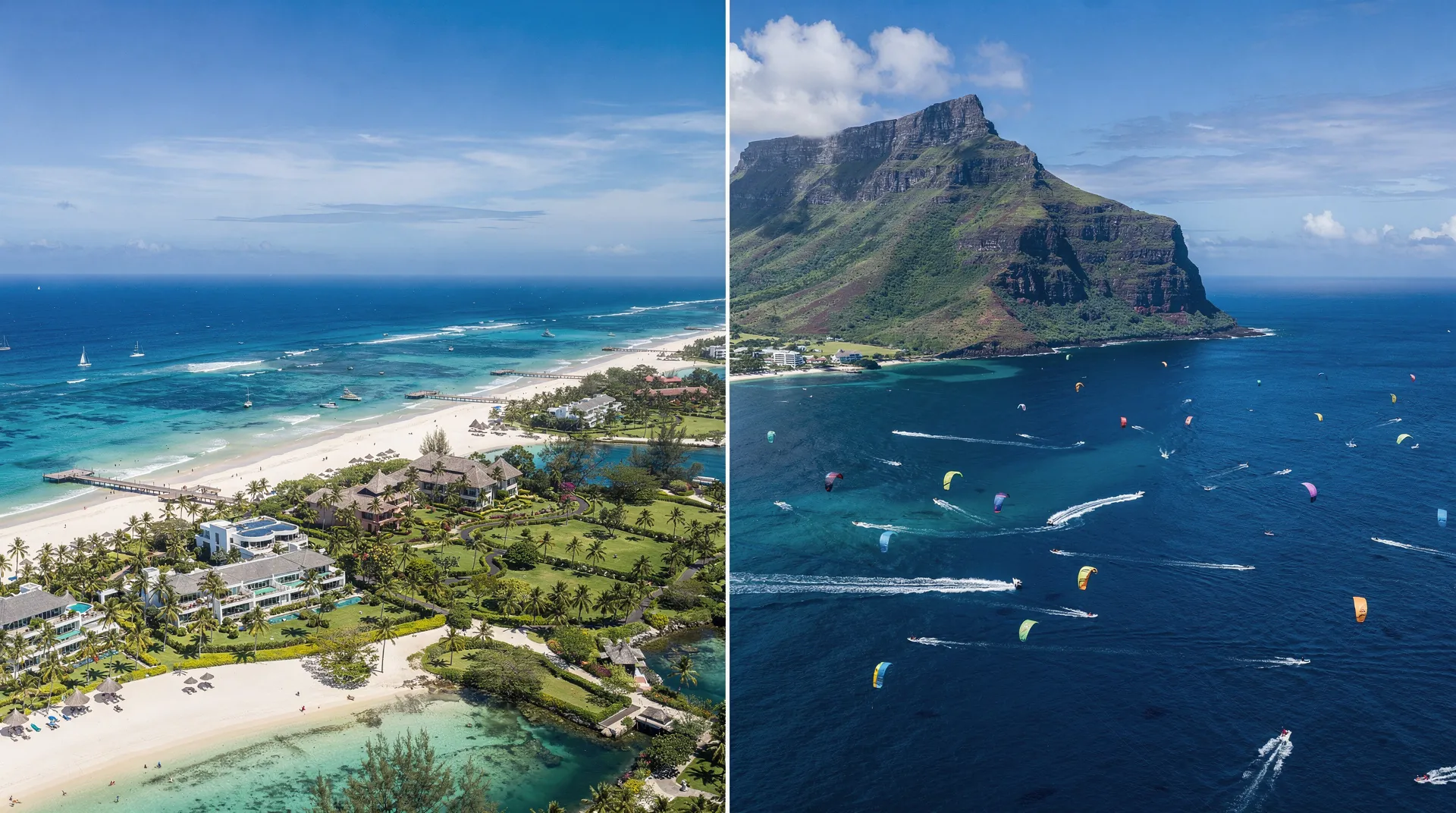
East Coast vs West Coast of Mauritius: Full Comparison to Help You Choose
Updated: August 2026
Is it better to go to the east coast or west coast of Mauritius?
The east coast (Belle Mare, Trou d'Eau Douce) is ideal for lovers of luxury, calm white-sand beaches and snorkeling. The west coast (Flic-en-Flac, Tamarin) offers better surf beaches, more local buzz and sunsets over the sea. Both deserve a visit.
East or west in Mauritius: a question every traveler asks
Mauritius is surrounded by sea, but not the same sea everywhere. Travelers who’ve explored both coasts of the island confirm it: the atmosphere, the color of the water, the texture of the sand, the activities on offer, and even the way days unfold differ noticeably from one coast to the other. Choosing between east and west isn’t a minor detail — it’s often the choice that sets the tone for the whole trip.
This guide puts the two coasts side by side on the criteria that matter most: weather, beaches, activities, accommodation, atmosphere and budget. For an overview that also covers the north-south axis, see our north vs south Mauritius comparison. The goal isn’t to declare an absolute winner, but to help you identify which coast best matches what you’re looking for.
| At a glance | East Coast | West Coast |
|---|---|---|
| Atmosphere | Luxurious, calm, resorts | Lively, local, animated |
| Best time | November to March (more sun) | June to August (calmer sea) |
| Accommodation budget | High (150 EUR+ outside luxury) | Moderate, all ranges from 40 EUR |
| Strong point | Calm lagoon, snorkeling, Ile aux Cerfs | Sunsets, surf, dolphins |
| How to get there | 45-60 min from the airport | 45-75 min from the airport depending on area |
Weather and microclimate: a decisive factor in choosing your coast
Mauritius is crossed by a mountain range that creates two distinct microclimates. Understanding this difference can change the logic of your trip.
The east coast is windward, meaning exposed to the prevailing winds, the southeast trade winds that blow across the Indian Ocean for much of the year. During the austral winter (June to August), this wind can be strong on the east coast — sometimes 30 to 40 km/h in gusts — which makes some beaches less pleasant for lounging. The good news: the trade winds push clouds inland, giving the east coast more hours of sunshine than the west coast during the rainy season (November to March). In short: when it’s cloudy and rainy in Flic-en-Flac, it’s often sunny in Belle Mare.
The west coast is leeward, sheltered from the trade winds by the central massif and the mountain range. During the austral winter, it’s calmer and the air is warmer. During the austral summer, it gets more rain than the east coast — but tropical downpours are generally brief (30 to 60 minutes) and followed by quick clear-ups. And above all: its sunsets are over the sea, something the east coast — which faces east — simply can’t offer.
Weather conclusion: if you’re coming in July-August, both coasts offer generally pleasant weather. If you’re coming between November and March (rainy season), the east coast has a slight edge in weather stability. Our full weather guide gives all the figures by month and by area.
The beaches: two very different visions
East coast: white sand, calm lagoon, postcard setting
The east coast beaches — Belle Mare, Palmar, Trou d’Eau Douce — are among the most photographed on the island. The sand is dazzlingly white, the lagoon remarkably clear and turquoise, and the waters are especially calm and shallow, protected by a wide reef barrier set far from the shore.
These beaches are ideal for family swimming (children can walk out several hundred meters without losing their footing), snorkeling near the reefs, and low-key beach days. They have less character for surfers, however, since waves are absorbed by the reef before reaching shore.
Belle Mare beach, more than 9 kilometers long, is regularly listed among the most beautiful in the Indian Ocean. It’s one of the most sought-after destinations on the island. Our Belle Mare accommodation guide covers all the options.
West coast: sunsets, surf, relaxed atmosphere
Flic-en-Flac, Tamarin and La Gaulette have beaches just as pleasant but with a fundamentally different atmosphere. The sea here is more green than turquoise, sunsets directly over the western horizon are magnificent and highly photogenic, and the waves — modest as they are in sheltered spots — allow for some surf sessions.
Flic-en-Flac beach is one of the longest on the island, with a lively, family atmosphere on weekends when Mauritians come to picnic. It’s a vibrant beach, less polished than the resort beaches of the east coast. Tamarin has a less perfect beach but an unmatched authentic village atmosphere.
For a detailed look at all the island’s beaches, our Mauritius beaches guide compares the options across every coast.
Activities: clearly different specialties
East coast: snorkeling, diving, Ile aux Cerfs
The east coast is a paradise for snorkeling and diving in a shallow lagoon. The clear water and well-preserved reefs create ideal conditions for observing marine life without sophisticated equipment.
Ile aux Cerfs (accessible from Trou d’Eau Douce) is one of the island’s most popular excursions: a tropical island with pristine beaches, sandy lagoons, an upscale golf course and restaurants. Speedboat or catamaran excursions are available from Trou d’Eau Douce for visitors not staying at the big resorts.
Booking ahead avoids haggling on the beach with street vendors: see the catamaran excursions to Ile aux Cerfs.
Stand-up paddleboarding (SUP) and kayaking are practiced in the calm lagoon. Big game fishing operates from several marinas on the east coast. For divers, the sites around Belle Mare offer well-preserved coral and varied marine life.
West coast: surf, kitesurf, dolphins, wrecks
The west coast is the territory of surfing and kitesurfing. Tamarin’s left-hand break is a legendary surf spot in the Indian Ocean. Le Morne, in the southwest, is one of the most renowned kitesurfing and windsurfing spots in the world, home to the mythical One Eye spot on the reef.
Flic-en-Flac has several wreck diving sites, including the legendary Kei Sei 113, a cargo ship deliberately sunk to create an artificial reef. These wrecks are home to an impressive array of marine life.
Tamarin bay is one of the best areas on the island to watch and interact with spinner dolphins. Our guide to swimming with dolphins explains how to arrange these outings responsibly. For a guided, responsible outing, booking an organized trip is preferable to beach touts: book a dolphin outing from Tamarin.
The west coast is also the natural starting point for excursions into the interior: Chamarel and its seven colored earths 30 minutes away, the Tamarin waterfalls, and the Black River Gorges National Park — the island’s largest forest, home to its endemic species.
Accommodation: luxury on one side, diversity on the other
East coast: the island’s luxury hub
The east coast is home to the island’s grandest resorts: Constance Belle Mare Plage, One&Only Le Saint Geran, Shangri-La Le Touessrok. It’s the destination of choice for high-end honeymoons and vacationers wanting the perfect resort facing a dream lagoon. Prices reflect that: it’s hard to find a quality property below 150 EUR a night, and the top resorts start at 400-500 EUR.
Outside the luxury resorts, options on the east coast are more limited. A few guest houses exist in the villages of Palmar and Quatre Cocos, along with villas for rent in the area, but overall independent accommodation is less developed than on the west coast.
West coast: every price range represented
The west coast offers much more diversity in accommodation types. Flic-en-Flac is the west’s major seaside town, with an abundant offer across all ranges: guest houses from 40 EUR, furnished apartments, mid-range hotels and quality resorts. Tamarin mainly offers mid-range and budget options for a more local experience. Le Morne is home to the major resorts in a spectacular setting.
Our detailed accommodation guides will help you choose: where to stay in Tamarin, where to stay in Le Morne, or check out the budget options if the west coast fits your budget.
Atmosphere and local life
The west coast is overall livelier than the east coast, especially for village life and interaction with the local population. Flic-en-Flac has beachfront restaurants, beach bars and a few clubs. Tamarin has an authentic village life with its market, local snack stands and surfers.
The east coast is calmer and more residential. Restaurant options outside the hotels are limited to Belle Mare, and villages like Trou d’Eau Douce remain quiet places where local life coexists discreetly with passing tourists.
For day-to-day interaction with the Mauritian population, the west coast (and Tamarin in particular) offers more opportunities. For fine dining at upscale hotel restaurants, the east coast is unmatched.
Budget compared
For comparable accommodation (a 3-star hotel or quality guest house), rates tend to be slightly higher on the east coast than on the west coast, due to the concentration of luxury properties and the scarcity of independent alternatives.
Dining outside hotels is generally cheaper on the west coast (more accessible local snack stands and restaurants) than on the east coast, where alternatives to hotel restaurants are scarce in some areas. Our Mauritius budget guide puts these differences into concrete figures.
Comparison table at a glance
Preferred weather: east coast in austral summer (November-March), tied in austral winter (June-August)
Most beautiful postcard beach: edge to the east coast (Belle Mare)
Sunsets over the sea: west coast only
Surf and kitesurf: west coast (Tamarin, Le Morne)
Snorkeling and diving in a calm lagoon: edge to the east coast
Ile aux Cerfs excursion: east coast (departing from Trou d’Eau Douce)
Dolphins: west coast (Tamarin)
Local life and authenticity: edge to the west coast
Accommodation across all ranges: edge to the west coast
Absolute luxury: edge to the east coast
Accommodation prices: edge to the west coast (more affordable)
Getting between the two coasts
Crossing the island between the east coast and the west coast generally takes between 1h and 1h30 by car depending on traffic, with the most direct route passing through the center of the island via Curepipe or Moka. It’s a perfectly manageable day trip if you’re staying on one coast and want to check out a site on the other — for example visiting Chamarel from a hotel in Belle Mare, or seeing Ile aux Cerfs from Flic-en-Flac.
Without a car, this trip is more of a hassle: it means either a taxi (budget 40 to 60 EUR one way) or a combination of buses with a transfer in Port Louis or Curepipe, which is slower. Our guide to travel times between areas of Mauritius details precise durations depending on your departure and arrival areas, and our comparison of driving vs. not driving helps you decide on the vehicle question.
If you could only pick one signature activity per coast
For the east coast, a day excursion to Ile aux Cerfs by catamaran, with a barbecue lunch and a snorkeling stop, sums up rather well the laid-back, turquoise-lagoon spirit of this coast. For the west coast, a sunrise dolphin-watching session in Tamarin bay, followed by an afternoon in Chamarel, combines marine and land nature in a single day. Both activities are easy to book from anywhere on the island with a bit of planning.
How to choose based on your travel style
Choose the east coast if:
- You’re traveling as a couple for a honeymoon or anniversary and want the perfect resort with the island’s most beautiful lagoon
- You’re traveling with young children and want the calmest, shallowest lagoon
- You’re coming between November and March and want to maximize your chances of good weather
- The Ile aux Cerfs excursion is at the top of your list
Choose the west coast if:
- You’re a surfer, kitesurfer, or into board sports
- You want sunsets over the sea from your terrace or the beach
- You’re looking to mix beach life with authentic local culture
- You have a moderate budget and want more independent accommodation choices
- Dolphins and dive wrecks appeal to you
Choose both if: You have 10 days or more and a rental car. The two coasts are different enough that a mixed stay, with 4 to 5 nights on each side, is often the best way to capture the island’s richness. Our Mauritius road trip guide offers detailed multi-base strategies.
Final verdict
There’s no wrong choice between the east coast and the west coast of Mauritius — they’re simply two different visions of the island, two different moods. The east coast is more photogenic with its dazzling turquoise lagoons, but the west coast is livelier, more diverse, and offers sunsets that no photo can truly capture.
For a first short trip: the east coast for absolute luxury and the perfect beach, the west coast for authenticity and freedom of movement. For a longer stay: both, without hesitation.