
Swimming with Dolphins in Mauritius: Complete Guide to Tamarin and Black River
Updated: August 2026
Can you swim with dolphins year-round in Mauritius?
Dolphins are present year-round in Tamarin Bay, but the best conditions are between May and October. An encounter is never guaranteed, as these are wild dolphins.
Swimming with dolphins in Mauritius: a unique experience
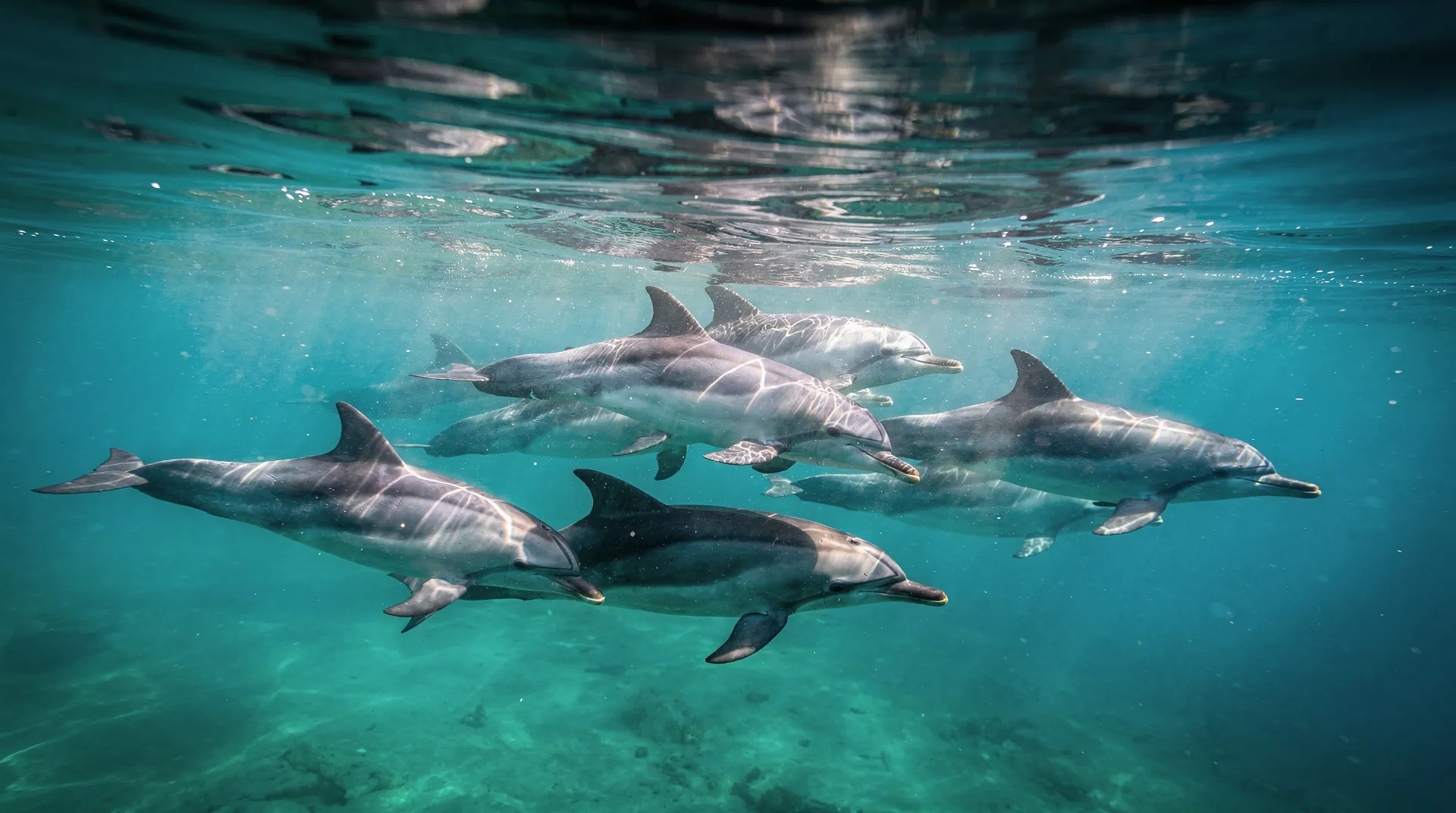
Swimming with wild dolphins in the warm waters of the Indian Ocean is one of the most memorable experiences you can have in Mauritius. Unlike some destinations that offer interactions with captive or semi-captive dolphins in pools or enclosures, Mauritius offers the rare and precious opportunity to meet these cetaceans in their natural habitat, in the deep waters off the island’s southwest coast.
This experience draws thousands of visitors every year, and for good reason: finding yourself surrounded by a pod of dolphins leaping, diving and playing around you is a moment of pure magic you never forget. The dolphins of Tamarin Bay are used to human presence in the water, and it’s not uncommon for them to approach out of curiosity and play around swimmers.
The Tamarin region and the Black River area form the preferred territory of these dolphins — a wild, sparsely built-up coastline that is also one of the most beautiful stretches of Mauritius’s west coast. Combining this excursion with a day at the beaches of Flic-en-Flac nearby is an excellent way to plan a memorable day.
At a Glance
| Where | Tamarin Bay and Black River, southwest coast |
| Price | approximately 1,000 to 2,500 rupees per person (shared boat trip) |
| Time needed | full morning, departure 6:30-7:30am, return before 1pm |
| How to get there | car from Flic-en-Flac or Tamarin, or transfer organized by the operator |
| Best time | May to October for calm seas, present year-round |
Where to find dolphins in Mauritius
Tamarin Bay
Tamarin Bay, on the west coast of Mauritius, is the main habitat of the island’s dolphins. This open, deep bay, framed by the wooded hills of Black River Gorges National Park, is home to mainly two dolphin species:
Spinner dolphins (Stenella longirostris): The most commonly observed species. These dolphins live in large groups of 50 to several hundred individuals. They display spectacular acrobatic behavior — leaping out of the water, spinning and appearing to genuinely enjoy the company of boats and swimmers. They are the most curious and the most likely to approach humans.
Bottlenose dolphins (Tursiops truncatus): Larger (up to 3 meters) and less numerous than spinner dolphins, they are mostly found in groups of 10 to 30 individuals. Less acrobatic but impressive in size, they tend to be more reserved around swimmers.
The dolphins of Tamarin follow a fascinating cyclical pattern linked to their feeding habits: they spend the night in the deep offshore waters feeding (the seabed at 400-600 meters deep teems with fish in this area), then return in the morning to the calmer waters of the bay to rest and socialize. It’s during this morning resting phase (generally between 7am and 10:30am) that excursions take place.
The Black River area
A few kilometers south of Tamarin, in the Black River area, the same dolphin populations are frequently observed. Some operators depart from Black River harbor to reach them, which can be slightly slower but often offers different conditions and sometimes groups of dolphins less approached by other boats.
The coast between Tamarin and Black River is one of the wildest and most beautiful stretches of Mauritius, with hills covered in tropical forest plunging straight into the sea. The setting of the excursion is spectacular in its own right.
The best season for swimming with dolphins
Year-round, but with nuances
Dolphins are technically present in Tamarin Bay throughout the year — they don’t follow a marked seasonal migration. However, certain periods offer better conditions:
May to October (cool season): This is the ideal period. The weather is clear, the sea is calm, and underwater visibility is excellent (up to 30 meters in good conditions in the clear waters of the west coast). Chances of an encounter are high — dolphins are regularly present in the bay — and swimming conditions are pleasant despite slightly cooler water (24-26°C). This is also the best period for diving in Mauritius in general.
November to April (hot and cyclonic season): Dolphins are present, but weather conditions are more variable. The sea can be rough due to trade winds or tropical depressions, and visibility can be reduced by rain and coastal runoff. Excursions may be cancelled in case of bad weather or rough seas. The water, warmer (27-29°C), is on the other hand more pleasant for swimming.
To find out which period to choose for your trip, our guide to the best time to visit Mauritius breaks down the climate month by month with personalized advice.
A word on guarantees
No serious operator can guarantee dolphin sightings. These are wild animals that decide their own behavior — they may be late, absent that day, or simply in a different part of the bay. Trustworthy operators generally refund the excursion or offer a new date if no dolphins are seen within a reasonable time. Check this policy when booking.
What to expect on a dolphin excursion
The typical schedule
Very early morning departure: Dolphin excursions start very early, generally between 6:30 and 7:30am. This isn’t negotiable: dolphins are in the bay in the morning and head to deeper waters by mid-morning. There is no afternoon dolphin excursion.
The search: The captain draws on years of accumulated experience, radio contact with other boats, and sometimes information shared by local fishermen to locate the pods. It’s not unusual to see several boats heading simultaneously toward the same area — a sign that dolphins have been spotted. On the most responsible excursions, hydrophones (underwater microphones) allow the operator to hear dolphin calls from a distance.
The swim: Once a pod of dolphins is located and in a favorable state (active, playful, not stressed), the guide gives the signal to enter the water. Participants get in with mask, snorkel and fins. The goal is to let yourself drift and observe the dolphins, not to actively chase or surround them. The best interactions happen when you stay still on the surface — curious dolphins will then approach on their own.
Duration of the interaction: An encounter usually lasts between 10 and 30 minutes depending on the dolphins’ behavior. After this phase, the boat often searches for another pod or heads to a reef snorkeling spot to round out the morning.
Additional activities: Most excursions include, after the dolphin encounter, a snorkeling session on a coral reef off the west coast. This is a chance to observe local marine life and enjoy a bit more of the warm Indian Ocean water. Some excursions also include a visit to Ile aux Benitiers, a white sand islet in the lagoon off Le Morne.
Return: Generally before noon to 1pm. It’s a full morning, not a full day.
What you’ll see underwater
Even if the dolphin encounter only lasts a few minutes, the spectacle is unforgettable. Underwater, you’ll see dolphins moving with astonishing grace and speed — they can reach 30 km/h when swimming fast. They “talk” to each other through a series of clicks and whistles that you’ll hear clearly, forming their communication system.
Spinner dolphins often like to approach swimmers out of curiosity, coming within a few dozen centimeters. Some play with the bubbles swimmers make while exhaling. If you have an underwater camera or GoPro, this is the perfect moment — the footage is spectacular.
Beyond the dolphins, the snorkeling sessions that follow allow you to observe colorful tropical fish, stingrays resting on the sand, and sometimes sea turtles. The seabed off Mauritius’s west coast is among the richest on the island.
Ethics and responsible tourism
Why ethics matter
Dolphin tourism in Tamarin has grown very rapidly over the past twenty years, raising legitimate and well-documented concerns among scientists and environmental organizations. Studies conducted by the University of Mauritius and international researchers have shown that repeated harassment of dolphin pods during their morning rest periods can significantly disrupt their behavior: reduced sleep time, increased stress (measured through stress hormone levels), and altered travel routes.
Over the long term, if these disturbances are too frequent and intense, dolphins may permanently leave the bay for less frequented areas — which would be an irreversible loss for the local ecosystem and for tourism itself.
Good practices to demand from your operator
Calm, respectful approach: The boat should approach dolphins slowly, gradually reducing speed and cutting the engine at a reasonable distance. It should then wait for dolphins to approach on their own rather than rushing at the pod.
No chasing dolphins: If dolphins swim away quickly or dive deep, that’s a clear signal they don’t want interaction. A responsible operator will never gun the engine to catch up with a fleeing pod.
Limited interaction time: Best practices limit interaction to a maximum of 20-30 minutes per dolphin pod. Beyond that, the benefit for tourists decreases while the stress on dolphins increases.
No touching: Touching dolphins is absolutely forbidden. This rule matters for two reasons: it avoids transmitting human diseases to them, and it protects you — an adult dolphin weighing 200 kg can unintentionally injure you with its tail if startled or stressed.
Limited number of boats: Avoid operators working simultaneously with 5 or 6 other boats on the same dolphin pod. This practice is particularly stressful for the animals.
No feeding: Feeding wild animals alters their natural behavior and creates harmful dependency. Be wary of any operator that offers this practice.
Reduced speed in the area: Boats speeding through dolphin habitat disturb their rest and create a collision risk. Good operators always move slowly in Tamarin Bay.
Labels and certifications
Look for operators who are members of the Mauritius Marine Conservation Society or who display a verifiable eco-responsible charter on their website. Some operators also offer trips with an onboard naturalist guide or marine biologist, who explains dolphin behavior and ecology — a significant educational added value.
Main operators
Recommended operators in Tamarin and Black River
Yan’s Dolphin Cruise (Tamarin): One of the oldest and most respectful operators in Tamarin Bay. Groups strictly limited to 8 people maximum for a more intimate experience, documented ethical approach, naturalist guide included on most trips. Expect 1,500 to 2,000 rupees per person.
Dolphin Dive Mauritius (Black River): Combines dolphin swimming with a reef diving session — ideal for certified divers who want to maximize their time underwater. 2,500 rupees all-inclusive. Bilingual PADI instructors.
Ken’s Dolphin Tour (Tamarin): Small groups, fast and maneuverable boat for a discreet approach, experienced guide with 15 years in the bay. 1,200 to 1,800 rupees per person.
Hotel-organized excursions: West coast hotels (particularly those in Flic-en-Flac, Tamarin and Le Morne) generally offer dolphin excursions, often pricier (3,000 to 5,000 rupees) but with the convenience of organized transport from the hotel. Quality depends on the subcontracted operator.
What the price generally includes
- Round-trip boat transport from the departure port
- Snorkeling equipment (mask, snorkel, fins) — specify if you bring your own
- Experienced guide onboard
- Life jacket (mandatory for all participants)
- Bottled water
- Sometimes: light breakfast or snack, additional reef snorkeling session
What’s generally not included: professional underwater photos and videos (a service often sold for an extra 500 to 1,000 rupees — an expense that’s worth it for the memories).
Prices and how to book
2026 indicative rates
| Type of excursion | Price per person |
|---|---|
| Basic excursion (3h, dolphins + snorkeling) | 1,000 to 1,500 rupees |
| Semi-private excursion (max 8 people) | 1,500 to 2,500 rupees |
| Private excursion (boat just for you) | 8,000 to 15,000 rupees |
| With onboard naturalist/marine biologist | 2,500 to 3,500 rupees |
| Combined dolphins + diving | 2,500 to 3,500 rupees |
Rates for children (generally under 12) are reduced by 40 to 50%. Most operators accept children from age 6, with mandatory life jackets and adult supervision.
How to book
Booking in advance is strongly recommended, especially in high season (July-August and December-January). Most operators accept bookings by email, WhatsApp, or through online booking platforms.
You can book your dolphin swimming excursion in Tamarin online in just a few clicks, with instant confirmation. Some hotels include a dolphin excursion in their honeymoon packages or as a paid option — ask your concierge.
For couples, a dolphin excursion is one of the most romantic activities to share. Our guide to romantic activities in Mauritius suggests several ways to make this experience even more memorable, including opting for a private boat with champagne on the way back.
Practical tips
Go on a light stomach: The sea can be rough, especially when leaving the lagoon for deeper waters. A heavy meal before the excursion can cause nausea. Also bring seasickness medication if you’re prone to it — take it the night before so it’s active by departure time.
Photography equipment: A waterproof camera or housing is essential. GoPros give excellent underwater results for dolphins — set the resolution to maximum and turn on stabilization. Charge your batteries the night before.
Mineral sunscreen only: Protect the coral reefs you’ll be snorkeling over after the dolphin excursion by using sunscreen free of oxybenzone. Some operators now require it.
Swimming level: You don’t need to be an expert swimmer. A life jacket is available for those who want one. However, knowing how to swim and feeling comfortable in open water is essential. The sea is not a swimming pool — there’s movement, light waves.
Children: Most operators accept children from age 6, with a mandatory life jacket. For younger children (under 6), a catamaran trip with dolphin watching from the boat (without entering the water) is a suitable and equally memorable alternative.
Cancellation and flexibility: Plan a backup for your itinerary. If weather or the absence of dolphins leads to a cancelled excursion, you’ll need an alternative. Mauritius’s west coast fortunately offers plenty of activities: snorkeling, kayaking, a visit to the Chamarel rum distillery, or simply a beach day in Flic-en-Flac.
Fitting the dolphin experience into your stay
Swimming with dolphins takes place early in the morning and ends before noon. So you have the afternoon free for other activities. If you’re staying between July and November, you can also make the most of the same west coast by booking a whale watching trip — an extraordinary complementary experience in the same waters. Here are some popular combinations:
- Dolphins in the morning + beach in Flic-en-Flac in the afternoon
- Dolphins in the morning + visit to Chamarel and the Coloured Earth in the afternoon (or book the all-in-one package: dolphin + Chamarel combo in one day)
- Dolphins in the morning + hiking in Black River Gorges in the afternoon for the active traveler
- Dolphins in the morning + spa in the afternoon for couples
For travelers who want to explore the dolphin area along with other water activities, a catamaran trip to Ile aux Benitiers from the west coast often lets you combine dolphin watching from the boat, snorkeling at Crystal Rock, and swimming in the Le Morne lagoon.
Dolphins or whales: which to choose?
If your trip falls between July and November, you may also encounter humpback whales in the same west coast waters. Here’s how to choose between the two experiences if you have to pick:
| Swimming with dolphins | Whale watching | |
|---|---|---|
| Season | year-round, ideal May-October | July to November only |
| Interaction | in-water swim possible with mask and snorkel | observation from the boat, in-water encounters rare and supervised |
| Duration | morning (3-4h) | 3 to 4 hours |
| Indicative budget | 1,000 to 2,500 rupees | 50 to 100 EUR |
| Best for | thrills, close-up contact | awe, wildlife photography |
Many travelers visiting in August-September choose to do both excursions a few days apart, since the experiences are so complementary.
What to check before booking
Before choosing an operator, always ask these questions: is the group size limited (prefer a maximum of 8 to 12 people)? Is the refund policy in case of no dolphin sighting clear and written? Does the boat have life jackets for everyone and a first-aid kit? Is snorkeling equipment included or do you need to bring your own? Finally, does the operator display a verifiable ethical charter, or does it simply offer a commercial promise of a guaranteed encounter — a red flag mentioned earlier. Our guide to budgeting for Mauritius will help you place this expense within your overall trip.
Swimming with dolphins in Mauritius is an experience that deserves to be lived with respect and awareness. By choosing a responsible operator, adopting good behavior in the water, and keeping in mind that these animals are graciously sharing their habitat with us, you help preserve this extraordinary species while living a moment that will stay etched in your memory forever.