
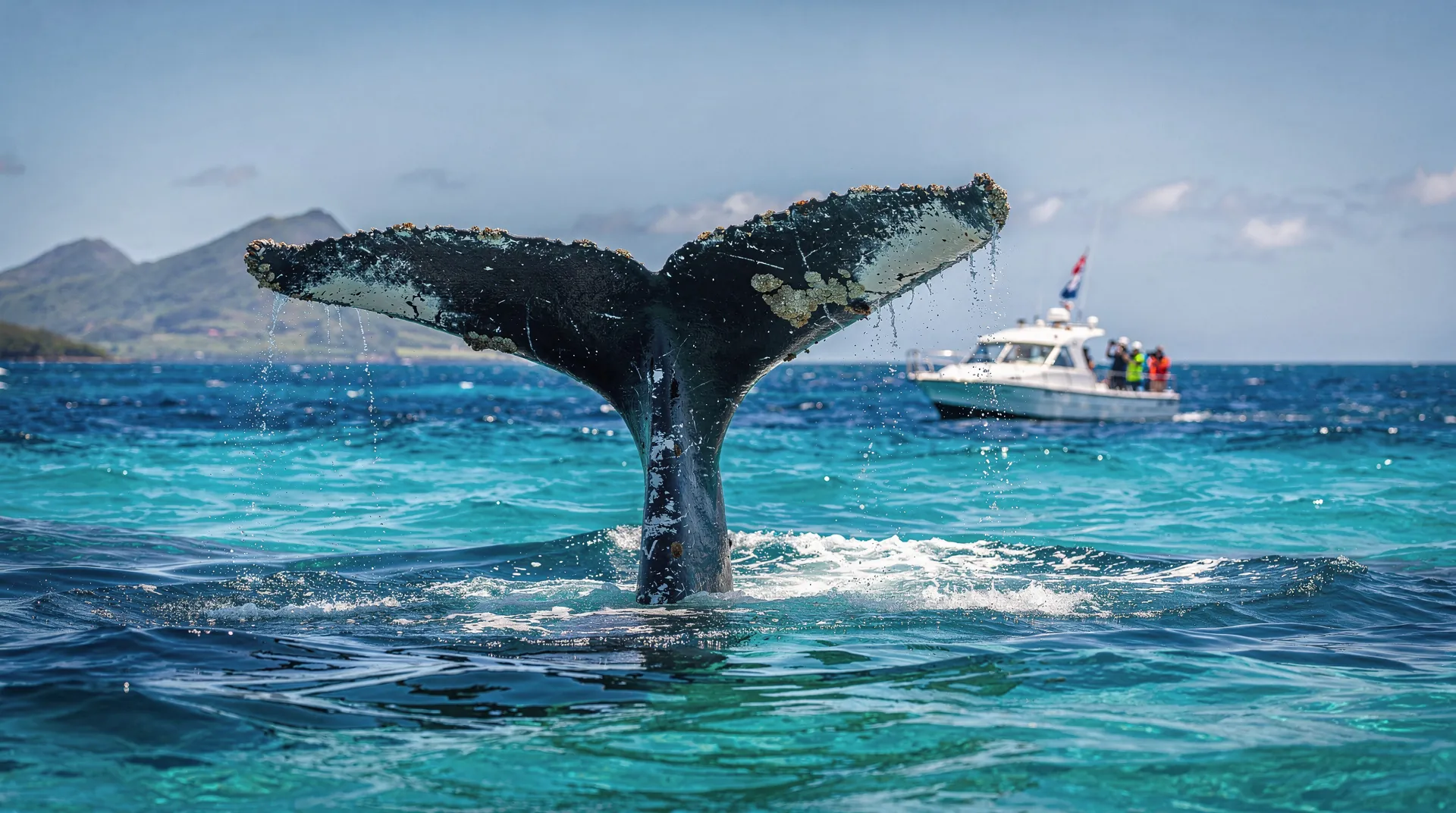
Whale Watching in Mauritius: Season, Operators and Ethical Tips
Updated: August 2026
When can you watch whales in Mauritius?
Whales are present in Mauritian waters from July to November, peaking in August-October. Boat trips depart from Tamarin on the west coast, starting from 50 euros per person.
Whale watching in Mauritius: an extraordinary experience
Few visitors know it, but Mauritius is one of the most accessible destinations in the Indian Ocean for watching humpback whales in their natural environment. These giants of the ocean (up to 15 meters long and 40 tonnes) visit Mauritian waters regularly every austral winter, offering sometimes spectacular viewing opportunities from a boat.
Whale watching in Mauritius is still a fairly under-the-radar activity compared to other world destinations like Tonga, Reunion Island or Mozambique. This relative obscurity gives it an authentic, uncrowded character. Trips are often intimate (10 to 15 people maximum per boat), and encounters with the animals can be strikingly close. You can book your whale watching trip in Mauritius online with ethical operators committed to cetacean protection.
This activity fits perfectly into the west coast’s calendar. The optimal period (July to November) coincides with the fine season, when the weather is mild and the sea calm. If you’re planning your trip around this experience, our guide to the best time to visit Mauritius will help you set your dates.
At a Glance
| Where | Tamarin and Black River, southwest coast |
| Price | approximately 50 to 100 EUR per adult |
| Time needed | 3 to 4 hours, dawn departure (7-8am) |
| How to get there | car to Tamarin, or transfer organized by the hotel/operator |
| Best time | July to November, peaking August-September |
Season and species present
The humpback whale (Megaptera novaeangliae)
The humpback whale is the most commonly observed species in Mauritian waters. Recognizable by its exceptionally long pectoral fins (up to a third of its body length), its complex songs and its spectacular leaps out of the water (called breaches), it’s considered one of the most expressive and impressive whales to watch.
These whales follow an annual migration between their feeding grounds in the cold Antarctic waters during the austral summer and their breeding and calving grounds in warm tropical waters during the austral winter. The southwest Indian Ocean, which includes Mauritian waters, is one of their preferred wintering and passage zones.
Behaviors you can hope to observe on a trip:
- The blow: a plume of vapor visible from several kilometers away, the first sign of presence
- The breach: a full leap out of the water, particularly spectacular and photogenic
- Lobtailing: a tail slap on the water’s surface
- Spy-hopping: the whale raises its head vertically out of the water to observe its surroundings
- Mothers with their calves (from late September to November) — one of the most moving sights
Other cetaceans
While the humpback whale is the star of whale watching season, other cetaceans can be observed during trips, considerably enriching the experience.
The sperm whale (Physeter macrocephalus): the largest of the odontocetes (toothed whales) is present year-round in the deep waters west of Mauritius. The waters off Black River plunge quickly to 1,000-2,000 meters — a perfect habitat for this exceptional diver, capable of descending more than 2,000 meters deep. Groups of sperm whales are regularly spotted on whale watching trips.
The bottlenose dolphin (Tursiops truncatus): present year-round in Tamarin bay, it can be seen alongside whales on trips. Watching a pod of bottlenose dolphins swim near whales in the same morning is a rare and striking experience.
The spinner dolphin (Stenella longirostris): it regularly enters Tamarin Bay to rest in the morning, sometimes at the same time as passing whales. Our guide to swimming with dolphins explains how to enjoy these encounters responsibly.
The July-to-November season: month-by-month nuances
The optimal viewing window runs from July to November, with important nuances by month:
- July: first humpback whale arrivals. Sightings are less frequent but already possible for the lucky ones. A good month to combine whale watching and kitesurfing at Le Morne.
- August-September: peak whale presence in Mauritian waters. Trips are statistically the most productive. This is the best time if sightings are your top priority.
- October-November: end of season but a particularly interesting period to observe mothers and their calves, born in September-October. These family sightings are among the most touching.
Outside this period (December to June), humpback whales are not present in Mauritian waters. However, sperm whales can be observed year-round thanks to the deep waters of the west coast.
Seasonality calendar
| Month | Whale presence | Sea conditions | Recommendation |
|---|---|---|---|
| July | first arrivals | good | possible, less frequent |
| August | peak presence | good | ideal |
| September | peak presence | good | ideal |
| October | strong presence, mothers and calves | good | excellent, family sightings |
| November | end of season | variable | still possible early in the month |
| December to June | absent (sperm whales year-round) | — | favor swimming with dolphins instead |
Departure points and viewing areas
Tamarin (west coast): the main departure point
Almost all whale watching trips depart from Tamarin or Black River, on the island’s southwest coast. This area is the most productive for several well-documented reasons:
The seabed drops off quickly beyond the coastal reef, going from a few meters in the lagoon to several hundred meters within a few kilometers. This underwater topography creates ideal conditions for whales, which prefer the deep waters where they hunt and travel.
Tamarin Bay is fairly sheltered from the prevailing southeasterly winds, which ensures comfortable trips even when the sea is a bit rough on the island’s east side.
Whales seem to have a historical preference for this area, likely linked to the shape of the island shelf and the currents that concentrate their food here.
Trips generally depart at dawn (7-8am) to take advantage of the calmest sea conditions and the best light for visibility, before the thermal winds pick up mid-morning.
The northwest coast (Grand Baie)
A few operators in the Grand Baie region also offer whale watching trips, although this area is generally less productive than the southwest coast. Some passing whales follow the northwest coast early and late in the season. For a traveler based in the north who can’t get to Tamarin, these trips remain a valid option.
Recommended operators
Whale and Dolphin Watching Mauritius (Tamarin)
This is the go-to operator for cetacean watching in Mauritius. Founded by passionate naturalists, it works with marine biologists and follows a rigorous scientific and ethical approach. Their guides are trained in species identification and cetacean behavior, which considerably enriches the experience.
Their boats are fast rigid-hulled inflatables that reach viewing areas quickly and maneuver nimbly around the animals. Capacity is intentionally limited to 10-12 people for a more intimate trip.
Indicative rates:
- Whale watching trip (3 to 4 hours): 60 to 80 EUR per adult
- Child under 12: 35 to 50 EUR
- Snorkeling gear included if there’s a lagoon stop
Ethical commitment: they strictly respect regulatory distances, limit the number of boats simultaneously around an animal, and never force an approach if the whale shows signs of stress or discomfort.
Tamarin Bay Whale and Dolphin Watching
This operator offers combined trips: cetacean watching + snorkeling + coastal cave visits. A good option for families wanting to diversify the morning and combine several experiences. The trip length (4 hours) suits children well.
Rates:
- Full 4-hour trip (whale watching + snorkeling): 55 to 70 EUR per adult
- Departure guaranteed with a minimum of 4 participants
Hotel-organized operators
Many west coast hotels — Heritage Awali, Paradis Beachcomber, Sugar Beach, Lux Le Morne — organize or recommend whale watching trips for their guests. Prices are generally slightly higher than booking direct but sometimes include transfer from the hotel, which simplifies logistics. Ask your accommodation as soon as you arrive.
Ethics and respect for the animals
The fundamental rules to follow
Ethical whale watching is a serious matter every traveler should be aware of before setting out. Cetaceans are sensitive animals whose behavior can be disrupted by approaches that are too aggressive, too frequent or too close.
Recommended distances:
- Stay at least 100 meters from a resting whale or a mother with her calf
- Never cross the path of a swimming whale
- Cut the engine or reduce to minimum speed near the animals
- Never surround an animal with several boats at once
If you’re in the water with the whales: Some operators offer in-water encounters (snorkeling, never scuba diving) with whales. This is only allowed when the animals appear comfortable and approach on their own. Never touch a whale. No underwater flash photography, which can frighten and stress the animals.
Signs of stress to recognize: If you notice sudden changes in direction, repeated short dives, or an increase in speed to move away, the boat should back off immediately. A serious operator will do this on their own, without waiting for passengers to ask.
How to choose a responsible operator
Favor operators that limit the number of passengers per boat (maximum 15), employ a qualified guide or naturalist able to identify species and comment on observed behavior, respect regulatory distances even if it disappoints some clients, don’t harass animals for a better photo, and contribute to research programs on Mauritian cetaceans.
Avoid absolutely any operator that promises a “guaranteed swim with whales”: it’s always the animal that decides the level of contact, and any responsible operator can only create favorable conditions for an approach, never guarantee it. Such a promise usually signals an aggressive, disrespectful approach.
Combining whale watching with other activities
The west coast — the main departure area for whale watching — offers many other activities to combine with your whale trips. That’s one of this area’s strengths: a day can start with whales in the morning, and the rest of the day can be spent snorkeling, visiting Chamarel and its colored earth, or simply relaxing at the beach.
Catamaran trips offered from the west coast often cover the same areas as whale watching trips, and sometimes combine both activities in a full day out.
If you’re also interested in dolphins, Tamarin bay hosts pods of spinner dolphins year-round — see our guide on how to swim with dolphins to prepare for this complementary experience.
For marine life enthusiasts, the snorkeling and diving guide to Mauritius covers the best underwater spots on the west coast, which can be visited during the same trip.
Practical tips for the trip
Preventing seasickness: trips take place in open water, and swells can occur even in good weather. If you’re prone to seasickness, take a preventive medication (Nautamine, Scopoderm) the night before and the morning of departure. Eat lightly before boarding.
Recommended gear:
- A camera with a good zoom (300mm minimum) or a recent phone with optical zoom
- Binoculars (very useful for spotting blows from several kilometers away)
- Polarized sunglasses (reduce glare and improve visibility in the water)
- A light windbreaker (even in fine weather, it can feel cool on the water during the Mauritian winter)
- Mineral sunscreen (biodegradable, to protect the marine environment)
Managing expectations: whale watching trips depend on weather conditions and the actual presence of the animals. In case of rough seas (waves over 1.5 meters), trips are cancelled for passenger safety. In the rare case of no whale sightings, serious operators offer a partial refund or reschedule to another date.
Variability is part of the experience: some trips result in an hour-long encounter with a dozen whales, others offer only a brief glimpse. The strongest memories are often the ones you didn’t plan for.
Budget and planning
A whale watching trip costs between 50 and 100 EUR per adult depending on the operator and duration. For a couple, budget 120 to 200 EUR. This is an expense that fits within the overall budget of a trip to Mauritius. To compare whale watching offers and check availability for your dates, book well ahead, especially in August-September, the peak of the season.
Most travelers who do this experience rank it among their top 3 memories of the trip — often ahead of the beaches and resorts. While Mauritius is often seen as a luxury beach destination, whale watching is a reminder that it’s also a privileged vantage point for observing the Indian Ocean’s marine wildlife.
Where to stay to make trips easier
Since nearly all departures happen early in the morning from Tamarin or Black River, staying on the west coast greatly simplifies logistics and avoids a long drive in the middle of the night. Our guide to where to stay in the west of Mauritius lists the best options around Tamarin and Flic-en-Flac. If you’re based further north, allow an extra 45 minutes to 1 hour of driving when you wake up — check the exact departure time with your operator before booking your accommodation.
Setting out to meet the whales in Mauritian waters remains one of the most intense experiences this archipelago has to offer. The size and grace of these animals, the silence of the open ocean, and the unpredictability of every encounter make it an unforgettable memory for everyone lucky enough to experience it.