
Tamarin
Tamarin, a surf village on the west coast: dolphin watching, historic salt pans, laid-back vibe and easy access to Le Morne. 2026 guide.
- Area
- West coast
- Vibe
- Laid-back, bohemian
- Beaches
- Surf waves, quiet coves
- Access
- 50 min from the airport
Tamarin: the authentic soul of the west coast
Tamarin is one of Mauritius’ best-kept secrets, even though the word has long since gotten out. This fishing village turned haven for surfers and travellers seeking authenticity has managed to preserve its unique character despite the tourism development of neighbouring areas. People come to Tamarin for its legendary waves, its dolphins, its historic salt pans, but above all for an atmosphere unlike anywhere else, one that contrasts delightfully with the big beach resorts of the north.
Unlike Flic en Flac to the north or Le Morne to the south, Tamarin isn’t a place trying to impress. It’s a village that moves at its own pace, where fishermen return to port early in the morning, where surfers wait for the right wave from the shore, and where restaurants serve honest food at fair prices. This is where Mauritius shows its true face, the one belonging to locals rather than tourist brochures.
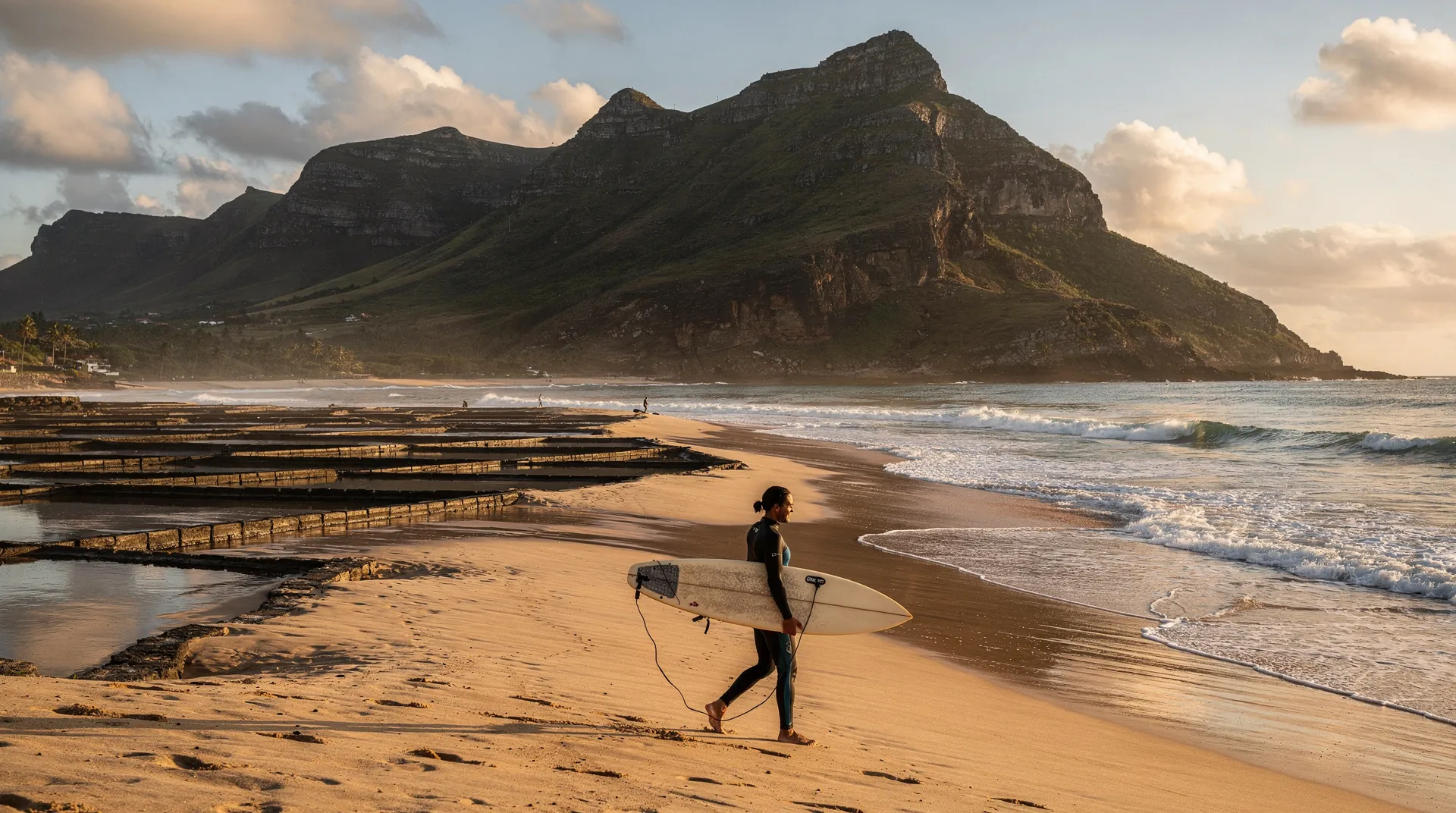
Tamarin Bay is tucked into a green setting at the foot of the inland hills. The mountains forming the bay’s backdrop change colour throughout the day: bright green in the morning, dark and mysterious at dusk. Le Morne Brabant, a UNESCO World Heritage site, is visible on the horizon to the south, forming one of the west coast’s most iconic views.
At a glance
| Aspect | Detail |
|---|---|
| Where | West coast, between Flic en Flac and Le Morne |
| Price | Guesthouse from about €40-60/night, villa from about €100/night, upscale hotel €200 and up |
| Time needed | 2 to 3 days to enjoy the surf, dolphins and salt pans |
| Getting there | About 50 min from the airport by car, car rental recommended |
| Best time | June to September for surfing; dolphins are seen year-round |
Things to do in Tamarin
Surfing: Tamarin’s founding identity
Tamarin owes its international reputation to its waves. Tamarin Bay is home to one of the best-known surf breaks in the Indian Ocean. The left-hand wave that forms here during the southern winter (June to September) has been renowned worldwide ever since the film “The Forgotten Island of Santosha” brought it to public attention in 1974. That documentary literally put Tamarin on the world surfing map, drawing generations of surfers on pilgrimage ever since.
The wave suits mainly intermediate to advanced surfers. It can become powerful during strong winter swells, with waves of 1.5 to 2.5 metres in the best conditions. For beginners, several local surf schools offer lessons in gentler conditions, notably on less demanding beach-break waves. Our kitesurfing and surfing in Mauritius guide gives you a full overview of the island’s surf spots and the skill levels required.
Even if you don’t surf, watching the surfers from the beach is a spectacle in itself. The silhouettes gliding along the waves with the mountains as a backdrop make for one of Mauritius’ most iconic images. Sunset on Tamarin beach, as the last surfers make the most of the gold-tinted waves, is a rare moment of grace.
Dolphin watching and swimming
Tamarin is regarded as one of the best places in Mauritius to observe dolphins in their natural habitat. Hundreds of spinner dolphins and bottlenose dolphins regularly visit the bay and its surroundings, especially early in the morning when they hunt in groups in the shallow waters.
Several local operators run boat trips at dawn to swim with dolphins. These excursions are very popular and should be booked ahead during high season. Responsible operators take care to respect the animals — choose ones that enforce strict distance rules and don’t encourage touching the dolphins or disturbing their natural behaviour.
A good excursion lets you watch the dolphins swim freely, sometimes with their young. You can book your dolphin-swimming trip in Tamarin now to avoid disappointment once you’re there.
The historic salt pans of Tamarin
The Tamarin salt pans are one of the few remaining traces of the salt industry that was once significant on Mauritius’ west coast. These salt basins, set within a landscape of mangroves and salt marshes, host a wealth of waterbirds that delight bird-watching enthusiasts: grey herons, little egrets, kingfishers, gulls and terns follow one another throughout the day in these wetlands rich in food.
Visiting the salt pans early in the morning, when the light is golden and nature is waking up, is an experience that stays with nature lovers. The reflections of flamingos (present in certain seasons) in the salt basins create scenes worthy of Africa’s finest nature reserves. It’s also an excellent spot for wildlife photography, far from the tourist bustle.
Hiking and exploring the interior
Tamarin is an excellent base for exploring the inland hills and mountains. Black River Gorges National Park is less than 20 minutes away by car. It’s home to the island’s last remaining native forests as well as marked trails for all levels of hiking in Mauritius, from easy walks to more demanding climbs.
Piton de la Rivière Noire, the highest peak in Mauritius at 828 metres, is accessible from the national park. The climb is demanding (3 to 4 hours round trip) but the view from the summit takes in a large part of the island, from Le Morne’s lagoon to the beaches of the east coast. Black River Gorge also offers spectacular scenery, accessible by 4x4 or on foot depending on conditions.
Diving and snorkelling
The waters around Tamarin and the south-west coast are home to remarkably rich diving and snorkelling sites. Le Morne, just 15 minutes to the south, is renowned for its drop-offs and exceptional marine biodiversity. Local dive centres organise trips to the best spots in the area, suitable for beginners and experienced divers alike.
Food and the local market
Tamarin’s market, lively at weekends, is a great place to buy fresh fruit, spices and craft items. The atmosphere is typically Mauritian, with Creole and Indo-Mauritian vendors, music and the smell of local cooking. It’s the perfect chance to try street-food specialities: dholl puri, gâteaux piments, meat skewers and freshly pressed fruit juice. Our Mauritian food guide will help you decode the local flavours and pick the best spots on the west coast.
Tamarin’s beaches
Tamarin Bay
Tamarin Bay is a large crescent-shaped cove sheltered by the inland hills. The southern part, where the surf wave breaks, is reserved for surfers and not well suited to regular swimming — currents can be strong and the bottom rocky in places. The northern part, better protected by a slight rocky outcrop, offers calmer water, ideal for cooling off after a session or for watching the sea quietly.
The beach itself is less spectacular than those at Flic en Flac or Belle Mare, but it has an authentic charm, with fishing boats pulled up on the sand, nets drying in the sun and coconut palms leaning in the trade winds. Mauritian families picnic here at weekends, and local surfers gather on the rocks in the late afternoon to watch the waves. This spontaneous local life is one of Tamarin’s real treasures.
The surrounding coves
The coastline around Tamarin reveals several small coves reachable on foot or by boat from the village. These often-deserted spots, tucked between basalt rocks and coastal vegetation, offer a wild, unspoiled beach experience far from the tourist bustle. Seeking out these hidden spots is part of the fun of exploring Tamarin. Some are only accessible at low tide or via unmarked trails — a good excuse to play explorer.
La Preneuse and surrounding area
A few kilometres south of Tamarin, the small village of La Preneuse offers a quiet, little-visited beach. This charming residential area, popular with expats, has a peaceful atmosphere with views of Le Morne mountain. Further south still, La Gaulette is a village increasingly attracting travellers looking for authenticity and total calm.
Where to stay in Tamarin
Tamarin has long lacked high-end accommodation, which has helped preserve its authenticity. That has changed in recent years with the opening of a few upscale establishments, but the range remains varied and suited to different budgets. Our where to stay in Tamarin guide will help you choose the accommodation best suited to what you’re after.
Guesthouses and small hotels
Guesthouses run by local families or expats are the most typical type of accommodation in Tamarin. These places often offer a warm welcome, simple, functional rooms, and valuable advice on surf spots and the best excursions. Some owners are surfers themselves and know the local conditions inside out — an invaluable resource for planning your sessions.
Villas and private rentals
Renting villas with a pool is particularly common in and around Tamarin. The west coast’s hinterland has many charming properties, some with views of Le Morne mountain, others right on the water with direct access to a private cove. It’s a great option for families or groups who want privacy and space while staying close to the surf spots.
Newer hotels and lodges
Several newer hotels have opened in and around Tamarin, offering fuller amenities — pool, restaurant, water sports — while respecting the character of the place. These establishments strike a good balance between comfort and authenticity. For couples on a romantic trip, our where to stay as a couple in Mauritius guide identifies the best addresses on the west coast.
Nearby luxury accommodation
For an upscale experience near Tamarin, the luxury resorts of Le Morne are just 15 minutes to the south. These five-star establishments offer an exceptional level of service while giving access to Tamarin’s natural and cultural attractions as a day trip. Our where to stay in style in Mauritius guide covers the best addresses on the Le Morne peninsula.
Tamarin with family: what to know
Tamarin isn’t the first destination that comes to mind for a family holiday, and for good reason: the main bay, exposed to swell and with a sometimes rocky bottom, isn’t the safest for young children. That said, several activities work very well for families: dolphin watching early in the morning generally fascinates young and old alike, visiting the salt pans and their wading birds is a nature outing suitable for all ages, and the weekend market offers a risk-free cultural immersion.
Our best beaches for families in Mauritius guide and our selection of family activities will help you put together a well-balanced stay if you’re basing yourself in the area.
For swimming with young children, it’s better to plan a stop at Flic en Flac, 15-20 minutes to the north, whose lagoon is noticeably calmer and shallow along its whole length.
Tamarin, Flic en Flac or Le Morne: how to choose
The west coast’s three flagship resorts have very different personalities. This table sums up the essentials to help you decide, especially if you’re weighing up where to base yourself for an island road trip that combines all three.
| Criteria | Tamarin | Flic en Flac | Le Morne |
|---|---|---|---|
| Vibe | Surf village, authentic | Family-friendly, lively, convenient | Luxury, sporty (kitesurfing) |
| Beach quality | Modest, waves and rocky bottom in places | Long family beach, calm lagoon | Spectacular UNESCO beach |
| Accommodation | Guesthouses and villas, a few newer hotels | Wide choice for all budgets | Mostly upscale resorts |
| Ideal for | Surfers, travellers seeking authenticity | Families, mid-range budgets | Couples, sports enthusiasts, luxury stays |
Getting to Tamarin and getting around
Tamarin is about 50 minutes by car from the international airport, via the west coast road or the M2 motorway. Renting a car in Mauritius is strongly recommended, as public transport serving Tamarin is infrequent and impractical for excursions. For everything on organising your airport transfer, see our dedicated guide.
From Flic en Flac, Tamarin is about 15 to 20 minutes by car to the south. From Le Morne, allow 10 to 15 minutes to the north. This position between two flagship west-coast destinations makes it a logical stop on an island road trip or in the 10-day Mauritius itinerary.
Taxis in Mauritius are available from Tamarin for one-off excursions. Local drivers usually know the surf spots and dolphin areas well and can act as informal guides. A public bus connects Tamarin to Port Louis and Flic en Flac, but the schedules aren’t well suited to early-morning dolphin or surf outings.
Best time to visit Tamarin
The best time for surfing in Tamarin is the southern winter, from June to September. This is when South Atlantic swells travel up into the Indian Ocean, creating conditions for the season’s best waves. July-August is generally considered the peak: cool water (25-26°C), steady wind and quality swells follow one after another.
For dolphin watching, trips are offered year-round since dolphins are present continuously in the west coast’s waters. The sea conditions most favourable for excursions (calm sea, good visibility) also correspond to the dry season. The southern summer (December to March) is warmer and more humid, with cyclone risk, but dolphins remain present and outings generally still take place. Our weather in Mauritius guide gives you detailed climate information by month.
Excursions from Tamarin
Tamarin is ideally placed for exploring the riches of Mauritius’ west and south-west coasts. 15 minutes to the south, Le Morne offers spectacular scenery, a world-class kitesurfing lagoon and a moving UNESCO history. 20 minutes to the north, Flic en Flac offers its long family beach and renowned dive sites.
Heading inland, Chamarel and its Seven Coloured Earths are 30 minutes away — a must-do excursion that combines perfectly with a visit to Chamarel Waterfall and the rum distillery. Further still, the Bel Ombre nature reserve offers forest hikes and safaris that beautifully complement the beach side of your stay.
For a boat trip combining dolphins and Île aux Bénitiers, book a catamaran trip from the west coast for an unforgettable day on the lagoon.
Our family itinerary in Mauritius guide suggests excursions suited to children from the west coast, while the honeymoon itinerary identifies the most romantic experiences in the region.
Practical tips
Tamarin is a village in the midst of development but one that preserves its authentic character. Respect that balance by being courteous to local residents and choosing providers rooted in the community — local dolphin and excursion operators deserve your preference over big tour agencies.
For surfing, it’s essential to honestly assess your level before getting in the water. Tamarin’s wave can be dangerous for beginners during big swells. If in doubt, ask local surfers, who know the conditions inside out. To stay connected affordably during your stay, our internet and eSIM in Mauritius guide explains the available options.
Tamarin and its surf community: a culture apart
Over the decades, Tamarin has developed a surf culture unique in Mauritius. The community of local surfers — Mauritian Creoles, expats and travellers who made the island their permanent base — has built up around the bay’s wave since the 1970s. This community, small and closed at first, has gradually opened up to the world without losing its own identity.
Today, Tamarin’s beach in the early morning looks like surf spots the world over: figures with their boards heading down to the water, expert eyes reading the waves, technical chat about conditions and swell. If you surf, you’ll be welcomed with the warmth reserved for those who share the same passion. If you don’t surf, watching this culture from the beach is fascinating — and local surfers are often excellent informal guides to the area’s secret spots.
Tamarin’s surfers have also played an essential role in preserving the village’s authentic character. Their attachment to an “undeveloped” place has long held back the property projects that could have turned Tamarin into a second Flic en Flac. That balance remains fragile — new buildings go up every year — but Tamarin’s identity still holds.
The west coast road: Tamarin as a stop
The west coast of Mauritius, between Flic en Flac to the north and Le Morne to the south, forms one of the island’s most beautiful road routes. The coastal road that runs through Tamarin hugs the shore through landscapes alternating black rocks, sandy beaches, mangroves and fishing villages. It’s a drive to savour slowly, with plenty of possible stops.
Between Flic en Flac and Tamarin, the road passes through Rivière Noire — an authentic fishing village where surf conditions are good on some days — and La Preneuse, with its small wild coves accessible on foot from the road. Between Tamarin and Le Morne, the road offers progressively more spectacular views of the basalt mountain drawing closer, building a sense of rising visual intensity.
Our road trip in Mauritius guide covers this coastal route in detail, with recommended stops, restaurants and snorkelling spots accessible from the road.
Everyday life in Tamarin
Tamarin is a village developing rapidly but still very accessible in terms of services. There’s a supermarket, a pharmacy, cash machines, several restaurants and a few shops. Wi-Fi is available in most accommodation and cafés. For medical emergencies, the nearest hospital is in Quatre Bornes or Curepipe — plan for transport.
Tamarin’s local market, smaller than the ones in Port Louis or Mahébourg, still offers good fresh fruit and vegetables. Local craft vendors are present at weekends. For everything on markets and Mauritian culture, our dedicated guide will accompany you on your discoveries.
Frequently asked questions about Tamarin
Can you see dolphins in Tamarin without taking a boat? Sometimes, dolphins come very close to shore in the bay, but boat excursions take you into their usual living areas and offer much better chances of seeing and swimming with them.
Do you need to know how to surf to enjoy Tamarin? Absolutely not. Watching the surfers from the beach, visiting the salt pans, dolphin trips and the village atmosphere can all be fully enjoyed without surfing. Tamarin is a destination for travellers seeking authenticity, not just for surfers.
Is Tamarin suitable for families? Yes, with some caveats. The main bay isn’t ideal for young children (currents and rocky bottom in places), but dolphin excursions, the salt pans and the surrounding villages suit families very well. For a family beach with a calm lagoon, Flic en Flac to the north remains the best option on the west coast.
Are there good restaurants in Tamarin? Yes, Tamarin has several excellent restaurants, including seafood spots and authentic Creole cuisine. Prices are generally lower than in Flic en Flac or Grand Baie for equivalent or better quality.
Can you rent a surfboard on site? Yes, several rental shops and surf schools are set up in the village, offering board and wetsuit rental plus lessons for all levels. Book the day before during peak surf season (July-August), as the best slots go fast.