
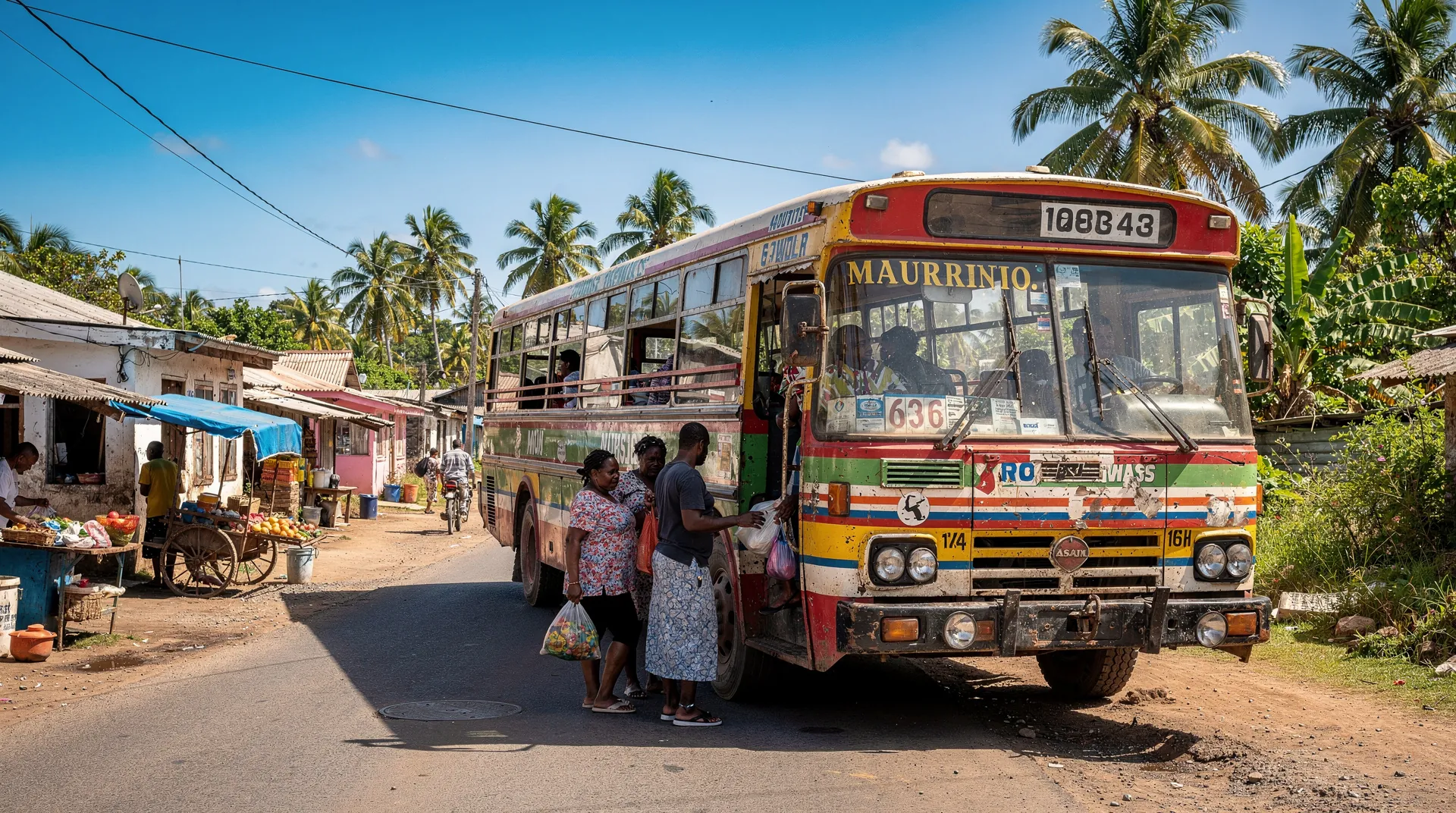
Buses in Mauritius: routes, schedules, prices and practical tips
Updated: August 2026
Can you visit Mauritius by bus?
Yes, the bus network covers the main routes between towns well. A trip costs between 20 and 90 MUR (0.40 to 1.80 EUR). Ideal for town-to-town travel, less practical for remote beaches.
At a glance
| Price per trip | roughly 20 to 90 MUR (0.40 to 1.80 EUR) depending on distance |
| Schedule | roughly 5:30am to 8-9pm depending on the line |
| Payment | cash only, paid to the conductor |
| Best for | town-to-town trips and tight budgets |
| Less suited for | remote beaches, large luggage, night trips |
| Best time to travel by bus | year-round, avoid school rush hours |
The Mauritian bus network: an overview
Mauritius has an extensive bus network that is the most widely used mode of transport among the local population. Affordable and covering most of the island’s inhabited areas, the bus is a serious option for budget travelers or anyone who wants to travel the way Mauritians do.
The network is run by several operators: the NTA (National Transport Authority), which oversees the whole sector and sets the routes and fares, and numerous private operators that run the different lines. Buses are mostly yellow and blue (the historic “Yellow Buses”) or green and white depending on the operator. Vehicles range from rickety old buses to modern, air-conditioned minibuses.
For budget travelers, the bus is by far the cheapest way to get around, often 10 to 20 times less expensive than a taxi for the same distance. In exchange, it demands time and adaptability.
What the bus can do for you
The bus is particularly good for:
- Connecting the main towns to each other (Port Louis, Curepipe, Quatre Bornes, Rose Hill, Mahebourg)
- Reaching residential areas from urban centers
- Getting to some popular beaches close to an urban center
- Traveling between regions cheaply if you’re light on luggage
- Experiencing everyday Mauritian life from the inside
The network’s limits
The bus is less suited for:
- Reaching remote beaches or attractions far from the main routes — Blue Bay or Le Morne are hard to reach by bus
- Traveling at night (buses generally stop running between 7pm and 9pm depending on the line)
- Carrying large wheeled luggage — the aisles are narrow and there’s no luggage hold
- Traveling with young children or people with reduced mobility
Main routes and destinations
Port Louis: the network’s central hub
Port Louis is the nerve center of the Mauritian bus network. Three main bus stations are located there:
Gare du Nord (Victoria Square / Immigration Square): the main station, serving the north of the island: Grand Baie, Trou aux Biches, Pamplemousses, Triolet, Goodlands, Cap Malheureux. This is where you’ll catch the bus for the northern tourist areas.
Gare du Centre: serves the center and the central plateau — Curepipe, Quatre Bornes, Rose Hill, Vacoas, Beau Bassin, Moka.
Gare du Sud: serves the south of the island — Mahebourg, Souillac, Riviere des Anguilles. Departures for the south coast.
Main connections and approximate durations
Port Louis - Grand Baie: about 1h to 1h30, frequent departures throughout the day (express and local buses). One of the routes most used by tourists. Price: 50 to 60 MUR.
Port Louis - Curepipe: 45 min to 1h, very frequent service (every 5 to 10 minutes at peak times). Price: 35 to 45 MUR.
Port Louis - Quatre Bornes: 40 to 55 minutes, frequent service. Price: 30 to 40 MUR.
Port Louis - Mahebourg: 1h to 1h30 depending on whether it’s a direct line or one with stops. Price: 75 to 90 MUR.
Port Louis - Flic en Flac: possible with a connection, about 1h to 1h30 depending on transfers. Price: 60 to 80 MUR.
Curepipe - Mahebourg: direct connection available, about 1h. Convenient for travelers from the central plateau.
Grand Baie - Trou aux Biches: coastal service available. Very cheap, under 20 MUR.
Grand Baie - Pamplemousses: access to the Botanical Garden possible by bus from the north. Price: 20 to 30 MUR.
Routes to the beach areas
The most accessible beaches by bus from Port Louis:
- Trou aux Biches: from Gare du Nord, line toward Triolet
- Flic en Flac: transfers required, but doable
- Belle Mare beach: hard to reach by direct bus, transfers at Flacq
More remote beaches like Le Morne, the Tamarin coast, or the wild beaches of the south are practically inaccessible by bus for a tourist with luggage.
Fares: the cheapest transport on the island
Mauritian bus fares are remarkably low and are calculated based on distance traveled. They’re set by the NTA and are non-negotiable.
Indicative fares in 2026
- Short trip in town (under 5 km): 20 to 25 MUR (0.40 to 0.50 EUR)
- Medium trip (10 to 20 km): 35 to 55 MUR (0.70 to 1.10 EUR)
- Long trip (30 to 50 km): 70 to 90 MUR (1.40 to 1.80 EUR)
- Port Louis - Grand Baie: about 50 to 60 MUR (1.00 to 1.20 EUR)
- Port Louis - Mahebourg: about 75 to 90 MUR (1.50 to 1.80 EUR)
- Port Louis - Curepipe: about 35 to 45 MUR (0.70 to 0.90 EUR)
- Airport - Port Louis (Airport Express): about 100 MUR (2 EUR)
For comparison, the same Port Louis - Grand Baie trip by taxi costs 600 to 900 MUR. The bus is therefore 10 to 15 times cheaper. Worked into your budget for Mauritius, the bus can save you 50 to 100 EUR over a week of travel.
Payment
Payment is made exclusively in cash, directly to the conductor (the staff member who moves through the bus collecting fares). There’s no rechargeable transport card for tourists in Mauritius. Always carry rupee change — coins and small notes (20, 50 MUR) are best. To understand currency in Mauritius and how to manage your cash, check out our dedicated guide.
How to use the bus in Mauritius
Finding the bus stop
Bus stops are marked with signs, sometimes in poor condition or missing in some rural areas. Mauritians frequently wait by the roadside for the bus, even without an official sign. If you see a group of people quietly waiting by the road, it’s probably an unofficial stop.
In towns, stops are better marked and bus stations are clearly identifiable. Ask your hotel or a local for the location of the nearest stop.
Boarding the bus
Board through the front door. There’s generally no electronic validation: the conductor — a staff member usually in uniform — will come to you to collect the fare after you’ve boarded. Tell them your destination in English or Creole (or show it on paper) and they’ll tell you how much you owe.
Identifying your line
Buses display their final destination on the front (on a lit-up or painted sign). Some also show the main stops along the way. Ask the conductor or driver to confirm if you’re not sure — they won’t bite and are used to slightly lost tourists.
Tip: take a photo of the number or name of the line you need before boarding, so you can find it again on the way back.
Signaling to get off
As in France, there’s generally a button or a cord to signal your stop. Sometimes it’s enough to simply ask the conductor to let you know at your stop — they’ll gladly do so.
Don’t be too shy to ask for help. Mauritians are generally very welcoming and will be happy to guide you, especially if you open with a “bonzour” and a smile.
Express buses and local buses
There’s an important distinction between express buses (few stops, faster, slightly more expensive) and local buses (stop on request, slower). For longer trips like Port Louis - Grand Baie, always prefer the express bus when available — the time difference can be 20 to 30 minutes.
Shared minibus taxis (taxi-bus)
In addition to the standard bus network, private minibuses (taxi-bus or taxi-vans) run on some popular routes. These vehicles, often faster and more direct, cost a bit more than the standard bus but remain very cheap compared to regular taxis. They leave once full rather than on a fixed schedule, which can mean some waiting.
Schedules: when do the buses run?
Mauritian buses generally run from 5:30am to 8pm or 9pm depending on the line, with varying frequency:
- Main lines (Port Louis - Curepipe, for example): buses every 5 to 10 minutes at peak times (7-9am and 4-6pm)
- Medium-town lines: every 20 to 45 minutes
- Rural and coastal lines: sometimes only 2 to 4 departures a day — check before relying on a return bus
There’s no reliable official app with real-time schedules in Mauritius. Ask locals, check at the local bus station, or visit the NTA Mauritius website.
Sundays and public holidays
Service is significantly reduced on Sundays and public holidays. Some secondary lines don’t run at all. If you need to travel on those days, plan for an alternative — taxi or an organized excursion.
Practical tips for bus travel in Mauritius
Set off early in the morning to get a seat. Mid-morning buses and school rush hours (7-8:30am and 3-4:30pm) are often packed.
Keep your belongings close: buses are very busy, so stay alert for your personal items. Pickpocketing is rare but does happen on crowded buses. For general safety tips, check our safety guide to Mauritius.
Air conditioning: modern buses are often air-conditioned, sometimes quite intensely. Keep a light layer handy, especially after the outdoor heat.
Carry change: conductors don’t always have change for 500 or 1,000 MUR notes. Keep coins and 50 MUR notes for the bus.
Be patient: Mauritian buses don’t always run exactly on schedule. A bus “every 20 minutes” can sometimes run 30 to 40 minutes late at peak times. Don’t plan tight connections.
Charged phone: have an internet connection for Google Maps to check your route in real time. Our eSIM and internet guide explains how to stay connected cheaply.
Traveling without a car in Mauritius: what strategy to use
For a stay without a rental car, the most effective strategy is to combine several modes of transport depending on the situation:
Bus for urban and inter-town trips: Port Louis for the market, Curepipe for the diamond shops, Quatre Bornes for the textile market.
Taxi for excursions off the main routes: a day trip to Chamarel, a visit to the Pamplemousses Garden, snorkeling at Blue Bay.
Organized excursions for the most touristy sites: Ile aux Cerfs, catamaran sea outings, swimming with dolphins.
For catamaran day trips to Ile aux Cerfs or organized dolphin outings, booking ahead avoids the queues from beach vendors: see the Ile aux Cerfs catamaran excursions.
For travelers planning to skip a car entirely, our car-free itinerary offers a complete 7-10 day program built around public transport and shared taxis.
Bus, taxi or rental car: which to choose?
| Criteria | Bus | Taxi | Rental car |
|---|---|---|---|
| Cost | very low (20 to 90 MUR/trip) | moderate to high (500 to 2,500 MUR/trip) | 35 to 80 EUR/day, worthwhile in a group |
| Schedule flexibility | low (fixed schedules, reduced evening service) | high | total |
| Access to remote beaches | low | good | excellent |
| Comfort with luggage/children | low | good | excellent |
| Local immersion | maximum | moderate | low |
To dig deeper into this trade-off based on your travel style, our comparison with and without a rental car breaks down the scenarios where each option makes the most sense.
The bus to and from the airport
The bus is generally not the best option for arriving at or departing from SSR Airport, especially with luggage: connections are inconvenient and evening schedules are limited. Most travelers prefer a pre-booked airport transfer or a taxi for this specific trip, then switch to the bus once settled in their accommodation area for day-to-day travel.
The local experience: a Mauritian bus is alive!
Taking the bus in Mauritius is also a cultural experience in its own right. You’ll hear sega music from the speakers, sit alongside schoolchildren in uniform, market vendors loaded with baskets, local workers chatting in Creole. The vibe is generally warm and relaxed.
It’s often on a bus that travelers make their best encounters and get the best local tips — the address of a family-run restaurant no guidebook mentions, a beach with no tourists that no one points you to, the exact time of the village market. Embrace this authentic experience and don’t hesitate to strike up a conversation.
Mauritians are multilingual — French, Creole, English — and appreciate it when tourists make the effort to approach them in French or say a few words of Creole. A simple “bonzour” opens a lot of doors.
Is the bus right for you?
Yes if:
- You’re traveling solo or as a couple with little luggage
- You have time on your hands and flexibility isn’t a burden
- Your budget is tight
- You’re staying near a bus station or a main route (central Port Louis, Grand Baie or Curepipe)
- You want an authentic immersion in Mauritian life
Less suited if:
- You’re traveling as a family with children and luggage
- Your accommodation is in a remote beach area
- You want total flexibility in your schedule
- You’re arriving or leaving at night or on a Sunday
The winning combination for many travelers: the bus for daily urban trips (the Port Louis market, a day trip to Curepipe) and a taxi or rental car for further excursions or remote beaches.