
Languages in Mauritius: French, English and Mauritian Creole
Updated: August 2026
Is French spoken in Mauritius?
Yes, French is widely spoken and understood in Mauritius. It's the language of the press, culture and informal exchanges. You'll have no trouble communicating in French, especially in tourist areas.
A multilingual country with a complex history
Mauritius is a fascinating example of a multilingual society. Colonised successively by the Dutch (17th century), the French (1715-1810) and the British (1810-1968), the island inherited a linguistic richness from these different presences that is unique in the world. To this historical palette are added the languages of the many communities who have settled the island over the past two centuries: indentured labourers from northern and southern India, the Sino-Mauritian community, and descendants of African and Malagasy slaves.
Today, Mauritians navigate remarkably easily between several languages, sometimes switching from one to another within the same conversation — a phenomenon known as “code-switching”. It’s perfectly normal, and shouldn’t surprise you, to hear a sentence that starts in Creole, continues in French and ends with an English word.
For French-speaking travellers, this linguistic reality is excellent news: you’ll be perfectly understood in every tourist situation, in the markets of Port-Louis as much as in the restaurants of Grand Baie.
| At a glance | |
|---|---|
| Official language | English (administration, law) |
| Language of culture | French (press, television, restaurants) |
| Everyday language | Mauritian Creole (Morisyen) |
| Language barrier for French speakers | virtually none |
| Best time to learn a few words | before departure, with the expressions below |
The official languages: English and French
English: the official administrative language
English is the sole official language of the Republic of Mauritius, a direct legacy of British colonisation (1810-1968). It’s the language used in legislation, official documents, administration, Parliament and the judicial system.
However, English isn’t the language most commonly spoken day-to-day by the population. Most Mauritians use it mainly in a professional or academic context — it’s the language of formal education in Mauritius, which explains why any Mauritian who has attended school speaks English with varying degrees of fluency.
In practice, for a French-speaking tourist: English will be useful in international hotels, with some younger Mauritians trained in English-medium programmes, and for reading signs and official documents.
French: the language of the heart
French holds a special place in Mauritian society. Although not the official language, it’s the language of the print press, television, literature, the arts and culture. The main newspapers (L’Express, Le Mauricien, Le Défi) are published in French. Most popular television programmes are in French.
French is also the language of formal and semi-formal social interactions: in restaurants, tourist shops, with taxi drivers, and in mid-range and upmarket hotels. In Mauritius, French is seen as the language of culture and prestige — speaking it well is valued.
Good news for French speakers: you’ll be perfectly understood in French in almost every tourist situation. Mauritians are generally delighted to speak French with visitors from France. The historical and cultural relationship between the two countries is a warm one. There’s none of the wariness or cultural distance you might find in other French-speaking destinations.
Differences from metropolitan French: Mauritian French has its own quirks. The accent is different, melodious, with characteristic Creole intonations. Some words or expressions may sound unfamiliar (plenty of borrowings from Creole). But mutual understanding is total.
A few expressions or words typical of Mauritian French that you’ll hear:
- “Alors!”: a very common exclamation, a sort of conversational filler
- “C’est bon”: used to mean “okay” or “very good”
- “Brèdes”: leafy greens (a Creole term absorbed into local French)
- “Carri”: Mauritian curry
- “Snack”: refers to a casual eatery (not a snack food)
Mauritian Creole: the everyday language
What is Mauritian Creole?
Mauritian Creole (called “Morisyen” in Creole) is the mother tongue of the vast majority of Mauritians, regardless of their ethnic background. It’s the language of the home, the street, the markets, friends, intimacy and popular culture.
Mauritian Creole is a fully-fledged language in its own right, not simply “bad French” or a patois. It has its own grammar, vocabulary, phonology and literature. It’s based on French (around 80% of the vocabulary comes from 18th-century French) but with significant influences from Indian languages (Hindi, Tamil, Bhojpuri), African languages, English and Malagasy.
It’s also a language gaining institutional recognition: since 2012, Mauritian Creole has been taught as an optional subject in primary schools, a historic step after decades of political debate.
Understanding Mauritian Creole as a French speaker
A patient French speaker can understand a fair amount of spoken Mauritian Creole, especially after a few days of exposure. The basic grammar and core vocabulary are close enough to French that passive understanding develops gradually.
A few features of Mauritian Creole:
- Final “r” sounds are often unpronounced or heavily softened (“manzé” for “manger”)
- Nasal sounds (-an, -in, -on) are pronounced differently from standard French
- Verb tense is expressed through particles placed before the verb (no complex conjugation)
- Many words are shortened or simplified (“monn” for “j’ai”, “mo” for “je”)
A few useful Creole words and phrases
Even a few words of Creole will be greatly appreciated by Mauritians and will make your interactions easier. It’s often the difference between a purely transactional exchange and a genuine moment of human connection.
Greetings and courtesy:
- “Bonzour”: Hello
- “Bonswar”: Good evening
- “Mersi”: Thank you
- “Kouma ou ete?”: How are you?
- “Mo bien, mersi”: I’m well, thank you
- “Pardon”: Sorry / Excuse me
Practical questions:
- “Kote sa?”: Where is it?
- “Kombie sa coute?”: How much does it cost? (useful at the market)
- “Eski ou koz franse?”: Do you speak French?
- “Mo pa konpran”: I don’t understand
Everyday expressions:
- “Ayo!”: An exclamation of surprise or admiration (very common)
- “Ena”: There is / There exists
- “Tou doux” or “dousma”: Slowly, gently — the Mauritian equivalent of the Italian “prego” or the English “easy”
- “Alors”: Well then (used very frequently, often as conversational punctuation)
- “Kot ou pé alé?”: Where are you going? (you’ll often hear this friendly question)
Other languages spoken in Mauritius
Bhojpuri
Bhojpuri is an Indo-Aryan language spoken by a significant part of the Indo-Mauritian community, descended from indentured labourers who came from northern India in the 19th century. Around 5 to 10% of the population speaks it fluently. It’s mainly a language of family and cultural transmission, practised in the rural areas of the centre and north of the island. You may hear Bhojpuri on the radio or at Hindu cultural festivals.
Tamil, Telugu, Marathi
These South Indian languages are spoken by the island’s Tamil, Telugu and Marathi communities. They’re taught in some schools and used during Hindu and Tamil religious ceremonies. Walking through the residential areas of Port-Louis, you might spot Tamil signs outside temples.
Mandarin and Hakka
The Sino-Mauritian community (around 3% of the population) mainly speaks Hakka, a Chinese dialect from southern China and the language of the first immigrants. Mandarin is more widespread among younger generations and in business dealings. The Chinatown of Port-Louis is one of the oldest in the Indian Ocean.
Arabic (a religious language)
Arabic is used in a religious context by the Mauritian Muslim community (around 17% of the population), mainly for reading the Quran and for prayer. It isn’t a language of everyday communication.
Which language should you use with Mauritians?
In hotels
Most hotels, across all categories, have staff who speak fluent French and English. In luxury hotels catering to a diverse European clientele, German, Italian and Russian are also often spoken, depending on the usual guests.
French is the preferred language for French-speaking tourists in Mauritian hotels. For all-inclusive hotels or villas, French-speaking staff are systematically arranged to welcome French guests.
In restaurants
In tourist restaurants, menus are generally in French and English, and staff speak French. In local and roadside restaurants, French works well too. In working-class residential areas, Creole is the main language, but everyone will understand French.
Since Mauritian cuisine is heavily influenced by French culture, the names of many dishes and the interactions around the table naturally happen in French.
On public transport
Mauritian taxi drivers generally speak French, or Creole with some French. Communicating in French works perfectly well to give a destination, negotiate a price or have a conversation.
On buses, communication happens mainly in Creole and English. But if you ask for your stop in French, the conductor will understand and help you.
At markets
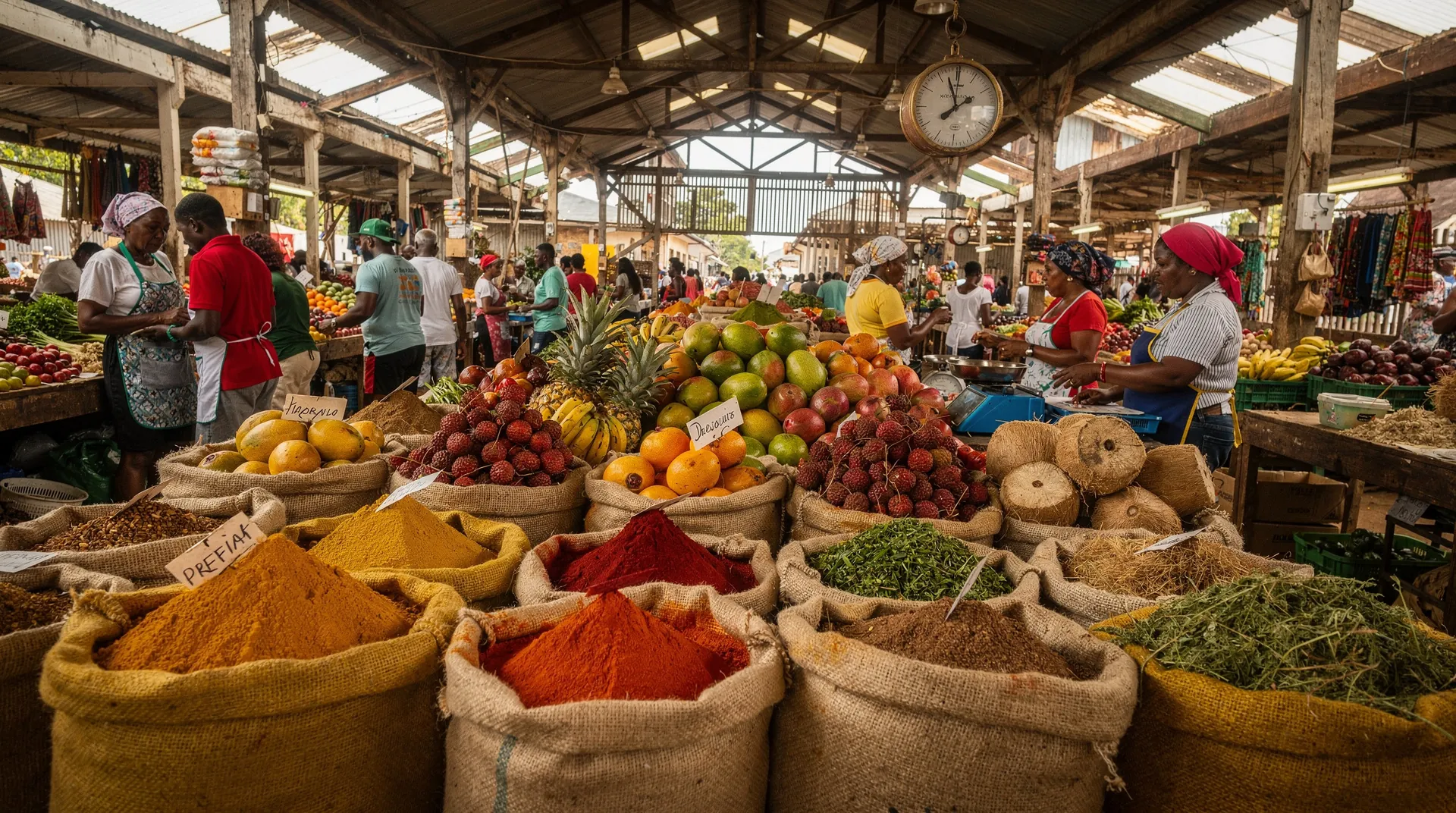
At the market, Creole reigns. But vendors understand and speak French to communicate with tourists. A few words of Creole (especially “mersi” and “bonzour”) will be met with warm smiles and often better service.
At the Monday market in Mahébourg or the central market in Port-Louis, the fruit, vegetable and spice vendors are used to tourists and appreciate the linguistic effort.
Among young people and in urban areas
Young Mauritians in the cities often mix Creole, French and English in their conversations. Approach them in French: you’ll generally get a fluent, warm response.
Language and Mauritian culture: what you should know
Linguistic sensitivities
The question of language in Mauritius is a sensitive cultural, and sometimes political, topic. Debates about the place of Creole in education, the country’s official language, or the recognition of ancestral languages come up regularly in Mauritian public discourse.
As a visitor, respect this reality by avoiding judgements about “bad French” or “exotic accents”. Mauritian Creole is a proud and rich language, not a lesser version of French.
Literature in French
Mauritian literature in French is rich and internationally recognised. Authors such as Ananda Devi, Jean-Marie Le Clézio (who grew up in Mauritius and has often returned) and Natacha Appanah are read well beyond the island’s shores. Reading one of these authors before your trip is a great way to immerse yourself in the Mauritian atmosphere.
Press and media
Mauritian newspapers such as L’Express de Maurice or Le Mauricien are published in French and available in newsstands and supermarkets. They offer a window onto local news, useful for understanding the island’s political and social context.
Which language to use depending on the situation?
To help you navigate quickly, here’s an overview of the most useful language for the situations you’ll encounter during your stay.
| Situation | Most useful language | Note |
|---|---|---|
| Hotel reception | French | French-speaking staff almost guaranteed |
| Tourist restaurant | French | menus often bilingual French/English |
| Local market (Port-Louis, Mahébourg) | French, a few words of Creole appreciated | ”mersi” and “bonzour” bring smiles |
| Taxi | French | negotiating the price in French is no problem |
| Public bus | Creole, English | a stop requested in French will be understood |
| Administration, official signage | English | legislation and administrative documents |
| Guided excursions | French available on request | check the guide’s language when booking |
Getting around and communicating: beyond language
Language is just one part of the practical preparation for your stay. To get around the island with ease, our guide to getting around Mauritius covers all your options (car, taxi, bus). If you’re planning to drive yourself, our guide to car rental in Mauritius details the process — communicating with rental agencies in French is no trouble at all.
For administrative steps before departure (forms, entry requirements), note that official Mauritian documents are written in English: our guide to entry requirements for Mauritius explains what you need to prepare. Once on the island, keep in mind that Mauritian currency, the rupee, is labelled in English on banknotes, but prices will be quoted to you in French in almost all tourist-facing businesses.
Practical summary for French-speaking travellers
As a French speaker, you won’t face any language barrier in Mauritius. French is everywhere, understood by everyone and often preferred over English in tourist interactions. Whether you’re staying in Grand Baie, Flic en Flac or Le Morne, communication will be easy and natural.
A few words of Creole will add a warm touch to your exchanges with locals. A simple “bonzour” or “mersi” said with the right Mauritian accent always makes an impression and brings out smiles. Try an “ayo!” when you make a lovely discovery — you’ll see faces light up.
Mauritius is, in this respect, a particularly comfortable destination for French, Belgian, Swiss and Québécois travellers. You’re at home here linguistically, while still being in a different, colourful and fascinating world. To prepare for every other aspect of your trip, check out our guides to safety, entry requirements and budget.
To go even further in discovering the local culture, a guided excursion in French immerses you in Mauritian diversity with cultural and historical commentary: see guided excursions in French in Mauritius.