
Currency in Mauritius: Mauritian rupee, exchange and payments
Updated: August 2026
What currency should I use in Mauritius?
The official currency is the Mauritian rupee (MUR). 1 EUR is worth roughly 48-50 MUR in 2026. Bank cards are accepted at hotels and tourist restaurants, but cash is essential for markets and taxis.
At a glance
| Currency | Mauritian rupee (MUR) |
| Approximate rate | around 1 EUR = 48 to 50 MUR |
| Where to withdraw | ATMs at banks, supermarkets and shopping centres |
| Cash essential for | taxis, buses, markets, small guesthouses |
| Best method | withdraw at an ATM on arrival + a fee-free card such as Revolut/N26/Wise |
The Mauritian rupee: an overview
The Mauritian rupee (ISO code: MUR, symbol: Rs or ₨) has been the official currency of the Republic of Mauritius since independence in 1968. It is issued and regulated by the Bank of Mauritius.
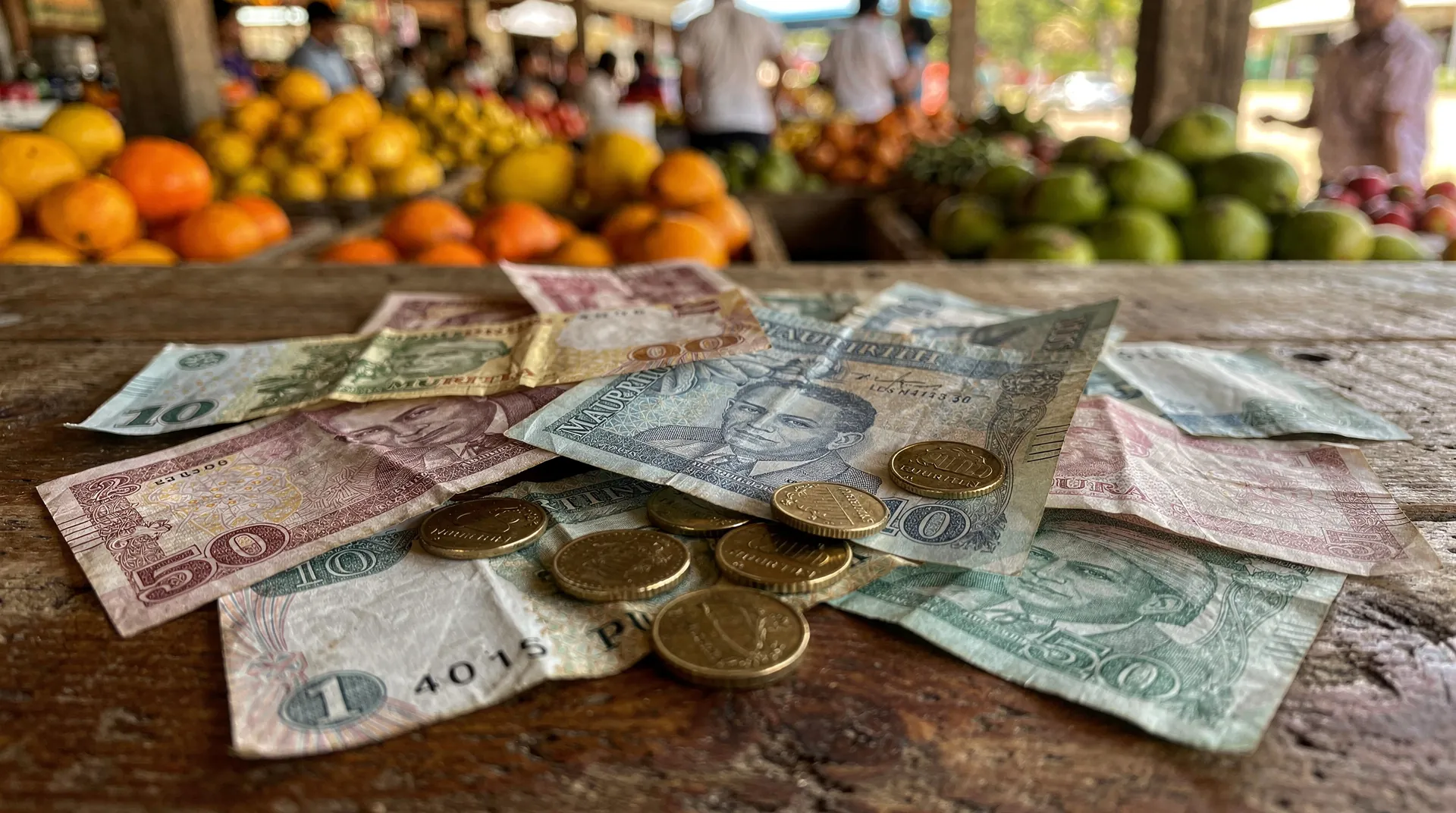
The rupee is divided into 100 cents, although cents are rarely used in everyday transactions. Notes come in denominations of 25, 50, 100, 200, 500, 1,000 and 2,000 rupees. Coins come in 5, 10, 20 and 50 cents, as well as 1, 5 and 20 rupees. Mauritian banknotes are colourful and feature historical figures and landscapes — collecting the different denominations makes a nice souvenir.
Exchange rate in 2026
As of April 2026, the exchange rate is roughly 1 EUR = 48 to 50 MUR. This rate fluctuates slightly depending on international financial market conditions.
For a quick mental conversion:
- 100 MUR = about 2 EUR
- 500 MUR = about 10 EUR
- 1,000 MUR = about 20 EUR
- 2,500 MUR = about 50 EUR
- 5,000 MUR = about 100 EUR
Practical tip: to quickly convert rupees into euros, divide by 50. To convert euros into rupees, multiply by 50. This approximation is good enough for most everyday situations, especially when gauging prices while negotiating a taxi fare or doing your shopping.
These figures fit into your overall Mauritius budget, which we recommend consulting for a complete estimate of your expenses.
Where to change money
At SSR Airport
The exchange bureau at Sir Seewoosagur Ramgoolam Airport is open when international flights arrive. Rates there are slightly less favourable than in town, but the commission remains reasonable.
Tip: only change enough at the airport to cover your first transfer and initial purchases (3,000 to 5,000 MUR is plenty). This lets you pay for your taxi from the airport or your first meal without stress. Look for a better rate in the following days once in town.
Banks
Mauritius’s main banks offer reliable exchange services:
MCB (Mauritius Commercial Bank): the island’s largest bank, with branches in every town and tourist area. Reliable exchange service, fair rates, staff often speak French.
SBM (State Bank of Mauritius): a good alternative with an extensive network across the whole country.
AfrAsia Bank, BRT: present in urban centres, sometimes offering competitive rates.
Banks are generally open Monday to Friday from 9am to 3pm, and Saturday morning until noon. They offer the best official rates but may charge a fixed commission per transaction (ask for the details before changing money).
Private exchange bureaus (forex)
Private exchange bureaus can be found in tourist areas: Grand Baie, Flic en Flac, Port-Louis and in some shopping centres. They’re often open later than banks (until 6pm or 8pm) and on weekends.
Rates vary from one bureau to another. Always compare the displayed rate (the one at which they buy your euros) and check whether there’s an additional commission.
Watch out: some exchange bureaus advertise an excellent rate in the window but then charge a significant commission on the transaction. Always ask for the net amount you’ll receive before confirming the exchange.
Hotels
Most hotels offer an exchange service for their guests. Convenient, but generally with the least favourable rate. Best reserved for emergencies or small amounts — if you need 500 MUR quickly to pay for an excursion, the hotel’s exchange desk will do the job efficiently.
Supermarkets and shopping centres
Jumbo Food and some shopping centres such as Bagatelle Mall offer exchange services at often competitive rates and with extended opening hours. A good option if you’re doing your shopping anyway.
ATMs
ATMs are widespread in Mauritius, found in shopping centres, supermarkets, bank branches and tourist areas. Outside the remote rural areas of the deep centre and south, you’ll always find an ATM within 15 minutes.
Cards accepted
Most Mauritian ATMs accept:
- Visa and Visa Electron (the most widely accepted)
- Mastercard and Maestro
- Cirrus
American Express is less widely accepted at ATMs but works as a direct payment method at many luxury hotels and restaurants.
Amounts and fees
Withdrawal limit: generally between 5,000 and 10,000 MUR per transaction (roughly 100 to 200 EUR), depending on the ATM and your French bank. Some MCB ATMs allow withdrawals of up to 15,000 MUR.
Fees for withdrawing abroad: your French bank will likely charge fees — typically 1 to 4 EUR in fixed commission plus 1 to 2% of the amount. Check your card’s terms before you leave.
Tip to minimise fees: withdraw larger amounts less often. An 8,000 MUR withdrawal with a 3 EUR fixed fee costs you 0.75% in total commission. Eight withdrawals of 1,000 MUR would cost 24 EUR in fixed fees — 2.4% commission, three times as much.
Fee-free cards for travel abroad: if you travel regularly, consider a card like Revolut, N26 or Wise, which charge little or no fees on withdrawals abroad. These cards can save you 30 to 50 EUR over a two-week trip to Mauritius. To avoid roaming charges on your phone and stay connected for online payments, a local eSIM is also an excellent investment: order an eSIM for Mauritius.
Using bank cards
Where cards are accepted
Credit cards (mainly Visa and Mastercard) are accepted at:
- Hotels (of all categories, even small ones)
- Tourist and mid-range restaurants in tourist areas
- Shopping centres and supermarkets (Jumbo, Super U, Winner’s)
- Car rental agencies
- Most shops in the tourist areas of Grand Baie and Flic en Flac
Where cash is essential
Cash remains the norm or even the only option for:
- Taxis (all payments, without exception)
- Buses (cash only, paid to the conductor)
- Local markets (Mahébourg, Quatre Bornes, Port-Louis)
- Street vendors and local food courts
- Small guesthouses and B&Bs
- Purchases in villages and neighbourhood shops
- Local excursions paid directly to the operator
Rule of thumb: always carry the equivalent of 50 to 100 EUR in rupees for everyday expenses. Never find yourself with only a credit card — you won’t be able to take a taxi.
The euro and foreign currencies in Mauritius
The euro is well recognised in Mauritius. Some tourist businesses (hotels, upscale restaurants, luxury boutiques) accept payment directly in euros. However, the rate applied is generally unfavourable for the customer — they apply a conservative exchange rate that works in their favour.
Tip: always pay in Mauritian rupees, unless the rate offered is clearly displayed and matches the market rate.
Some taxis also quote a price in euros — check that it doesn’t exceed the rupee price at the day’s rate. A taxi asking for 50 EUR for a ride worth 2,000 MUR is charging you at a rate of 40 MUR/EUR instead of 48 to 50 MUR/EUR — that’s 20 to 25% more.
Change euros before leaving or in Mauritius?
The classic traveller’s dilemma. Both options are viable, each with its own advantages:
Changing in France before departure: your French bank or the exchange bureaus at the Paris airports generally offer decent EUR/MUR rates. The advantage is arriving with rupees in your pocket and not having to hunt for an exchange bureau after a long flight. The rate at Roissy or Orly can be slightly worse than in Mauritius — compare before deciding.
Changing in Mauritius: exchange bureaus in town often offer good rates. The downside is arriving without local cash, which can be a problem for your first taxi or first meal.
The recommended hybrid solution: bring 100 to 200 EUR in cash or withdraw from the airport ATM on arrival to cover your first expenses (5,000 to 8,000 MUR). Change the bulk of your budget at a bank or exchange bureau in town within the first two days.
Security and managing your money
Split your resources: never keep all your cash and cards in one place. Leave some in your room safe. Carry only what you need for the day.
Photograph your cards: keep your card numbers and emergency hotline numbers in your phone (offline) or in your emails — accessible even without a connection.
In case of loss or theft: contact your bank immediately to block the card. Hotlines operate 24/7. For safety matters during your stay, see our Mauritius safety guide.
Avoid ATMs in isolated or poorly lit spots. Prefer ATMs inside banks, supermarkets or well-lit shopping centres.
Don’t carry large sums of cash. For a typical day of sightseeing with transport, meals and small purchases, 2,000 to 3,000 MUR is plenty in most cases.
Beware of crowded markets: the markets of Port-Louis and Quatre Bornes attract pickpockets — the same precautions as in Paris or Barcelona apply.
Tipping in Mauritius
Tipping is not mandatory in Mauritius but is appreciated in certain cultural contexts:
- Restaurants: 10% if service isn’t included in the bill (check — some restaurants add an automatic “service charge”)
- Full-day taxis: 200 to 500 MUR depending on duration and quality of service, if you had an excellent driver-guide
- Hotel porters: 100 to 200 MUR per service
- Masseurs and spas: 10% if you’re satisfied
- Hiking guides: 300 to 500 MUR for a full day
For simple transactions (coffee at the counter, shop purchase), a tip isn’t expected. Unlike American culture, Mauritius doesn’t have a systematic tipping culture — tip when the service genuinely satisfied you, not out of obligation.
Budgeting cash for activities
Some activities are paid exclusively in cash, particularly excursions with small local operators. Before a day of snorkelling, a catamaran excursion or hiking, make sure you have rupees in cash. Even activities booked online may require a cash payment on-site for guide tips or incidental fees.
For water activities from Trou aux Biches, Flic en Flac or Blue Bay, budget 2,000 to 5,000 MUR per person in cash depending on the activity.
Comparison: ATM withdrawal or exchange bureau?
| Criterion | ATM (card withdrawal) | Exchange bureau / bank |
|---|---|---|
| Speed | Instant, available 24/7 | Subject to opening hours |
| Rate | Interbank rate, generally favourable | Variable, worth comparing |
| Fees | Fixed fees + % from your French bank | Commission sometimes hidden in the displayed rate |
| Convenience | Ideal for small, regular amounts | Better suited to a large one-off exchange |
| Recommended for | Travellers with a fee-free card abroad | Travellers wanting to leave with a fixed pre-set amount |
In practice, the most economical solution for most travellers remains a fee-free bank card used at ATMs, supplemented if needed by a small exchange at a bureau to have cash on hand immediately on arrival. To refine your overall budget estimate, our Mauritius budget guide breaks down the most common expense categories.
Special case: paying for excursions and activities
Many excursions and water activities booked on-site (rather than online in advance) are settled in cash directly with the operator, especially with small local snorkelling operators or catamaran trips. Large online booking platforms, on the other hand, accept bank cards, which can be a simple way to limit the cash you need to carry for your pricier activities.