
Port Louis
Port Louis, the capital of Mauritius: Central Market, Caudan Waterfront, Chinatown, museums and cultural life. Complete guide to exploring the city.
- Area
- Northwest coast
- Vibe
- Urban, cosmopolitan
- Beaches
- No beach in town
- Access
- 45 min from the airport
Port Louis: the capital of a thousand faces
Port Louis is a city like no other: capital of a tropical paradise, a bustling business hub, a melting pot of centuries-old cultures, and an inexhaustible mine of colonial history. With around 150,000 residents, it is by far the largest city in Mauritius and has been the island’s main commercial port for three centuries. Founded by the French in the 18th century and developed further by the British in the 19th, the city has absorbed influences from four civilisations — French, British, Indian and Chinese — to create something truly unique in the world.
For travellers, Port Louis offers an experience that’s a world away from the beach resorts. Here, the ethnic and cultural diversity of Mauritius reveals itself in full: Hindu temples covered in colourful statuettes stand next to understated mosques and baroque Catholic cathedrals, the spice aromas of the central market mingle with the smells of Chinatown’s cooking, and the skyscrapers of the modern business district reflect in the water of the redeveloped harbour. This is Mauritius in all its human and cultural complexity.
For the best experience of the capital, combine Port Louis with the other destinations on the north coast. Our 7-day Mauritius itinerary fits Port Louis into a route that also covers Grand Baie and the northern beaches. To explore Mauritian cuisine in all its diversity, Port Louis is the ideal place to start.
At a glance
| Where | Cost | Time needed | How to get there | Best time to visit |
|---|---|---|---|---|
| Capital, northwest coast | Free to explore the city and market (aside from purchases); museums and guided tours cost extra | 1 to 2 days, or a day trip | 40-50 min by car or bus from the northern resorts, ~45 min from the airport | May to November |
What to do in Port Louis
The Central Market: a feast for the senses
Port Louis’s Central Market is one of the most impressive covered markets in the Indian Ocean. Founded in the 19th century, it spreads across several levels and dozens of aisles where tropical vegetables, colourful spices, textiles, souvenirs and handicrafts jostle together in an organised chaos of colours, smells and sounds.
The ground floor is devoted to fruit and vegetables: rambutans, longans, lychees, fragrant mangoes, orange papayas, chillies of every colour and aromatic herbs are piled into generous pyramids. The spice stalls sell local turmeric, fresh ginger, Madagascar cinnamon, and curry blends prepared on the spot from family recipes passed down through generations. To understand the flavours behind Creole and Indo-Mauritian cooking, a walk through the spice aisles is a must. Our guide to markets and culture in Mauritius will help you decode what you’re seeing and negotiate prices.
Upstairs are the souvenir stalls: model wooden boats (a Mauritian speciality with an exceptional level of craftsmanship), ebony items, embroidered textiles, and worked coral and shells. Prices are lower than in the tourist boutiques of Grand Baie, and haggling is expected. Arrive early in the morning to beat the crowds from organised excursions — and to find the best goods before they sell out.
Caudan Waterfront: the reinvented seafront
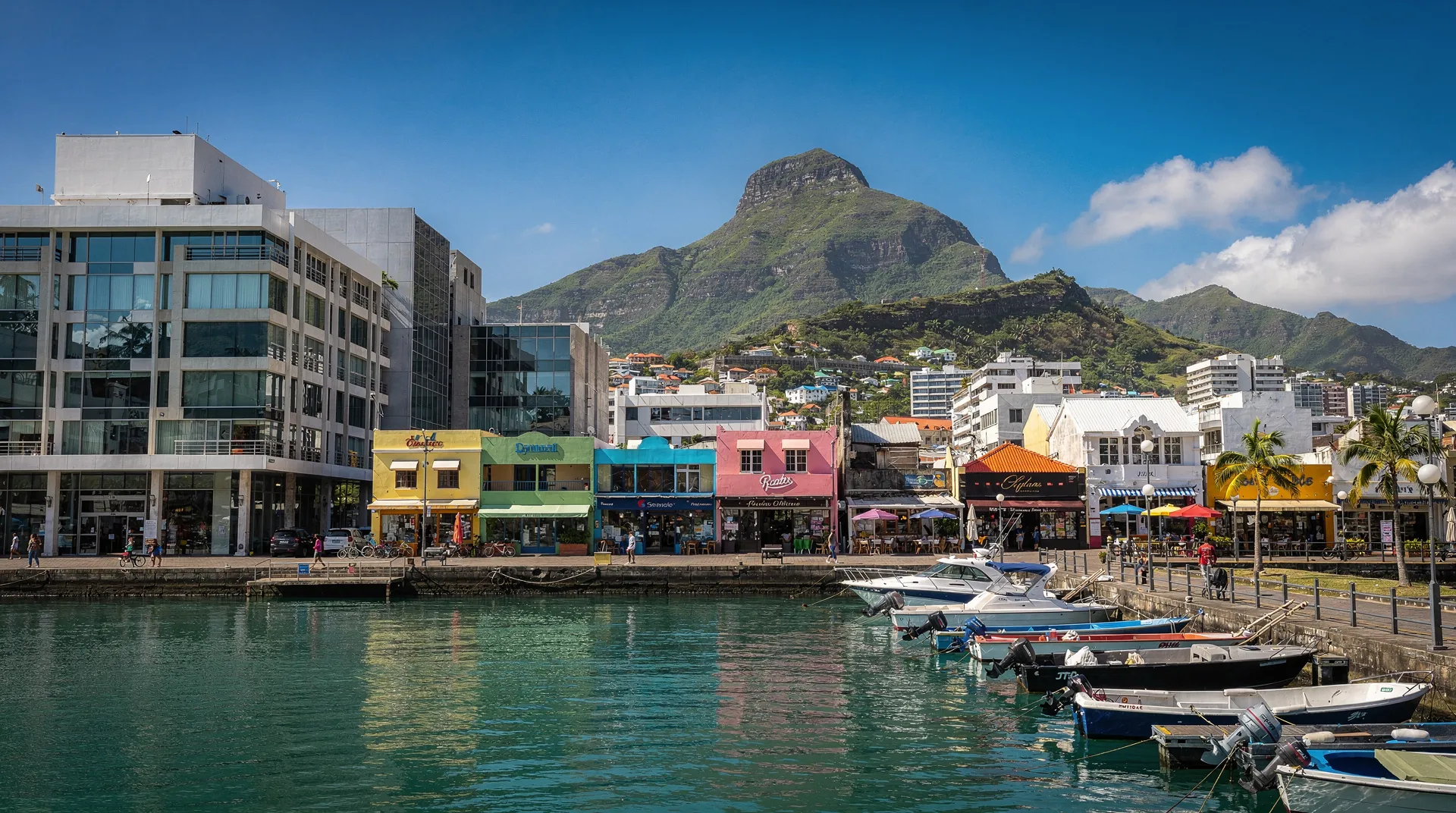
Caudan Waterfront is the commercial and tourist heart of Port Louis’s seafront. This modern complex, built on the site of 19th-century port warehouses, brings together shops, restaurants, a casino, cinemas, a bowling alley and several museums in an architecturally harmonious setting open to the harbour.
The Caudan promenade is especially pleasant in the late afternoon, once the heat has faded and locals come out to stroll after work. The view over the harbour — fishing boats and cargo ships in the inner port, with the Citadel hill as a backdrop — is particularly beautiful. Caudan is also where several ferry lines depart towards the inner harbour and industrial areas, offering a different perspective on the capital’s port life.
Chinatown: a slice of Asia in Mauritius
Port Louis’s Chinatown is one of the city’s most picturesque and authentic neighbourhoods. The Chinese community, established in Mauritius since the mid-19th century (arriving initially as traders), created a small Asian quarter defined by its temples, family-run restaurants and specialist grocery stores.
The Chinese pagoda in Port Louis is the oldest and most beautiful on the island, with curved roofs adorned with dragons and mythological creatures. It’s open to visitors outside of ceremonies.
Chinatown’s restaurants serve authentic Sino-Mauritian cuisine, quite different from the standardised “Chinese food” of tourist restaurants: stir-fried noodles with vegetables and prawns, braised pork bowls, steamed dumplings, and various duck and pork dishes adapted to local tastes over the generations. To dig deeper into the island’s food culture, our guide to Mauritian cuisine covers all the influences that make up this singular cooking style.
The museums: understanding the history of Mauritius
Port Louis is home to most of the island’s museums. The Natural History Museum, the oldest museum in Mauritius, features the reconstructed skeleton of the dodo, the island’s iconic bird, driven to extinction in the 17th century by hunting and invasive species introduced by settlers. This museum is a fascinating window onto the island’s original biodiversity and the dramatic consequences of human intervention on island ecosystems.
The Photography Museum traces the visual history of the island through thousands of 19th- and 20th-century photographs, from portraits of colonial governors to everyday scenes of Indo-Mauritian and Creole community life. It’s an exceptional historical record of the evolution from colonial society to independent nation.
Aapravasi Ghat, a UNESCO World Heritage Site since 2006, is the landing site for the first Indian indentured labourers who arrived in Mauritius from 1834, after the abolition of slavery. This site commemorates one of the largest migration movements in modern history — between 1834 and 1920, more than 500,000 Indian workers passed through this quay to work on the island’s sugarcane plantations, and their descendants now make up the largest community on the island.
Place d’Armes and the historic quarter
Place d’Armes is the historic and symbolic heart of Port Louis. This esplanade, lined with majestic rows of royal palms facing the sea, is dominated by the statue of King George V and flanked by colonial-era government buildings. Government House (the official residence of the Prime Minister), built by the French in the 18th century and later expanded by the British, is a remarkable example of tropical colonial architecture.
The area around Place d’Armes has the largest concentration of preserved historic buildings. A walk through these streets reveals architectural layers from the French and British eras stacked harmoniously on top of one another: colonnaded facades from the Napoleonic period, Victorian bow windows, and Creole verandas with wooden louvred shutters. Our guide to markets and culture in Mauritius suggests a walking route through the historic centre.
Champ de Mars: horse racing and tradition
Champ de Mars is the oldest racecourse in the Southern Hemisphere and one of the oldest in the world — races have been held here since 1812. Races take place on weekends from May to November and draw huge crowds of Mauritians passionate about this national sport. Attending a race day is a memorable cultural experience: the electric atmosphere in the stands, the lively betting, and the crowd’s passion for their horses make for a spectacle as fascinating as the races themselves.
The Company Garden
The Company Garden (also known as Sir Seewoosagur Ramgoolam Garden) is a green haven in the heart of the capital. These gardens, founded in the 18th century and beautifully maintained, offer a cool, shaded break from exploring the city. Fountains, benches under century-old ficus trees and statues of Mauritian historical figures fill this public garden, popular with locals during their lunch break.
Where to stay in Port Louis
Port Louis is mostly visited on a day trip from the coastal resorts, but it also has a few interesting accommodation options for those who want to immerse themselves in Mauritian city life. Our where to stay in Mauritius guide covers the options available in the capital.
Business and city hotels
Several business hotels are located in the city centre and around Caudan Waterfront. These properties offer comfortable rooms at rates that are often competitive compared to beach resorts, especially in the off season. They’re convenient for visitors who want to explore the city on foot or who are attending conferences.
Budget alternatives
Guesthouses and furnished apartments are available in the residential neighbourhoods around the city centre. These budget options suit independent travellers who want to use Port Louis as a base for exploring the island by bus — the La Caudan and Victoria Square terminals, from which most intercity routes depart, are both located in the centre.
Getting to Port Louis and getting around
Port Louis is connected to every part of the island by the Mauritian bus network. Most intercity routes to every destination on the island depart from Port Louis. The La Caudan terminal (north coast) and Victoria Square terminal (rest of the island) serve Grand Baie, Trou aux Biches and all destinations in the centre, east and south respectively.
By car from the airport, allow 40 to 50 minutes depending on traffic. The capital is regularly congested during rush hour (7am-9am and 4pm-7pm). Avoid arriving or leaving during these peak times. Taxis are plentiful in Port Louis but can be hard to find late in the day — use a booking app or ask your hotel to call one for you. For details on the airport transfer, see our dedicated guide.
If you’re based in the north at Grand Baie or Trou aux Biches, visiting Port Louis by bus is an excellent option — buses are frequent, cheap, and spare you the hassle of parking in town. Car hire in Mauritius isn’t recommended for exploring Port Louis itself (heavy traffic, difficult parking) but is useful for excursions into the island’s interior.
Best time to visit
Port Louis can be visited year-round, but the months from May to November are the most pleasant climate-wise. Avoid January to March, when the combination of heat, humidity and the city’s topography — hemmed in by mountains that block the breeze — makes exploring on foot exhausting, especially during rush hour. The city is especially lively during Hindu religious festivals (Diwali, Maha Shivaratri), Chinese New Year, and Creole festivals — exceptional occasions to see the cultural diversity of Mauritius in full expression.
Our weather in Mauritius guide gives you detailed monthly climate forecasts, and our best time to visit Mauritius guide will help you plan your trip based on your priorities.
Day trips from Port Louis
The capital is the island’s central hub, from which every destination is reachable by bus. Thirty minutes north by bus, Grand Baie with its beaches, restaurants and nightlife is ideal for a day trip or an extended stay. Fifteen minutes from the city by road, the Pamplemousses Botanical Garden is one of the oldest and most beautiful botanical gardens in the world — its giant Victoria amazonica water lilies and avenues of royal palms make it a must-see.
You can book a street food tour of the Port Louis market with a French-speaking guide to discover the flavours of the capital alongside a local expert.
Our 7-day Mauritius itinerary includes Port Louis in an optimised northwest circuit, and the family itinerary offers child-friendly visits from the capital. For a road trip around the island by car, Port Louis is the natural starting point for heading out to every coast.
If you’d like to explore the north of the island on an organised excursion from the capital, a north Mauritius excursion with street food tasting covers Pamplemousses, Cap Malheureux and the region’s landmark sites.
To explore Port Louis in depth with a specialist in urban art and local food, the Port Louis food & street art tour is an original, immersive experience. Finally, for a complete guided tour of the capital, the guided Port Louis tour covers all the historic quarters in half a day.
Practical tips
Visit the Central Market on a weekday, ideally Tuesday or Wednesday morning, to avoid the crowds from organised tour groups. Tuesday morning between 8am and 11am offers the best atmosphere, and vendors are more available to chat and explain their products.
The city is easy to explore on foot within the historic centre — Place d’Armes, Central Market, Chinatown, Caudan Waterfront — an area of about 2 square kilometres. Taxis and motorised rickshaws are available for longer trips. To stay connected while exploring, our internet and eSIM in Mauritius guide explains how to get a local data plan.
Safety: Port Louis is generally safe for tourists who stick to busy areas during the day. As in any big city, avoid displaying valuables and stay alert in crowded areas such as the market. In the evening, stick to the well-lit, busy areas of Caudan Waterfront.
Port Louis and Mauritian multiculturalism
Port Louis is the living laboratory of Mauritian multiculturalism. Within a few hundred metres, you can witness a Hindu ceremony in a temple decorated with thousands of colourful statuettes, step into a plain, elegant mosque, pass a baroque Catholic cathedral, then stop in front of a small Creole altar covered in offerings. This coexistence of religions and cultures, which may seem surprising to European visitors used to more homogeneous societies, feels perfectly natural to Mauritians, who grew up surrounded by this diversity.
The major religious festivals turn Port Louis into a remarkable spectacle. Chinese New Year (January-February) fills Chinatown with dragon dances, firecrackers and lanterns. Diwali (October-November) lights up the whole city with oil lamps. Maha Shivaratri (February-March) sees tens of thousands of Hindu pilgrims cross the island to reach the sacred lake of Grand Bassin in Savanne. Our guide to Grand Bassin and Ganga Talao explains this fascinating pilgrimage, one of the island’s most impressive religious events.
The architecture of Port Louis: a history book in stone
Port Louis is an open-air museum of architecture that traces three centuries of colonisation. French 18th-century architecture — grey stone buildings with steep roofs designed to withstand cyclones — can be seen in several buildings around Place d’Armes. British Victorian architecture of the 19th century added bow windows, cast-iron pillars and brick facades imported from England on top of this original fabric.
Tropical Creole architecture, developed locally to suit the climate, is recognisable by its large covered verandas, wooden louvred shutters that filter light while allowing ventilation, and shaded inner courtyards. A few outstanding examples of this architecture survive in the residential neighbourhoods of the city centre, preserved by their owners or converted into offices and restaurants.
Caudan Waterfront and the modern buildings of the business district represent the contemporary layer of this architectural stack. The overall effect has an improbable harmony to it — the city has managed to embrace modernity without entirely destroying its heritage.
Transport from Port Louis to the rest of the island
Port Louis is the public transport hub of Mauritius. From the two bus terminals — La Caudan for the north coast and Victoria Square for the rest of the island — buses depart every 15 to 30 minutes to every major destination. It’s from Port Louis that you catch a bus for Grand Baie, Flic en Flac, Mahébourg or Curepipe.
This central position makes Port Louis an excellent connection point for travellers exploring the island by public bus without a rental car. Our bus guide to Mauritius gives you all the details on routes, timetables and fares to plan your trips from the capital. For more flexible journeys, taxis from Port Louis are available at any hour from the bus terminals and Caudan Waterfront.
Port Louis and cyclones: a city that knows how to prepare
Port Louis is built in a natural basin surrounded by mountains, which gives it a particular microclimate but also a specific vulnerability to cyclones. The city has weathered several devastating cyclones throughout its history, including the terrible Cyclone Carol in 1960, which killed 42 people and destroyed a large part of the island’s housing. These dramatic events forged a highly developed cyclone-preparedness culture in Mauritius.
Today, the island’s cyclone prevention and warning systems are among the most effective in the Indian Ocean. Numbered alerts (from 1 to 4) allow the population to organise well in advance. If you’re visiting Mauritius during cyclone season (December to March), find out about the alert procedure and the guidelines to follow — your hotel will be your best source of information in the event of a warning.
The alternative markets of Port Louis
Beyond the Central Market, Port Louis is home to other markets and shopping areas worth knowing about. Curepipe market, 20 kilometres south of the capital towards the central plateau, is an excellent complement for buying textiles and handicrafts. Our guide to markets and culture in Mauritius covers all the island’s markets, along with their specialities and opening days.
The shopping area around Sir William Newton Street, in the historic centre, is home to Indian merchants specialising in fabrics, spices and haberdashery — a very different commercial experience from the tourist boutiques of Caudan. For gold jewellery (the traditional Indo-Mauritian trade par excellence), China Town Street has several reputable jewellers where prices are competitive compared to airport shops.
Port Louis practical info: what to know before you come
Port Louis is an office city that empties and fills up during rush hour. Avoid entering or leaving the city between 7:30am and 9am in the morning and between 4pm and 6:30pm in the evening — traffic jams can be nightmarish. At lunchtime (noon-2pm), the city buzzes around restaurants and shopping streets, with a relaxed, cosmopolitan atmosphere.
Public toilets are rare in the city centre. Restaurants, cafes and department stores are your best bet. ATMs are plentiful in the centre, especially around Caudan and Place d’Armes. Midday heat can be exhausting from December to March — bring water, sun protection, and plan a visit to air-conditioned sites (museums, shopping centres) during the hottest hours. Check our Mauritius budget guide for food and transport costs in town.
The Citadel (Fort Adelaide)
Overlooking the city from a hill south of the centre, the Citadel, also known as Fort Adelaide, offers one of the best views over Port Louis, its harbour and the surrounding mountains. Built by the British in the 19th century to guard against possible uprisings rather than to repel an invasion, it’s free to visit and can be reached on foot from the city centre in about a fifteen-minute climb, or by taxi to avoid the heat. Sunset from the ramparts, as the city lights up gradually below, is one of the most photogenic moments in the capital.
Port Louis is clearly worth the detour, even for just a day: it’s the best way to understand multicultural Mauritius beyond the beaches. An overnight stay is only really useful for business travellers or those relying on buses; for everyone else, a day trip from the north is more than enough.
Frequently asked questions about Port Louis
Should you spend a night in Port Louis, or is a day trip enough? A day trip is enough to see the main sights. Port Louis doesn’t offer much for visitors at night — the northern beaches are far more pleasant for evenings. Staying in Port Louis is only recommended for business travellers or those exploring the island by public transport.
Can you eat cheaply in Port Louis? Absolutely. The restaurants of Chinatown, the street food vendors around the central market, and the snack bars of Caudan all serve excellent meals for a few hundred rupees. It’s the cheapest place on the island to eat well.
Is the Port Louis central market worth it compared to the Grand Baie market? Yes, without a doubt. Port Louis’s market is much bigger, more authentic and less touristy than those at the beach resorts. It’s a genuine Mauritian city market, not a market aimed at tourists.
Are there ATMs in Port Louis? Plenty of ATMs are available throughout the city centre, especially around Caudan Waterfront and Victoria Square. Most major international banks have branches in town.
How much time should you allow to visit the Citadel and the historic centre? Allow around two hours for the climb up to the Citadel, exploring the ramparts, and the walk back down to Place d’Armes. It combines easily with a morning at the Central Market to make a full day of visiting the capital.
Is Port Louis suitable for a family visit with young children? Yes, for a well-organised half-day: the Natural History Museum and its dodo generally appeal to children, as does the colourful bustle of the market. That said, the heat, traffic and lack of a beach make it better suited to a short stop than a family base for several days; our family activities guide to Mauritius offers a programme better suited to children over several days.