
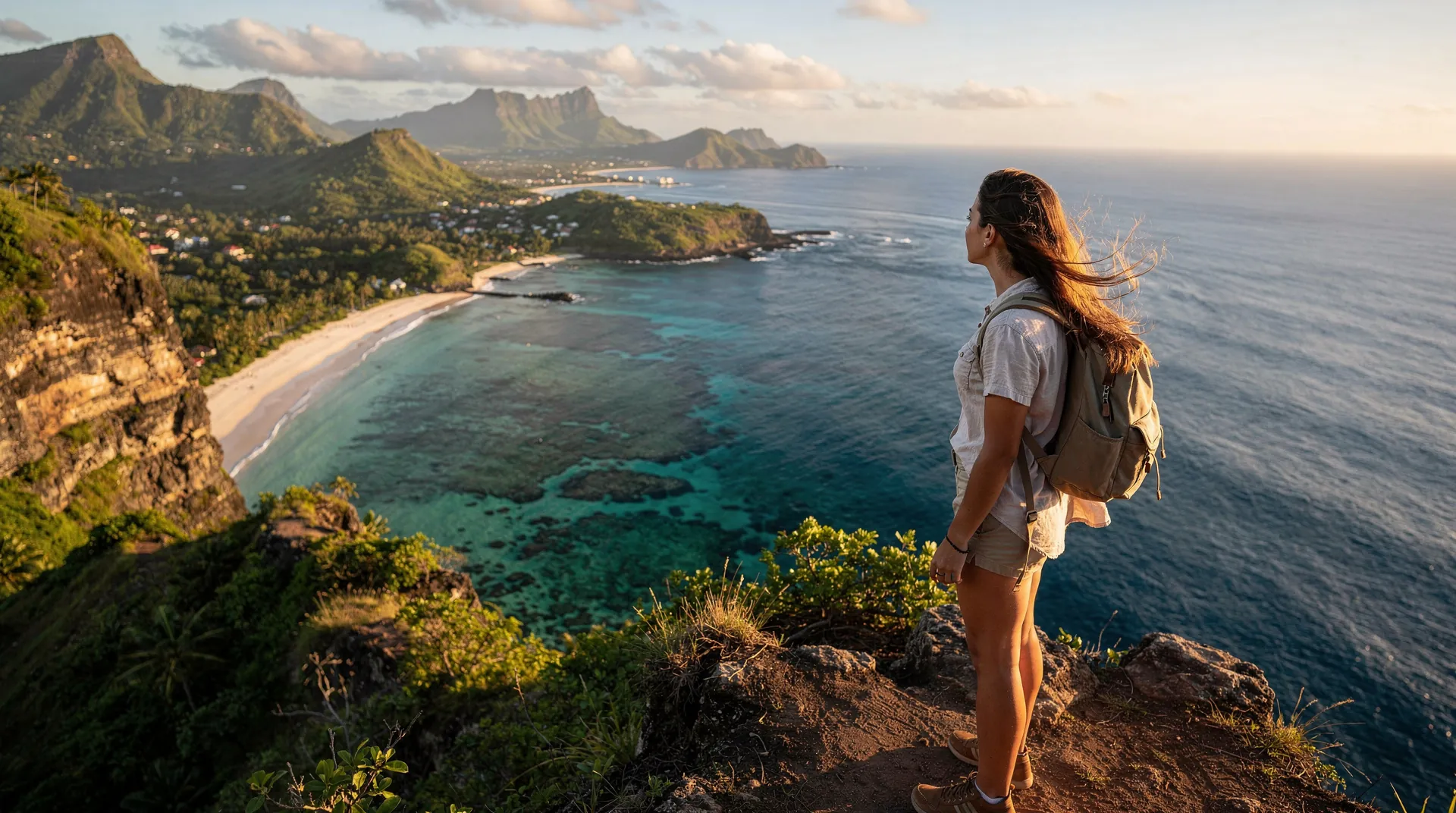
7-Day Mauritius Itinerary: The Classic, Unforgettable Week
Updated: August 2026
7 Days in Mauritius: The First-Visit Itinerary
A week in Mauritius is the ideal length for a first visit. Not too short to leave you wanting more, not too long to run out of ideas, a week lets you cover all four corners of the island, taste the diversity of its landscapes, and understand why Mauritius fascinates its visitors so much.
This 7-day itinerary is designed for travelers discovering the island for the first time. It combines the absolute must-sees — the iconic beaches, the emblematic natural sites, the lively capital — with genuine moments of relaxation and a few less touristy experiences to go beyond the postcard. Before you leave, read our guide to a first trip to Mauritius to prepare every detail of your stay.
Renting a car is the best travel companion for this itinerary. The island is 65 km from north to south and 48 km from east to west, which is very manageable. With a car, you’re free to leave whenever suits you and stop wherever you like. Check our Mauritius road trip guide for practical tips on driving on the left and navigating the island.
At a Glance
| Duration | 7 days, 6-7 nights on the ground |
| Recommended base | North (single base) or north + southwest/west (two bases) |
| Estimated budget (2 people, excluding flights) | Around 1,330 to 2,290 euros |
| Car needed | Yes, strongly recommended |
| Best time to go | May to December, avoiding the January-February lull |
| Pace | Balanced: one major area per day, with 1 freer day |
Is 7 Days Enough for a First Visit?
For a first trip, seven days is the most commonly recommended length: long enough to cover the north, south, east and capital without rushing, short enough to remain affordable. If you can stay longer, the 10-day itinerary adds half-days of rest and lets you explore more of the island’s interior and its nature parks.
If your time is limited, our 5-day itinerary condenses this same program into a shorter version. Couples looking for a more active trip can also check our couple’s itinerary, which follows a similar path but pushes further east.
Where to Stay for This Itinerary
For a week, two strategies work well. Our guide to where to stay in Mauritius covers all the areas and their advantages.
Single base: Choose accommodation in the north (Grand Baie, Trou aux Biches, Mont Choisy) and base yourself there for the whole trip. It’s the most convenient option, with no stress from switching hotels. All the sites are within 1h30. Check our selection of best hotels in Mauritius to find the one that fits your budget.
Two bases: Spend the first 4 days in the north, then move to the southwest (Le Morne, Bel Ombre) or the west coast (Flic en Flac) for the last 3. More varied, but requires more organization and packing/unpacking.
For a first visit, a single base in the north is generally recommended.
Day 1: Arrival and Discovering the North
Morning — Settling In and Transfer
Arrival in Mauritius, whatever time your flight lands, deserves a smooth start. If you’ve arranged your airport transfer in advance, a driver will be waiting in the arrivals hall with your name on a sign — a real help after 11 hours of flying.
You can book your private airport-hotel transfer in Mauritius directly online for a stress-free arrival. Settle into your accommodation, get to know your neighborhood on foot, and take a dip in the pool or the sea depending on where you’re staying.
Afternoon — Trou aux Biches Beach
Trou aux Biches beach, ranked among the finest in the Indian Ocean, is just minutes from the center of Grand Baie. Its shallow lagoon and emerald waters give you a fitting welcome. The seabed is accessible even to children, and the fine sand is some of the best in the north of the island. It’s the perfect spot for an introductory snorkel — check our snorkeling and diving guide to find out what you might spot.
Evening — Grand Baie
Grand Baie is the main tourist hub of the Mauritian north. Its main street (Royal Road) is lined with restaurants of every cuisine, shops and a relaxed atmosphere. Start your culinary discovery with a Creole dinner: rougaille, curry, dholl puri, or grilled fresh fish. To find out more about what you’ll be eating this week, our guide to Mauritian cuisine introduces all the must-try dishes.
Day 2: The North of the Island — Cap Malheureux and Pamplemousses
Morning — Cap Malheureux and the Northern Islands
Cap Malheureux is the northernmost point of the island. The red-roofed Notre-Dame Auxiliatrice church, with its view over Coin de Mire, Flat Island and Gabriel Island, is one of the most photographed images of Mauritius. Arrive early (before 9am) for the morning light and to avoid the crowds.
Continue on to Grand Gaube and Roches Noires to discover the still relatively untouristed northeast coast, with its wild beaches and colorful fishermen’s houses. These authentic villages offer a welcome contrast to the buzz of Grand Baie.
Afternoon — Pamplemousses Garden
The Sir Seewoosagur Ramgoolam Botanical Garden (Pamplemousses) is one of the oldest tropical gardens in the world. Founded in the 18th century, it holds collections of giant Victoria amazonica water lilies (whose leaves can support the weight of a child), rare palms, spice trees and an avenue of century-old royal palms.
Allow 2 hours for the visit. Hire a local guide on site (negotiate the price at the entrance) for insight into the flora and the garden’s history — it makes for a much richer visit. Pamplemousses Garden is also a great stop on a family trip.
Evening — Back to Grand Baie
Browse the craft market in Grand Baie in the evening, then dine at one of the seaside restaurants. Mauritius’s markets are a fascinating immersion into local life — colors, smells, all kinds of goods. Our guide to markets and culture introduces the island’s best markets.
Day 3: Port-Louis, the Creole Capital
Morning — The Central Market and Old Town
Port-Louis deserves a full day. Leave early to arrive when the central market opens (from 6-7am). It’s one of the liveliest covered markets in the Indian Ocean: loose spices, exotic vegetables, fish landed that same morning, herbal teas and medicinal plants, crafts. The tropical fruit stalls — mangoes, lychees, longans, jackfruit — are a spectacle in themselves.
Then explore the historic quarter on foot: Place d’Armes with its century-old royal palms and the statue of Mahé de Labourdonnais, Fort Adelaide watching over the city from the heights, and Chinatown with its dim sum restaurants and temples. The religious and cultural diversity of Port-Louis is striking — Hindu temples, mosques, a Catholic cathedral and Chinese pagodas coexist just streets apart.
Lunch — Port-Louis’s Chinatown
Port-Louis’s Chinatown is one of the most authentic in the Indian Ocean. Have lunch at one of the family-run restaurants serving noodles, mine frites, wonton soup or bao (steamed filled buns). Prices are very reasonable — a full meal for 200-300 rupees (4-6 euros).
Afternoon — Caudan Waterfront and Museum
The Caudan Waterfront is the modern shopping and cultural hub of Port-Louis, attractively built along the harbor. The Photography Museum and the Natural History Museum are worth a detour. The shops selling spiced rum, model boats and Mauritian textiles are ideal for shopping. The Blue Penny Museum displays the world’s two most valuable postage stamps: the Blue Penny and the One Penny Orange from 1847.
If time allows, walk up (or take a taxi) to Fort Adelaide for a panoramic view over the capital, the harbor and the sea.
Day 4: The Southwest — Chamarel and Le Morne
Morning — The Seven Coloured Earths
Head out early towards Chamarel in the southwest. The Seven Coloured Earths is one of the most famous natural sites in Mauritius. These dunes of volcanic ash in striking shades (red, purple, brown, green…) have the unusual property of never blending, despite rain and wind. The scientific mystery adds to the site’s appeal.
Our complete guide to Chamarel explains everything about this unique geological phenomenon. To visit Chamarel without a car, you can book a tour of Chamarel with the waterfall and coloured earths from your hotel.
The complex also includes the Chamarel coffee plantation, the Chamarel waterfall (a 100-meter drop framed by primary forest) and a giant Aldabra tortoise enclosure. Allow 2 to 3 hours on site. If you’re a nature and hiking enthusiast, check our Mauritius hiking guide for walking trails in the area.
Lunch — Panoramic Views in Chamarel
La Rhumerie de Chamarel or La Table de Chamarel offer gourmet menus with a breathtaking view over the southwest coast and the ocean. For a tighter budget, the small snack stalls in Chamarel village serve delicious home-style food at very reasonable prices.
Afternoon — Le Morne Brabant
The Le Morne Brabant peninsula has been a UNESCO World Heritage site since 2008. It’s one of the symbols of freedom in Mauritius: this is where maroon slaves took refuge in the mountain’s caves to escape their owners. The tragedy of their final day — when, not realizing abolition had been declared, they leapt to their deaths rather than surrender — is commemorated every year on February 1st.
Le Morne’s beach is magnificent, sheltered by the mountain. It’s also the world-famous kitesurfing spot, thanks to the steady, reliable trade winds. The lagoon here is a deep blue, dotted with the shadows kitesurfers trace in their wake.
Day 5: The West Coast — Diving and Flic en Flac
Morning — Snorkeling or Diving at Flic en Flac
The west coast is known for the quality of its diving waters. Flic en Flac is home to remarkable marine life just meters from shore: moray eels, octopus, lionfish, sea turtles. Numerous dive centers offer introductory dives and outings for experienced divers at very accessible prices (60-90 euros for a two-dive trip). All the details on the best snorkeling and diving trips are in our dedicated guide.
If you don’t dive, snorkeling along the reef edge is enough to observe dozens of tropical fish species. Rent a mask and snorkel on the beach for an experience accessible to everyone.
Afternoon — Flic en Flac and Tamarin
Flic en Flac is a long, straight beach with calm, clear water. Late afternoon, as the sun dips over the sea, brings some of the island’s most spectacular sunsets.
Continue on to Tamarin, a surf and fishing village, to spot the dolphins that regularly visit the bay in the morning. If you want to experience swimming with dolphins, plan a morning outing from Tamarin — it’s one of the most memorable experiences Mauritius has to offer.
Evening — Fresh Fish Dinner
The restaurants in Flic en Flac serve excellent fish caught that same day. Capitaine, vieille (parrotfish) and Creole-style tuna are the specialties not to miss. Book a terrace table to enjoy the last light of the sunset over the sea.
Day 6: The East Coast — Ile aux Cerfs and Mahebourg
Morning — Ile aux Cerfs
The east coast is less developed than the north or west, and wilder. Trou d’Eau Douce is the departure village for Ile aux Cerfs, a 10-minute boat ride away. Arrive before 9am to enjoy the beaches before the crowds arrive.
Ile aux Cerfs is Mauritius’s living postcard: dazzling white sand, clear turquoise water, leaning coconut palms. You can book a catamaran excursion to Ile aux Cerfs with lunch included to reach the island in comfort and enjoy a fish barbecue on site.
Spend the morning swimming, snorkeling or simply admiring the scenery. The island has several beaches with different moods — explore them all. A range of water activities is available on site: waterskiing, paddleboarding, banana boat rides.
Afternoon — Mahebourg and the Museum
Mahebourg is an authentic port town in the southeast. Its Mauritius History Museum is one of the island’s most interesting. Its collections trace the history of Mauritius from the first Arab and Portuguese navigators through to independence in 1968, covering French and British colonization along the way.
The waterfront in Mahebourg, with its fish restaurants and market, is worth a stroll. If it’s a Monday, you’ll get to experience the weekly market, one of the most authentic on the island — a kaleidoscope of colors, smells and local life.
Evening — Blue Bay
Blue Bay beach, ranked among the finest in the Indian Ocean, is 20 minutes from Mahebourg. Its marine park protects an outstanding coral reef — the underwater biodiversity here is among the richest on the island. One last evening swim in its deep blue waters makes for an unforgettable memory. Snorkeling at Blue Bay directly from the beach (no boat needed) is possible with just a mask and snorkel.
Day 7: Final Day — Freedom and Farewell
Morning — Whatever You Feel Like
The last day is intentionally left free so you can revisit your favorite spots. Maybe that beach you glimpsed from the road and promised yourself you’d come back to. Maybe a hike you didn’t get time for. Maybe just a hammock strung between two coconut palms.
A few suggestions if you’re short on ideas:
Catamaran excursion to the northern islands: A catamaran trip from Grand Baie to Ile Plate and Ile Gabriel. These two small, uninhabited islands are surrounded by pristine coral reefs teeming with marine life. A grilled fish barbecue on the beach is included in most trips. Ideal if you haven’t yet had this experience out at sea.
Swimming with dolphins at Tamarin: If you haven’t done this iconic excursion yet, now’s the time. Pods of spinner dolphins regularly visit Tamarin bay in the morning — an unforgettable wild encounter. Book your spot to swim with dolphins at Tamarin in advance to secure your outing.
Shopping in Port-Louis: If you haven’t picked up souvenirs yet, one last visit to the Caudan Waterfront or the central market in Port-Louis. Spices, spiced rum, vanilla, model boats — Mauritian crafts are of very good quality.
Morning hike: Lion Mountain, above Mahebourg, offers a panoramic view over the southeast coast and lagoon from the summit. Allow 3-4 hours round trip for hiking enthusiasts.
Evening — One Last Sunset
Whatever time your flight leaves, treat yourself to one last Mauritian sunset. On the west coast, from Flic en Flac or Le Morne, the show is guaranteed. On the north coast, from Trou aux Biches beach or Cap Malheureux, the evening light turns everything to gold.
Overview: The 7 Days at a Glance
| Day | Area | Highlights |
|---|---|---|
| 1 | North | Arrival, Trou aux Biches beach, evening in Grand Baie |
| 2 | North | Cap Malheureux, Pamplemousses Garden |
| 3 | Capital | Port-Louis: central market, Caudan Waterfront, Blue Penny Museum |
| 4 | Southwest | Chamarel, Le Morne Brabant |
| 5 | West | Diving/snorkeling at Flic en Flac, Tamarin |
| 6 | East / southeast | Ile aux Cerfs, Mahebourg, Blue Bay |
| 7 | Free / departure | Revisiting your favorites, one last sunset |
Estimated Budget for 7 Days
For two people in the “moderate” category (3-4 star hotel, varied restaurants, car rental):
- Accommodation: 70-120 euros/night, so 490-840 euros
- Car rental: 35-45 euros/day, so 245-315 euros
- Meals (lunch + dinner): 35-65 euros/day for two, so 245-455 euros
- Activities (Ile aux Cerfs, catamaran, diving, admissions): 200-400 euros
- Fuel: 50-80 euros
- Miscellaneous: 100-200 euros
- Total estimate: 1,330 to 2,290 euros for two, excluding flights
For a tighter or more luxurious budget, our Mauritius budget guide breaks down all the ways to save or upgrade.
Tips for a Successful Week
Weather flexibility: The weather in Mauritius can be unpredictable, especially from November to April. If your planned beach day turns out rainy, switch to a cultural visit in Port-Louis or to a museum and push the beach day back. The west coast is often sunny even when it’s raining on the east coast.
Early mornings: Most sites are more pleasant before 10am. Get up early, use the cool hours for sightseeing, and save the middle of the day for the beach or a nap.
Avoiding traffic jams: The motorway ring around Port-Louis gets congested during rush hour (7-9am and 4-6pm). Plan your travel accordingly. Our road trip guide gives you tips for avoiding busy routes.
Dress code: Hindu temples, mosques and some fine dining restaurants require modest dress. Pack a sarong or shawl in your bag.
If this week has made you want to come back, check out our 10-day itinerary for a deeper exploration of the island, or our honeymoon itinerary for a romantic getaway for two.