
Markets and Culture in Mauritius: Port Louis, Flacq, Temples and Museums
Updated: August 2026
When is the Flacq market held in Mauritius?
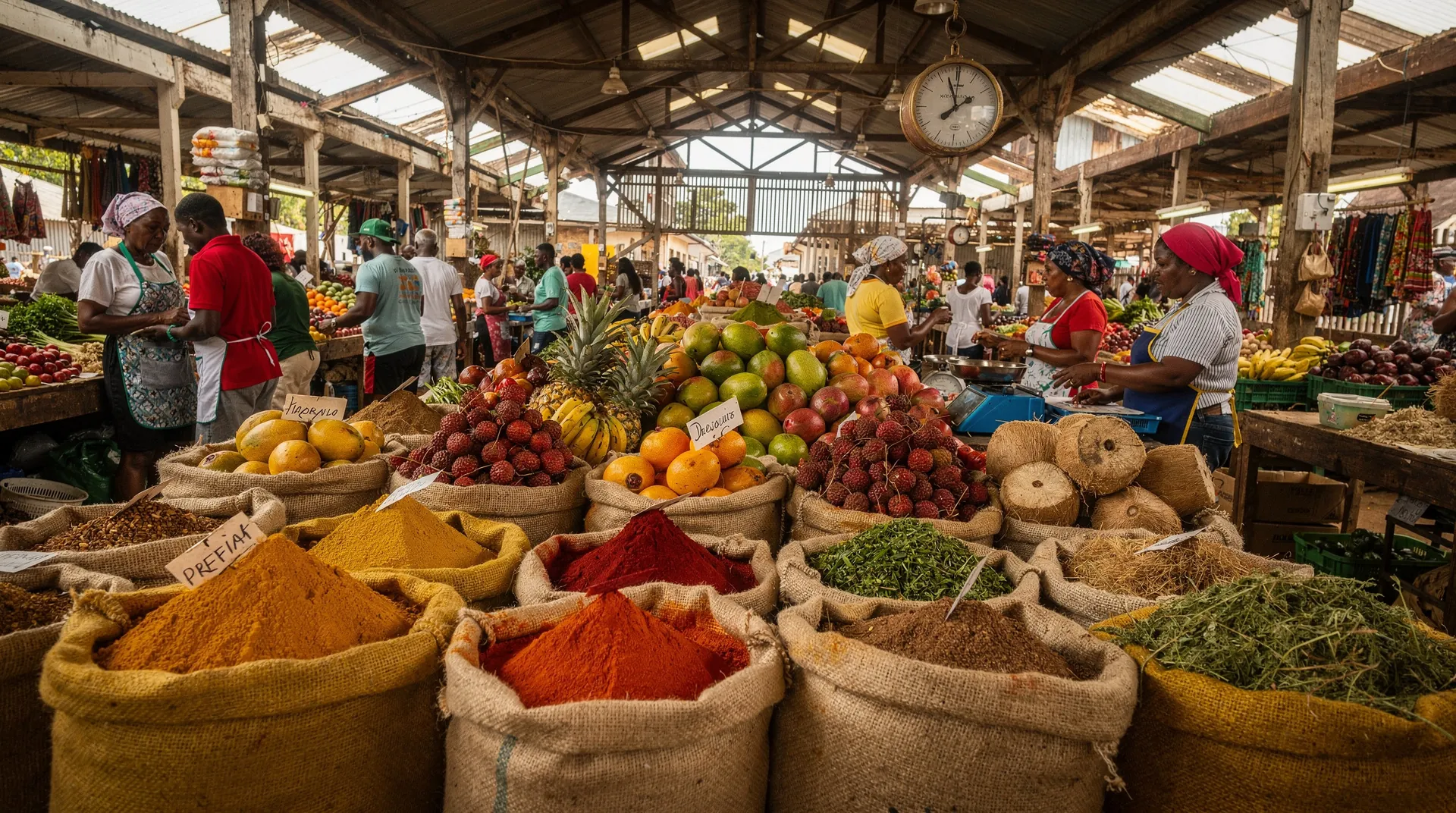
The Flacq market is held on Sunday morning. It's the largest open-air market in Mauritius, ideal for buying spices, exotic fruit and crafts at local prices.
Mauritian culture: a mosaic of civilisations
Mauritius is often cited as one of the world’s most successful examples of multicultural coexistence. In barely 350 years of human history — the island was uninhabited before the 17th century — Africans, north and south Indians, Chinese and Europeans blended their cultures, religions, cuisines and languages to create a uniquely composite and fascinating Mauritian civilisation.
Discovering this cultural richness means going well beyond the beaches and luxury hotels: wandering through colourful markets overflowing with tropical fruit and heady spices, visiting temples and mosques with spectacular architecture, tasting the culinary specialities of different communities, and exploring the colonial houses that tell the island’s complex story since colonisation. It’s a dimension of a trip to Mauritius that many tourists overlook — and one they often regret not exploring once they’re back home.
To organise your cultural exploration, a car is the most practical option, especially if you want to visit several sites in one day. Our guide to car rental in Mauritius can help. Alternatively, Port Louis is accessible by bus or taxi from most tourist areas, and local taxi drivers can organise tailor-made cultural excursions — see our guide to taxis in Mauritius.
| At a glance | |
|---|---|
| Where | Port Louis, Flacq (east coast), Mahébourg (southeast) |
| Price | free entry to the markets, a few hundred rupees for colonial houses and museums |
| Time needed | 1h30 to 2h per market, half a day to combine a market with a nearby site |
| Getting there | a car is recommended, bus possible to Port Louis and Flacq |
| Best time | year-round; early morning for authenticity and cooler temperatures |
Comparing the three main markets
| Market | Day | Hours | Atmosphere |
|---|---|---|---|
| Port Louis | Monday to Saturday (Sunday morning) | 6:30am-6pm (noon on Sunday) | The most touristy, very comprehensive |
| Flacq | Sunday | 8am-1pm | The largest open-air market, very authentic |
| Mahébourg | Monday | 8am-noon | The most intimate and local |
Port Louis central market
The Victorian market hall
The Port Louis Central Market is the commercial, culinary and cultural heart of the Mauritian capital. This covered market, built in Victorian style in the late 19th century and fully renovated in the 2000s while retaining its original architecture, spans several levels and themed sections. It’s the liveliest, most colourful and most authentically Mauritian spot in Port Louis, and probably the most interesting market to visit on the whole island.
Hours: Monday to Saturday, 6:30am to 6pm. Sunday, 6:30am to noon. Arrive early in the morning (before 8am) for the best choice, the lowest prices and the most authentic atmosphere — vendors set up at dawn and things are in full swing by 7am.
What you’ll find
Lower level — Food and spices: Stalls overflow with an impressively fresh and varied range of tropical fruit and vegetables. Mangoes (from May to November, in different varieties), lychees, longans, jackfruit, passion fruit, rambutans, loquats, Mauritian pomelos (different from European grapefruit), star fruit… Spices also take centre stage, filling the air: Mauritian saffron (freshly dried local turmeric), green and black cardamom, cinnamon sticks, fresh green peppercorns still on the stem, fresh ginger, chillies of every heat level, and homemade curry powder prepared by vendors following century-old family recipes.
Craft level: Wooden model ships (a Mauritian speciality — some craftsmen still work using traditional methods on models of historic ships such as the Cutty Sark or the Bounty), embroidered tablecloths, woven raffia items, mother-of-pearl and coral jewellery, and local ebony-wood carvings.
Beware of fakes: Genuine handmade Mauritian model ships take weeks to make — a small quality model (30-50 cm) costs between 8,000 and 25,000 rupees. Cheap models (under 2,000 rupees) are generally mass-produced in factories. Ask to see the craftsman at work if possible.
Textile level: Brightly coloured saris imported from India (mainly Gujarat and Rajasthan), traditional Creole clothing, colourful fabrics, and light cottons suited to the tropical climate.
Practical tips: Bargaining is welcome and expected for crafts, but not for food, which has fixed, displayed prices. Bring rupees in small notes. Stay alert to your belongings in the busiest areas — our safety guide to Mauritius covers the basic precautions.
The Flacq market (east coast)
The island’s largest open-air market
The Flacq Market, held every Sunday morning from 8am to 1pm in the town of Centre de Flacq on the east coast, is regarded by connoisseurs as the largest and most authentic open-air market in Mauritius. It’s a hugely popular weekly event for residents of the entire east coast — whole families spend the morning there, and it’s as much a social ritual as a market.
Unlike the Port Louis market, which now draws a significant share of tourists, Flacq market remains very much off the tourist trail and very authentic. Here you’ll see real, everyday Mauritius, not a version staged for visitors. Prices are often lower than in Port Louis.
What you’ll find at Flacq:
- Fruit and vegetables at the island’s lowest prices — buy for cooking if you have accommodation with a kitchen
- Second-hand and new clothing at very low prices
- Loose spices sold by weight
- Traditional medicinal plants and home remedies
- Household items, crockery, tools
- Plenty of local street food — dholl puri, rotis, fried samosas, briyani in bags, curry buns
How to get there: By bus from Port Louis (about 1h30), by taxi, or by car from Belle Mare (20 minutes). The market is in central Flacq, easy to find and unmissable on Sunday mornings thanks to the surrounding bustle.
Mahébourg market
The Mahébourg Market is held every Monday morning on the seafront of this historic southeastern town, between 8am and noon. It’s a smaller, more relaxed market than those of Port Louis or Flacq — very local, and a perfect reflection of the calm atmosphere of a provincial Mauritian town.
Next to the market, the Mahébourg Historical Museum occupies a magnificent 19th-century colonial house surrounded by a tropical garden. The museum tells the story of the 1810 Battle of Grand Port — the only French naval victory over the British during the Napoleonic era, still inscribed today on the Arc de Triomphe in Paris among the Empire’s great victories. The collection includes weapons, historic maps, personal effects belonging to officers from both sides, and model ships from the period. Free entry.
The Mahébourg region is also the departure point for boat trips to Île aux Cerfs, and it lies close to the Blue Bay marine park — a day combining the market in the morning and snorkelling in the afternoon is entirely doable.
Port Louis: architecture and history
The waterfront and the harbour
The Caudan Waterfront in Port Louis is the redeveloped commercial and cultural hub built around the capital’s historic harbour. Luxury shops, restaurants of every kind, a multiplex cinema, and a casino housed in a historic building. On the seafront, the view over the working harbour and the mountains surrounding the capital (Signal Mountain, Le Pouce, Pieter Both in the distance) is stunning. Best visited in the late afternoon, once the day’s heat has faded and the harbour comes alive.
Place d’Armes
The main thoroughfare of Port Louis, Place d’Armes (formerly called Champs de Mars by the French), runs from the Waterfront up to Government House, passing the colonial government buildings. The large filao trees lining the avenue provide welcome shade. The equestrian statue of King Edward VII at the centre of the square is one of the capital’s landmarks.
Champ de Mars and horse racing
The Champ de Mars is the oldest racecourse in the southern hemisphere (founded in 1812 by the British on the former French parade ground). Horse races are held on Saturdays from April to November — a Mauritian social institution worth experiencing at least once. The atmosphere is festive and unique: betting is brisk at the stands, and Mauritian families of every background come together in a mix of elegance and popular passion.
Entry to the general stands is free (payment required for reserved stands). Bets are placed with official bookmakers (the Mauritius Turf Club). It’s an authentic cultural experience that reveals an unexpected side of Mauritian society.
Temples, mosques and places of worship
The Church at Cap Malheureux
Notre-Dame Auxiliatrice Church in Cap Malheureux, with its red-tiled roof and white facade facing the northern lagoon, with Coin de Mire and Plate islands in the background, is the most photographed spot on the whole island. Built in 1938, it has become a symbol of Mauritius, found on every postcard and in every travel guide. The site is also historically significant: it was here that the British landed in November 1810 to seize Mauritius from the French after the Battle of Grand Port.
The Hindu temples of Port Louis
Port Louis has several remarkable Hindu temples that reflect the central place of the Hindu community in Mauritian society (around 48% of the population).
The Shiva-Vishnu-Lakshmi temple complex in Port Louis’s Chinatown is one of the most important and active. The Shivala Cave, carved directly into the basalt rock at La Citadelle, is a surprising cave shrine that few tourists know about.
For a deep immersion in Mauritian Hindu spirituality, visit Grand Bassin (Ganga Talao), the sacred crater lake in the highlands of the Savanne region. This volcanic crater lake is considered a branch of the sacred Ganges in India. It’s the destination of the Maha Shivaratri pilgrimage (usually in February-March), when hundreds of thousands of pilgrims walk for several days from their villages, carrying kavadis — bamboo frames decorated with flowers and peacock feathers.
The Jummah Mosque of Port Louis
The Jummah Mosque (1852), in the historic Muslim quarter of Port Louis, is one of the most important mosques in the entire Indian Ocean. Its immaculate white facade with green domes, flanked by slender minaret towers, is an iconic feature of the Port Louis skyline. It’s open to non-Muslim visitors outside Friday prayer times and the five daily prayers, with modest dress required (shoulders and knees covered for both women and men).
The Muslim community in Mauritius makes up around 17% of the population and is mainly of Indian origin (descendants of indentured labourers from the Gujarat region and merchants from the Indian subcontinent).
The Tamil temples
The Mauritian Tamil community (of south Indian origin, mostly from Tamil Nadu) has built temples (kovils) recognisable by their gopurams — the colourful sculpted towers above the main entrance. The Siva Subramanya temple in Quatre Bornes and the Shree Bhujanga Nath Mahadeva Temple in Rivière du Rempart are among the most impressive on the island.
These temples hold public religious ceremonies during major festivals such as Thaipoosam Cavadee (January-February), during which devotees pierce their bodies with needles and skewers as an act of penance and devotion — an intense cultural and religious spectacle, sometimes unsettling for the uninitiated, but deeply meaningful for understanding this community’s spirituality.
The Chinese community
Although a minority (around 3% of the population), the Sino-Mauritian community has left a lasting mark on the island’s culture, particularly in trade, food and the arts. Chinatown in Port Louis, along Royal Street, is one of the oldest in the southern hemisphere. Its grocery shops with windows crammed with spices and unusual ingredients, its “bol renversé” restaurants (a local dish of Chinese origin), and its quiet Buddhist and Taoist temples reward a slow, curious wander.
Colonial houses and built heritage
Eureka House (Moka)
Maison Eureka in Moka is the finest surviving example of Creole colonial architecture in Mauritius. This 19th-century manor house (with its 116 doors and windows, a number that reflects the prosperity of its successive owners) is surrounded by tropical gardens and a river cascading through the property. Now a living museum, it’s inhabited by the owning family, who welcome visitors and recount the life of the 19th-century Creole bourgeoisie through its furniture, archives and everyday objects.
Entry: 300 rupees for adults. A Creole lunch is available on site (booking required): 1,200 to 1,800 rupees for a traditional meal served in the house’s grand rooms.
Château de Labourdonnais (north)
A magnificent estate in the north of the island, accessible from the main road between Grand Baie and Pamplemousses, with a carefully restored colonial house, a working tropical fruit orchard, an artisanal cider works and a gourmet restaurant. Guided tour of the house and tasting of artisanal ciders and jams. Entry: 300 rupees.
Domaine de Saint Aubin (south coast)
In the Souillac area, this still-working 19th-century colonial estate offers guided tours of its rum distillery, vanilla plantation and botanical garden. Lunch in the main colonial house is both a culinary and historical experience.
Aapravasi Ghat (Port Louis)
Aapravasi Ghat (“the immigration depot” in Hindustani) has been a UNESCO World Heritage site since 2006. It was here, on this quay in Port Louis harbour, that Indian indentured labourers (the “coolies,” a term used at the time without pejorative connotation) disembarked after arriving in Mauritius to work in the sugar cane fields following the abolition of slavery in 1835.
Between 1834 and 1910, more than 500,000 labourers passed through this quay — a massive migration that fundamentally transformed the demographics, culture and economy of Mauritius. These workers were recruited in India, particularly in Bihar, Uttar Pradesh and Madras, on renewable five-year contracts.
Today, a moving modern museum retells this history in the partially restored period buildings. Letters, immigration registers, personal belongings and reconstructed photographic testimonies create a poignant, memorial-like experience. Free entry. Open Monday to Saturday, 9am to 4pm.
The Pamplemousses Garden
Not to be missed on a cultural visit to the north of the island: the Pamplemousses Botanical Garden, one of the oldest botanical gardens in the southern hemisphere (founded in 1736). Its giant water lilies (Victoria amazonica), avenues of century-old royal palms, cinnamon and nutmeg trees make this garden an exceptional botanical and historical stroll.
You can book a street food tour of Port Louis market with an English-speaking guide to discover the authentic flavours of the Mauritian capital.
Gastronomy and food culture
Mauritian cuisine is itself an extraordinary cultural journey. A few culinary and cultural experiences not to miss during your stay:
Dholl puri: The quintessential Mauritian sandwich — a flatbread made from split yellow pea flour, filled with curried vegetables, served with achards (pickled vegetables) and tomato rougail. Eaten standing in the street or in small canteens for 20 to 30 rupees per flatbread. A full meal for under 100 rupees.
Mine frite: Stir-fried noodles Sino-Mauritian style, with prawns, squid or chicken, vegetables and soy sauce. Found everywhere at popular snack stalls.
Bol renversé: Rice, vegetables (chayote, beans, carrots) and meat or fish served in a bowl turned out onto a plate — the presentation is spectacular and the taste delicious.
Mauritian briyani: Fragrant Mauritian rice with meat or vegetables, plenty of spices and saffron, different from Indian biryani — lighter, less rich, with a spice balance subtly adjusted to the Mauritian palate.
Creole cuisine: Rougail (spicy tomato sauce with meat or smoked fish), fresh fish curry with coconut milk and turmeric, vindaye de poisson (fish marinated in vinegar and spices), vegetable achards.
To dive deeper into Mauritian gastronomy, our guide to Mauritian cuisine offers a full tour of the island’s dishes, restaurants and food markets.
Cultural events and festivals
Mauritius is an island of celebrations — its various communities celebrate their religious and cultural traditions throughout the year, and these events are generally open to respectful visitors.
Diwali (October-November): The Hindu festival of lights turns the whole island into a sea of lamps and candles. Thousands of diyas (small clay oil lamps) are lit at sunset in homes, temples and streets. A magical sight.
Eid: The end of Ramadan is celebrated by the Muslim community with communal prayers, shared meals and traditional pastries offered to all.
Chinese New Year (January-February): Port Louis’s Chinatown comes alive with dragons, firecrackers and banquets. Sino-Mauritian cuisine takes centre stage for several days.
Thaipoosam Cavadee (January-February): Penance and processions from the Tamil community, with kavadis carried to the temples. An intense cultural spectacle.
Maha Shivaratri (February-March): Hundreds of thousands of Hindu pilgrims walk to Grand Bassin in a pilgrimage that symbolises the faith and devotion of the Mauritian Hindu community.
Crafts and souvenirs: what to bring back from the markets
Mauritian markets are the best source of authentic souvenirs, provided you know where to look. Beyond the model ships mentioned above, loose spices (local saffron, cinnamon, cardamom) travel well and cost a fraction of airport shop prices. Artisanal rhum arrangé, sold at some stalls in Port Louis market or in the shops of the colonial estates, also makes an excellent gift — our guide to Mauritian rum explains how to spot a good product. For a full list and customs advice, see our guide to souvenirs to bring back from Mauritius.
Cultural budget for a day of sightseeing
A typical cultural day (market, entry to a colonial house or temple, Creole lunch, some shopping) generally costs between 800 and 1,500 rupees per person, not including car transport. UNESCO-listed sites such as Aapravasi Ghat and the temples are free, which helps balance the budget if you combine several paid visits in the same day. For a broader view of your trip expenses, our guide to the budget for Mauritius breaks down the main cost categories.
Combining culture with other activities
A cultural day in Mauritius combines well with other activities. A few popular combinations:
Culture + Beach: Flacq market on Sunday morning + beach at Belle Mare in the afternoon — the east coast is just 20 minutes from Flacq.
Culture + Nature: Visit the Pamplemousses Garden in the morning + lunch at Château de Labourdonnais + hike in Black River Gorges park the next day. To explore more of the north of the island, you can also book a guided tour of the north of Mauritius with street food tasting, which includes several cultural and natural sites in one organised day.
For an even deeper immersion, the Port Louis food & street art tour combines street food and urban art in the capital.
Culture + Chamarel: Port Louis market + visit to Chamarel and the Rhumerie + sunset on the west coast.
For families, our guide to family activities in Mauritius includes several cultural experiences suited to children — including a visit to Vanille Nature Park and encounters with the giant tortoises of Chamarel.
Discovering Mauritius through its markets, temples, museums and popular festivals means going well beyond the postcard image of the beach. It means encountering a living, multifaceted island, rich with a complex and sometimes painful history, and a plural present that is built every day through the respectful — and often joyful — coexistence of its different communities.