
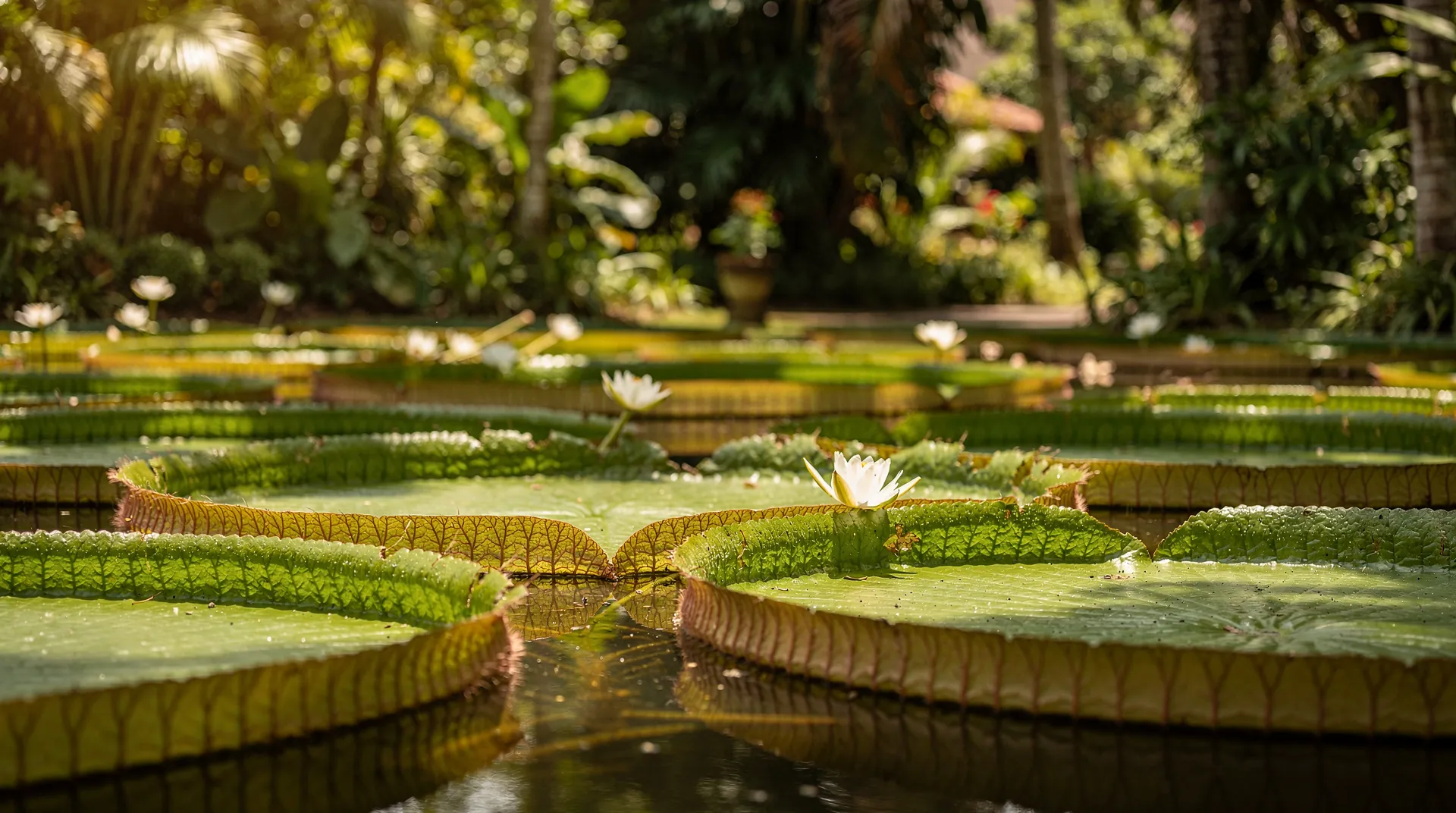
Pamplemousses Botanical Garden: giant water lilies, history and visitor guide
Updated: August 2026
How much does entry to Pamplemousses Botanical Garden cost?
Entry to Pamplemousses Botanical Garden costs 200 rupees (about 4 euros) per adult for non-resident foreigners. The garden is open every day from 8:30am to 5:30pm. An on-site guide costs an extra 200 to 400 rupees.
Pamplemousses Botanical Garden: an extraordinary botanical institution
The Sir Seewoosagur Ramgoolam Botanical Garden in Pamplemousses is one of the oldest and most famous botanical gardens in the southern hemisphere. Officially founded in 1770, though its history dates back to the 1730s, it is often ranked among the ten most beautiful botanical gardens in the world and is one of the most essential cultural and natural sites in Mauritius.
Located in the district of Pamplemousses, in the north of the island about 20 kilometers from Port Louis, this 37-hectare garden holds an extraordinary collection of tropical plants, including the famous Victoria amazonica, the giant Amazonian water lily whose circular leaves can exceed 2 meters in diameter. It’s the garden’s signature plant, its visual trademark, and one of the most photographed sights in all of Mauritius.
The garden is one of the sites our guide to must-sees in Mauritius consistently ranks among the not-to-miss visits, regardless of how long your stay is. On site, French-language guided tours are offered by the garden’s authorities to enrich your discovery of this exceptional botanical heritage — don’t hesitate to ask at the entrance.
At a glance
| Where | Pamplemousses, north of the island, 20 km from Port Louis |
| Price | about 200 MUR (~4 EUR) foreign adult; guide extra 200-400 MUR |
| Time needed | 1h30 to 2h30 (guided tour recommended) |
| How to get there | car (25 min from Port Louis), bus, taxi, or organized excursion |
| Best time | year-round; water lilies at their best from November to March |
History: from the origins to today
The beginnings in the 18th century
The history of Pamplemousses Botanical Garden is closely tied to the colonial history of Mauritius. The first botanical developments on this site date back to the 1730s, under the administration of the French East India Company, which then governed the island known as “Isle de France.”
But the garden as it exists today owes its structure to two major figures: Pierre Poivre (1719-1786), intendant of Isle de France from 1767 to 1772, and Philibert Commerson (1727-1773), botanist on Bougainville’s expedition. Pierre Poivre is the founding figure: this visionary agronomist transformed the estate into an acclimatization botanical garden, with a very concrete goal — breaking the Dutch monopoly on the spice trade.
Poivre had clove and nutmeg plants — at the time the world’s most precious spices — smuggled in from Banda (Indonesia). Pamplemousses thus became the starting point for spice cultivation in the French colonies of the Indian Ocean, an economic episode that transformed colonial trade.
The garden under the British and today
After the British took the island in 1810, the garden went through a period of decline before being revitalized under the direction of James Duncan, who managed it in the second half of the 19th century. It was Duncan who introduced Victoria amazonica to the garden and built the circular ponds where they still thrive today.
The second half of the 19th century saw the garden reach its peak with the introduction of hundreds of botanical species from around the world: Seychelles palms, ornamental banana trees, breadfruit trees, rubber trees, ylang-ylang, cinnamon trees, and pepper plants. These introductions created the extraordinary richness of today’s collection.
Renamed in honor of Sir Seewoosagur Ramgoolam, the first Prime Minister of independent Mauritius (1968), the garden is managed by the Mauritian government. An ongoing restoration and replanting program is underway, with particular focus on endemic Mauritian species, some of which are critically endangered.
What you’ll see in the garden
Victoria Amazonica: the main attraction
The giant Victoria amazonica water lilies are undoubtedly the garden’s absolute stars — and quite possibly the most spectacular aquatic plants on Earth. Native to the Amazon’s lagoons, these aquatic plants grow enormous circular leaves with a characteristic upturned rim, intense green on top and pinkish-red underneath, supported by a network of ribs that gives them remarkable structural strength.
These leaves can support the weight of a 20 to 30 kg child spread evenly across the surface — a fact that fascinates children and parents alike during visits. Their flowers, which open in the evening and change color between the first and second night (white the first evening, pink-red the second), are strikingly beautiful, though few visitors get the chance to see them.
The best months to see the water lilies at their peak are November to March (the hot season), when peak temperatures and light favor their growth. During the southern winter, growth slows but the plants remain impressive.
The palm trees: an exceptional collection of 85 species
Pamplemousses Garden holds one of the largest palm tree collections in the world, with more than 85 different species. Among the most spectacular:
The Talipot palm (Corypha umbraculifera): this giant can reach 25 meters in height and flowers only once in its lifetime, after 30 to 80 years, producing the largest inflorescence in the plant kingdom (up to 7 meters), before dying. If you’re lucky enough to visit the garden during a Talipot flowering event, it’s a rare and unforgettable natural spectacle.
The Queen Palm (Syagrus romanzoffiana): a majestic avenue of these slender palms lines the main access path, creating a photogenic colonnade effect — one of the garden’s signature images.
The Bottle Palm (Hyophorbe lagenicaulis): endemic to Round Island (off the coast of Mauritius), this tree is critically endangered in the wild. Pamplemousses Garden preserves several remarkable specimens that are among the most precious ambassadors of Mauritius’s endemic biodiversity.
The Coco de Mer (Lodoicea maldivica): native to the Seychelles, this palm produces the largest seed in the plant kingdom, weighing up to 25 kg. The specimens at Pamplemousses are among the oldest cultivated outside their natural habitat.
Remarkable trees
- A centuries-old banyan tree (Ficus benghalensis) whose aerial roots span an area of several dozen square meters, creating a fascinating maze-like structure
- Imposing baobabs (Adansonia digitata), native to Africa, with massive, distinctive trunks
- A two-hundred-year-old camphor tree whose bark and leaves give off a characteristic camphor scent
- Rubber trees with smooth trunks and sprawling aerial roots that form strange, highly photogenic sculptural shapes
- Flame trees (Delonix regia) that burst into red-orange blooms from November to January — a burst of color that sets the garden’s paths alight
The garden’s wildlife
The garden is not only a botanical haven but also a sanctuary for tropical wildlife. You’ll regularly spot:
Aldabra giant tortoises (Aldabrachelys gigantea) roaming freely around the garden, offering unique opportunities for close encounters and photos. These giant tortoises can weigh up to 250 kg and live for more than a century.
Blue peacocks that stroll along the paths, stop to watch you with their round eyes, and sometimes spread their spectacular tail for the females — an unpredictable and unforgettable sight.
Ducks and waterbirds that inhabit the water-lily ponds and small ponds around the garden. Java sparrows, doves and Mauritius fody birds are also present.
Fruit bats perched in the tall trees during the day, visible from the paths if you look up.
The Paul and Virginie monument
A historical curiosity: in one corner of the garden stands a monument dedicated to Paul and Virginie, characters from the eponymous novel by Bernardin de Saint-Pierre (1788). This romantic novel, set in Isle de France, is one of the most widely read 18th-century French literary works and helped shape Europe’s romantic image of Mauritius. A symbolic tomb has been built in the garden — even though the characters are fictional.
Practical information
Hours and prices
The garden is open every day (including weekends and public holidays) from 8:30am to 5:30pm (last entry at 5pm).
Prices:
- Non-resident foreign adults: 200 rupees (about 4 EUR)
- Foreign children (under 12): 100 rupees (about 2 EUR)
- Mauritian residents: reduced rate (50 rupees adult)
- Under 3: free
An official guide can be hired at the entrance for a guided tour: expect an extra 200 to 400 rupees for a 1h30 visit. Guides speak French, English and Creole. A guided tour is strongly recommended to understand the garden’s fascinating history and identify the remarkable plant species — a simple self-guided stroll means missing a lot of valuable information.
To pay in local currency, bring Mauritian rupees in cash — there isn’t always a card payment terminal at the entrance.
How to get there
By car: the garden is located in Pamplemousses, accessible via the A1 road from Port Louis (20 km, 25 minutes). From Grand Baie to the north, allow 30 minutes via the coastal road or 20 minutes via the inland road. Free parking is available at the main entrance. Our guide to driving in Mauritius covers the practical rules of the road.
By bus: bus routes regularly connect Port Louis to Pamplemousses (about a 40-minute trip, under 1 EUR). From Grand Baie, a change at Triolet is generally required. Our guide to buses in Mauritius explains how the network works.
By taxi: from Port Louis, expect 600 to 800 rupees round-trip with waiting time included. Our guide to taxis in Mauritius gives reference rates for all routes.
On an organized excursion: most taxi drivers and guides offer a half-day combining the garden with a visit to Port Louis or other sites in the north.
Recommended visit duration
- Quick visit (the main highlights: water lilies, palm trees, tortoises): 1 hour
- Full visit with a guide: 2 to 2h30
- In-depth visit for botany enthusiasts: 3 hours
Tips for making the most of your visit
Come early. Opening at 8:30am offers the best conditions: ideal morning light for photos, fewer tour groups, and relative coolness before the heat of the day sets in. The tortoises and peacocks are generally more active in the morning.
Wear a hat and sunscreen. The garden is outdoors and the main paths offer little shade. In summer (November to March), the heat can get intense from 10am onward.
Comfortable shoes. The garden is large (37 hectares) and the paths are sometimes dirt or gravel. Beach sandals aren’t ideal.
Camera. The giant water lilies, the tortoises that let you approach, the peacocks with their tails on display, and the rows of palm trees are exceptional photo subjects that no traveler regrets capturing.
Combined excursions from Pamplemousses
Port Louis (20 km to the south)
The Mauritian capital lies 20 km south of the garden. A morning at the garden combined with an afternoon in Port Louis (central market, Caudan Waterfront, photography museum, historic monuments) is a very popular pairing that fits easily into a single day. Our guide to Port Louis covers all the sites in the capital.
If you’d rather go without a car, you can book a guided tour of northern Mauritius that includes Pamplemousses and other northern sites with hotel transport included.
L’Aventure du Sucre (great tip, right next to the garden)
This interactive museum, set in a former sugar mill, tells the story of the sugar industry and the history of Mauritius in a thorough, accessible way. It’s an ideal complement to the garden — the two sites are just a few hundred meters apart. Allow an extra 1h30 to 2 hours.
The north coast (Grand Baie, Trou aux Biches)
The garden is 15 to 20 minutes from the beaches in the north. A botanical morning at Pamplemousses followed by a beach afternoon at Grand Baie or Trou aux Biches is a very popular and enjoyable combination. It’s actually the ideal setup if you’re based in the north of the island.
Grand Bassin (Ganga Talao)
If you have a car, an excursion to Pamplemousses can be combined with a visit to Grand Bassin in the highlands, for a cultural day that touches on both botany and spirituality. Allow a full day for both sites.
Why visit Pamplemousses Botanical Garden
Pamplemousses Garden isn’t just a botanical garden — it’s a journey through the island’s history, a sanctuary of tropical biodiversity, and a lesson in plant-world beauty. It’s one of those rare places that leaves a lasting impression on everyone who visits, regardless of age or prior interest in botany.
The 4 EUR entry fee is one of the best deals on the island — an excellent value for several hours of discovery in one of the world’s most remarkable botanical gardens. Whether you’re a plant lover, a history buff, a photographer hunting for great subjects, or simply curious, Pamplemousses has something to offer you.
The Pamplemousses market and immediate surroundings
Just a few minutes from the garden, the village of Pamplemousses is worth a quick detour: a small church, seasonal fruit stalls, and the authentic feel of a rural northern town, far from the tourist bustle of Grand Baie. It’s also a chance to try a dholl puri or gateaux piments made fresh on the spot, the local version of Mauritian street snacks — an inexpensive and tasty break before or after visiting the garden.
The area around Pamplemousses also has several historic sugar-cane estates, including the former sugar mill turned L’Aventure du Sucre, which naturally extends the garden’s historical theme.
Accessibility and families
The garden is generally stroller-friendly along the main paths, but some more remote areas have dirt surfaces that turn muddy after rain — plan for this during the hot season (November to March), when brief but frequent tropical showers occur. For visitors with reduced mobility, the central paths around the water-lily ponds and the palm avenue remain accessible, but the full 37 hectares isn’t designed as an obstacle-free route — it’s better to target the main sections rather than aim for an exhaustive visit.
With kids, count on the giant tortoises and peacocks to hold their attention right away — it’s often one of the favorite sites for families listed in our guide to family activities, alongside more active options like those described in our guide to water activities.