
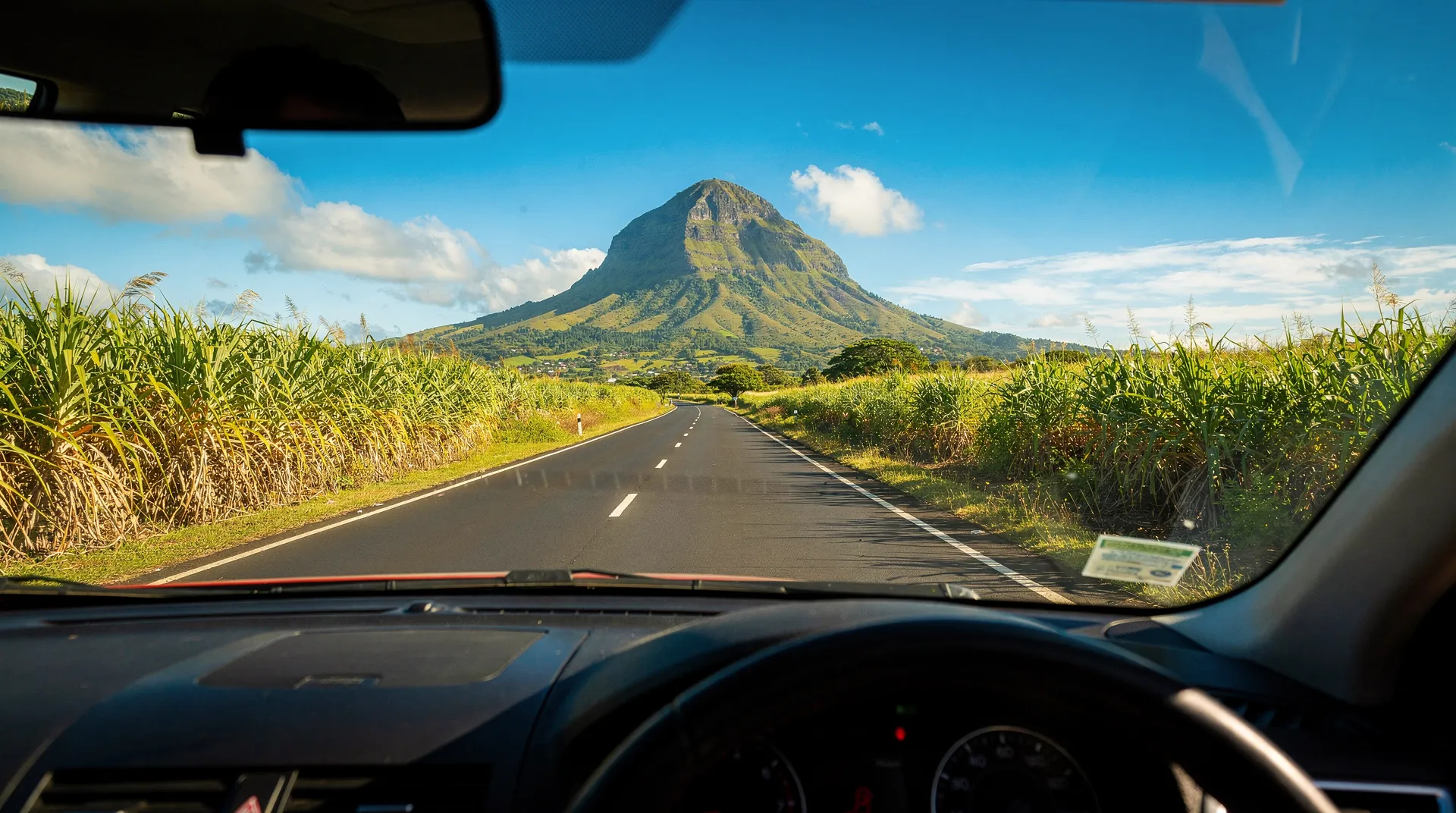
Driving in Mauritius: a practical guide to driving on the left
Updated: August 2026
Can you drive in Mauritius with a French driving licence?
Yes, a French driving licence is valid in Mauritius without any translation or international permit required. Driving is on the left, as in the United Kingdom.
In brief
| Licence required | Valid French licence, no international permit needed |
| Side of the road | Left-hand side, a British legacy |
| Adjustment | About 30 to 60 minutes of actual driving |
| Car rental | Around 25 to 60 € per day depending on category and season |
| Speed limits | 50 km/h in built-up areas, 80 km/h on the open road, 110 km/h on motorways |
Driving on the left: getting used to it quickly
The first thing that surprises French drivers arriving in Mauritius is driving on the left. A legacy of British colonisation, this practice is deeply rooted in local habits. If you’ve never driven on the left before, don’t worry: the vast majority of travellers adapt within 30 to 60 minutes of actual driving. The human brain is remarkably quick at picking up this new pattern, especially in an environment where every other vehicle is also driving on the left.
The key is to stay calm, drive slowly at first, and not panic if an automatic reflex pushes you toward the right. This happens to every driver, even experienced ones, in the first few minutes.
The reflexes you need to change
Position on the road: you drive in the left lane. The centre line (solid or dashed) is always on your right. This is the exact opposite of what you do in France.
The steering wheel is on the right: in Mauritian rental cars, the steering wheel is on the right-hand side of the vehicle, as in the United Kingdom. This is the most disorienting change at first. Your driver’s seat is close to the pavement, not the centre line.
Overtaking: you overtake on the right when driving on the left (unlike in France, where you overtake on the left). Before overtaking, check your left mirror and your left blind spot.
Roundabouts: traffic flows clockwise (the opposite of France). Vehicles already on the roundabout have priority — exactly as in France, just in the other direction.
Indicators and wipers: in right-hand-drive cars, the stalk positions are often reversed. It’s not unusual for new drivers to turn on the wipers when they meant to signal! It amuses passengers, and it quickly stops happening.
Practical tips for adjusting
- First drive: make your first trip on quiet roads (a calm coastal road, a peaceful residential area) rather than diving straight into Port Louis during rush hour
- Repeat it to yourself: “I’m on the left, I overtake on the right” — it sounds silly but it works
- At intersections: look right first (traffic comes from the right when driving on the left). This is the opposite of your instinct in France.
- Automatic gearbox recommended: if you’re not fully comfortable with left-hand driving, an automatic gearbox lets you focus on the road. Most rental agencies offer automatics for a small surcharge.
- A co-pilot passenger: if you’re travelling as a pair, ask your companion to watch the left blind spot, often the hardest to manage early in the trip
- Starting off from a car park: before pulling out of a parking space, a mental reminder — “I’m pulling out to the left” — helps avoid instinctively heading right
Road conditions in Mauritius
The main network
Mauritius’s road network is generally of good quality for an island of this size. The national roads (M1, M2, A1, A2, B-roads) are wide, well maintained and offer comfortable driving conditions.
Motorways: Mauritius has a small toll motorway network. The M1 motorway links Port Louis to Mahébourg along the west coast. The M2 motorway serves Curepipe and the central plateau. These roads are very convenient for crossing the island quickly without going through town streets.
Tolls: tolls are automatic and inexpensive (around 50 to 100 MUR per crossing). Some rental cars are fitted with an electronic toll tag (similar to the French Liber-t); check with your agency whether this service is included or charged separately.
Secondary roads
Secondary roads and village roads are more variable and require extra attention:
Narrow roads: in inland villages and some coastal areas around Tamarin or the south, roads can be very narrow, barely wide enough for two cars. Passing sometimes requires one driver to stop and pull over onto the verge to let the other through. Local drivers are used to this dance and handle it good-naturedly.
Speed bumps: speed bumps are numerous, including on main roads and in places you wouldn’t expect them. Slow down without fail — some are quite steep and can damage the underside of a low-clearance vehicle.
Potholes: secondary and rural roads sometimes have potholes, especially after the rainy season (January–March). On the east coast roads and in the south, extra caution is needed.
Coastal tracks: some isolated beaches around Blue Bay or in the south are only accessible via unpaved tracks or stony paths. An SUV or a vehicle with higher ground clearance is recommended for these routes.
The Mauritian highway code
Main rules
Speed: limits are similar to France. In built-up areas: 50 km/h. On the open road: 80 km/h. On motorways: 110 km/h. These limits are shown on signs similar to European road signs. Locals sometimes drive fast, but tourists can be fined — don’t take local drivers as your reference.
Seatbelts: mandatory for the driver and all passengers, front and back. Children must be in age-appropriate car seats.
Phones while driving: banned, as in France. Use a hands-free kit or ask your passenger to handle navigation.
Drink driving: the legal limit is 0.5 g/L of alcohol in the blood, the same as in France. Roadside checks do happen, particularly on weekends and evenings on busy routes.
Priority to the right: at some unmarked intersections, priority to the right applies — but be careful, when driving on the left this means the vehicle coming from your left (on your right relative to the direction of travel) has priority. This rule can be confusing. If in doubt, slow down and give way.
Headlights: switch on from nightfall. Country roads are often poorly lit.
Road signs
Road signage in Mauritius broadly follows international conventions. Prohibition signs (red circles) and mandatory signs (blue circles) are identical to European signs. Information signs are bilingual in English/Creole, with place names that may differ slightly from the ones you’re familiar with.
A few names worth knowing: “Black River” = Rivière Noire, “Mahebourg” = Mahébourg, “Tamarin” is the same. Village names on signs are often in Creole or English.
In case of an accident
In the event of an accident, even a minor one, you are required to call the police. A police report is needed for insurance claims. The police number is 999 (or 112 from a mobile).
Do not move the vehicles before the police arrive if the accident is significant. Call your rental agency immediately to inform them. Photograph the scene from every angle before anything is moved.
Driving in town: Port Louis and urban centres
Port Louis
The capital is known for its heavy traffic, especially during rush hour (7:30–9:00am and 4:30–6:30pm). Traffic jams can double your journey time. If you need to cross Port Louis, avoid these times or take the bypass roads (the M1 motorway lets you go around the city).
Parking is paid in the city centre and can be hard to find. Stick to organised car parks — the Caudan Waterfront has a large car park that also serves the central market.
Grand Baie
A lively tourist hub in the north, Grand Baie has fairly narrow streets and heavy daytime traffic. Extra caution is needed, as motorbikes and scooters can appear suddenly. Allow 10 to 15 minutes to cross the village even on a short trip.
Mahébourg
A market town in the south-east, Mahébourg is easier to drive through than Grand Baie or Port Louis. Monday market day draws large crowds — if you plan to visit this market, arrive early to find easy parking.
Villages
Driving through villages calls for patience. Children, animals and pedestrians often share the road. Slow down to 30 km/h or less through village crossings, and stay especially alert.
Parking in Mauritius
Parking is generally free and fairly easy outside urban centres. A few rules to follow:
- Never block an access point, a house entrance or a vehicle exit — Mauritians are polite but firm on this point
- No-parking zones are marked with yellow lines on the ground or with signs
- In shopping areas and supermarkets, parking attendants sometimes watch over vehicles (a tip of 50 to 100 MUR is appreciated)
- In car parks at popular beaches such as Belle Mare or Trou aux Biches, avoid leaving valuables visible in the vehicle. Opportunistic thefts (broken windows) do happen in busy car parks.
- In rural areas, parking on the roadside is generally tolerated as long as you don’t obstruct traffic
Driving licence and required documents
Documents to carry with you at all times
- Driving licence: a French licence (pink or the new card format) is valid in Mauritius for European nationals. No international permit is needed, nor an official translation.
- Rental agreement: keep it in the vehicle for the whole rental period, ideally in the glovebox
- Passport or ID: keep it on you
- Insurance certificate: provided by the rental agency, to be kept with the contract
Police checks
Roadside police checks do happen in Mauritius, particularly on major routes and on the outskirts of towns. If stopped, stay courteous, present your documents and answer questions calmly. Most officers speak French or English. Never attempt to bribe a police officer.
Fuel: where to fill up
Petrol stations (often Engen, Total, Shell) are well distributed across the whole road network. They’re generally open from 6am to 10pm, sometimes 24/7 on main routes such as the M1 motorway.
Fuel types: unleaded petrol (unleaded / SP98) and diesel. Check which fuel type your rental car requires in the contract — some small city cars run on diesel.
Payment: in Mauritian rupees or by card at most modern stations.
Prices: slightly lower than French prices in general. Expect around 60 to 70 MUR per litre of petrol. A full tank for a small city car (30-35 litre tank) costs about 1,800 to 2,500 MUR (36 to 50 EUR).
Tip: fill up as soon as the tank drops below a quarter. Petrol stations can be scarce in some rural areas of the south. And a reminder: always return the car with a full tank to avoid the agency’s refuelling fees.
Insurance and excess in case of damage
Most rental agencies include basic insurance in the price, with an excess that remains your responsibility in the event of a claim — often between 500 and 1,500 EUR depending on the vehicle category. You can generally reduce or waive this excess by taking out additional cover locally or through travel insurance purchased before departure. Always check the vehicle’s condition and report any existing scratch or damage before setting off, taking dated photos as proof. Our guide to travel insurance in Mauritius details the options available to cover this type of risk.
Do you really need to rent a car?
Renting a car isn’t compulsory in Mauritius, but it profoundly changes how you experience the island. Without a car, you rely on buses (cheap but slow), taxis (convenient but expensive over time) or organised excursions, which limits access to less touristy spots in the south and centre.
With a car, the entire island becomes reachable within half a day’s drive at most, including the tracks leading to isolated beaches or the highland plateaus. Our comparison of travelling with or without a car details the pros and cons of both options depending on your travel style, and our guide to taxis in Mauritius presents the alternative if you’d rather not drive.
Navigation: GPS and apps
Google Maps works perfectly in Mauritius with good network coverage. Download the offline map before you leave for areas with limited connectivity. To stay connected at all times, our guide to eSIM and internet in Mauritius presents the best options. An eSIM activated as soon as you land at the airport is the ideal solution for navigating without racking up roaming charges: eSIM for Mauritius — GPS and mobile navigation.
And if you’d rather start your stay without a car, a private transfer from the airport remains the most comfortable option: private airport-to-hotel transfer in Mauritius.
Waze is also usable and can alert you to police checks and traffic jams, which is handy around Port Louis.
Watch out for GPS shortcuts: some GPS apps suggest shortcuts via tracks or paths unsuitable for cars. Stick to the main roads if you’re driving a low-clearance city car.
Driving at night
Avoid driving at night on rural secondary roads if you don’t know the island well. The lack of street lighting, unexpected speed bumps and animals on the road (cows, dogs, deer near nature parks) make night driving riskier. On well-lit main roads (M1, A1), night driving is fine.
For your overall safety in Mauritius, see our complete safety guide to Mauritius.
Planning your exploration by car
With a car at your disposal, the whole island opens up to you. For optimised circuits and itineraries, see our Mauritius road trip guide, which offers themed routes based on the length of your stay.
The most popular routes include the two-day grand coastal tour, the highland road toward Chamarel, and exploring the wild south coast. For families, our family itinerary includes stops that work well with children.
If you’d like to compare regions before deciding where to stay and where to prioritise driving, our north/south comparison and east/west comparison give a clear picture of what each coast has to offer.
Summary: driving in Mauritius with confidence
Driving in Mauritius is manageable for the vast majority of European drivers. The main challenge is left-hand driving, which you pick up quickly. Roads are generally good, weather conditions are favourable outside cyclone season, and short distances mean you never have to drive for very long at a stretch.
Take your time settling into the vehicle before setting off, check your seat and mirror settings, trust your instincts and enjoy the unmatched freedom that a car gives you to explore this beautiful island. That first hesitant U-turn on the wrong side is part of the learning curve — local drivers understand and are patient with tourists.