
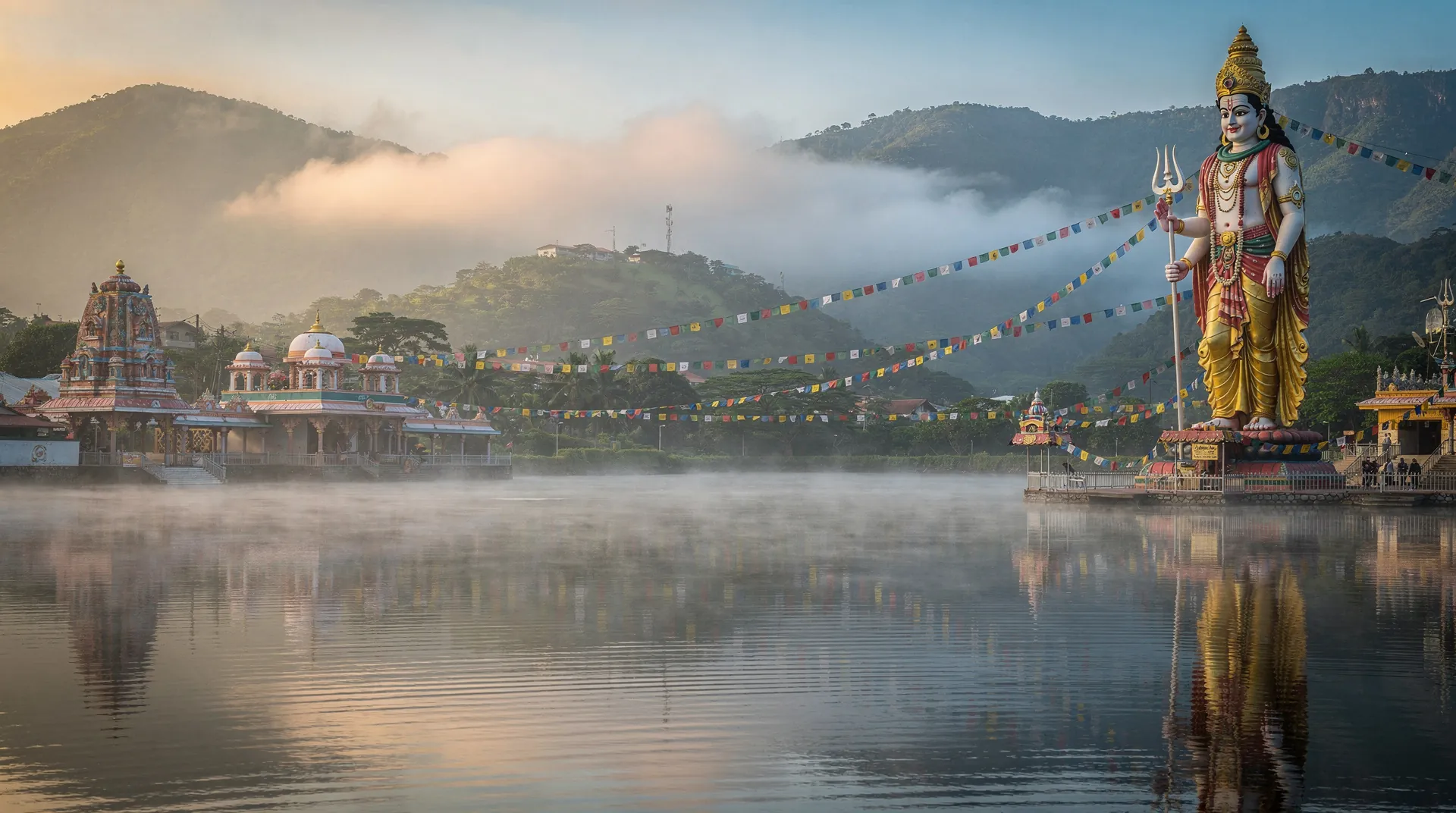
Grand Bassin (Ganga Talao): Mauritius's sacred Hindu lake
Updated: August 2026
How do you visit Grand Bassin in Mauritius?
Grand Bassin is accessible by car or on an organised excursion from anywhere on the island (about 1 hour from Grand Baie). Entry is free. Wear modest, covering clothing. It's best to visit early in the morning to avoid the crowds.
Grand Bassin (Ganga Talao): the spiritual heart of Mauritius
In the highlands of central Mauritius, at around 700 metres of altitude, lies a place that holds a unique position in the heart of the Mauritian Hindu community and fascinates every visitor who discovers it: Grand Bassin, known in religious terms as Ganga Talao, literally “lake of the Ganges”.
This natural lake, tucked inside an ancient volcanic crater ringed by tropical forest and vegetation-covered hills, is considered the holiest Hindu site in Mauritius, and one of the most important in the entire southern hemisphere. Legend has it that its waters are mystically connected to the waters of the Ganges in India, Hinduism’s sacred river par excellence. This belief makes it a major pilgrimage destination for Mauritian Hindus, and an essential cultural site for visitors of every background.
Grand Bassin features among the recommended visits in our guide to Mauritius must-see attractions. It’s a site that touches something essential in Mauritian identity — the island’s unique ability to be both an international beach destination and a place of intense spiritual life.
To visit Grand Bassin and the other sites of the southwest in a single organised day, you can book a full southern excursion including Chamarel and Grand Bassin with transport and a guide from your hotel.
At a glance
| Element | Detail |
|---|---|
| Where | Central-southern highlands, Savanne district, around 700 m altitude |
| Price | Free entry, free on-site parking |
| Time needed | About 1h30 to 2h for a relaxed visit |
| How to get there | By car (45 min to 1h15 depending on your starting region) or on an organised excursion |
| Best time | Year-round; early morning for a peaceful visit, avoid driving there during Maha Shivaratri (February or March) |
History and religious significance
The origin of Grand Bassin
Grand Bassin was discovered by Mauritian Hindus in the 19th century, following the massive arrival of indentured labourers (the “coolies”) from India between 1835 and 1907, brought in to replace slave labour on the sugar cane plantations. These immigrants, often from Bihar, Uttar Pradesh and Tamil Nadu, brought with them their religious traditions and deep faith, often in a context of difficult uprooting.
In the 1890s, a pandit (Hindu priest) is said to have had a vision that the waters of Grand Bassin were spiritually linked to the Ganges. Since then, the lake has been regarded as a tirtha (pilgrimage site) and has been progressively developed with temples, monumental statues and ghats (steps leading down to the sacred water).
Ganga Talao and Maha Shivaratri
Grand Bassin lies at the heart of the most important celebration in the Mauritian Hindu calendar: Maha Shivaratri, the “Great Night of Shiva”. Every year, during this festival (usually in February or March according to the lunar calendar), several hundred thousand Mauritian Hindu pilgrims make the journey on foot to Grand Bassin.
The pilgrims, dressed in white or saffron, sometimes walk dozens of kilometres from their home village. They carry “kanwars” on their shoulders: decorative structures made of bamboo and flowers, sometimes impressively large, from which hang clay pots filled with sacred water from Grand Bassin. This water is later poured ritually over the Shiva lingam in their local temple upon their return.
This pilgrimage can bring together between 400,000 and 600,000 people over two to three days — roughly a third of the island’s total population. It is one of the largest religious gatherings in the southern hemisphere. If you happen to be in Mauritius during this period, it is a cultural experience of rare intensity, even as a respectful outside observer.
Mauritian Hindu cosmology
Understanding a few elements of Hindu cosmology greatly enriches the visit. The sacred lake is primarily dedicated to Shiva, one of the three great deities of the Hindu pantheon (alongside Brahma the Creator and Vishnu the Preserver). Shiva is the Destroyer-Transformer, the one who dissolves the universe to allow its rebirth. His main symbol is the lingam, a phallic representation of divine creative energy.
Water plays a central role in Hindu cosmology — it purifies, it links the worlds, it enables passage between the profane and the sacred. The water of Grand Bassin, perceived as connected to the Ganges, holds an extraordinary purifying and blessing power for devotees.
The site: what you’ll see
The sacred lake
Grand Bassin lake itself is an irregularly shaped body of water, surrounded by lush Mauritian subtropical forest. Its waters are dark and still, with a greenish tint from algae and depth. This is not a lake for swimming (the water is sacred and cold), but for contemplation, prayer and reflection.
Fish can be seen at the surface, considered sacred and protected by devotees. Visitors can buy fish food from local vendors and feed them from the ghats — an activity especially popular with children, who approach these huge, human-habituated carp with curiosity.
The monumental statues
The great Shiva statue (33 metres tall) is visible from the road well before you reach the site. This monumental silver-grey statue, built in 2007, depicts Shiva in a meditative posture, the crescent moon in his hair and the Ganges flowing from his locks. It is one of the largest Shiva statues in the world, and its scale is dizzying when you stand at its feet.
The Hanuman statue (20 metres) depicts the monkey-god hero of the Ramayana, in a posture of prayer facing the lake. Hanuman is the deity of absolute devotion and strength — very popular in Mauritian Hinduism.
The Ganesha statue, the elephant-headed god, stands at the entrance to the site. It is traditional to begin any religious undertaking by honouring Ganesha, the remover of obstacles and master of new beginnings.
The temples and how they work
Several temples surround the lake, dedicated to different deities:
The Shiva temple is the most important, with a central lingam around which the Maha Shivaratri pilgrimage is centred. Priests perform daily pujas (ritual prayer ceremonies) with incense, oil lamps and flower offerings.
The Lakshmi temple (goddess of prosperity and beauty) is visited by devotees seeking to pray for success, abundance and family wellbeing.
Vendors set up all around the site sell offerings that devotees present during their prayers: marigold garlands, coconuts, incense, deity figurines, containers for the sacred water. This economy of the sacred is part of the site’s atmosphere.
The site’s unique atmosphere
Grand Bassin is a place of intense spiritual life, worlds away from the island’s typical tourist spots. Throughout the day, families and individuals come to pray, perform ritual ablutions, light incense and immerse themselves in devotion. The sound of temple bells, chanting and prayers creates an atmosphere that is both soothing and striking for non-Hindu visitors who show the site respect.
The site is especially atmospheric early in the morning, when mist clings to the surrounding forests and the first pilgrims arrive in the calm of dawn, as priests recite their mantras and incense begins to rise into the cool highland air.
How to visit Grand Bassin
By car
Grand Bassin lies in the central-southern highlands of the island, in the Savanne district. From the main tourist regions:
- From Grand Baie (north): about 1h15 via the M1 motorway to Curepipe, then the B46 road towards Nouvelle France and Grand Bassin
- From Flic-en-Flac (west): about 45 minutes via Quatre Bornes and Vacoas
- From Port Louis: about 1 hour via the M1 motorway and Curepipe
- From Mahebourg (southeast): about 45 minutes via the central road
The final access road from Nouvelle France is narrow and winding, running through dense forest — manageable in a standard car but best taken slowly. Free parking is available on site. Our guide to driving in Mauritius covers the practical rules for getting around the island.
On an organised excursion
Many tour operators and local guides offer excursions that include Grand Bassin, often combined with other sites in the central-south:
- Chamarel and the Seven Coloured Earths
- Chamarel waterfall (the island’s tallest)
- Casela nature park (safari and birds)
A full-day excursion combining these sites usually costs between 60 and 100 EUR per person, including transport from your accommodation.
During Maha Shivaratri
If you’re visiting during Maha Shivaratri (February or March depending on the lunar calendar), be aware that access by car is extremely difficult, if not impossible, during the two days of the pilgrimage. Most roads leading to Grand Bassin are packed with pilgrims on foot.
Some operators offer night-time or very early morning tours to observe the pilgrimage at its most intense — an extraordinary cultural experience, but one that requires planning ahead. The sight of hundreds of thousands of pilgrims dressed in white, walking in procession through the night with their illuminated kanwars, is among the most powerful the island has to offer.
Tips for visiting as a tourist
Dress code — respect is essential
Grand Bassin is an active place of worship and should be visited with sincere, not merely formal, respect. Dress matters: covered shoulders (a sleeved t-shirt, no tank tops), covered legs (trousers or a long skirt — avoid short shorts altogether), and shoes removed before entering the temples.
Avoid beachwear, visible swimsuits and light sarongs worn as casual cover-ups. Proper sarongs can usually be bought or rented on site from local vendors if you’re not prepared.
Behaviour and respect
Do not touch the statues or the offerings. Always ask permission before photographing people at prayer — many devotees appreciate a visitor taking an interest in their faith, provided it’s done with respect and discretion. Speak quietly within the temple grounds. Do not consume alcohol or non-vegetarian food on site.
Best time to visit
Early morning (7am to 9am) offers the most peaceful atmosphere: beautiful light for photos, fewer crowds, atmospheric mist over the lake. Midday is livelier but also hotter. Avoid weekends and public holidays if you’re seeking tranquillity.
The recommended duration is 1h30 to 2h for a relaxed visit: a walk around the lake, a visit to the main temples, admiring the monumental statues and taking in the life of the site. If you’d like to witness a prayer ceremony, allow an extra hour or so.
Accessibility and visitor comfort
The site is built to handle very large crowds during Maha Shivaratri, which makes it comfortable the rest of the year: wide paths around the lake, a few shaded benches, public toilets near the car park, and street vendors selling water, snacks and fresh coconut. The main access is flat from the car park, manageable with a stroller, but some paths near the ghats include steps — bring a baby carrier if you’re travelling with an infant.
There’s little direct shade right at the water’s edge during the hottest hours: a hat and water are recommended, especially if you visit around midday. Mobile network coverage is good on site, but there’s no ATM in the immediate vicinity — bring rupees in cash for offerings or small purchases.
Time of day: what really changes
| Time | Atmosphere | Crowds |
|---|---|---|
| Early morning (7am-9am) | Mist, soft light, priests in full ceremony | Low |
| Midday | Heat, site very visible but less mystical | Moderate to high |
| Weekends and public holidays | Mauritian families visiting, lively atmosphere | High |
| Maha Shivaratri (Feb/Mar) | Mass pilgrimage, exceptional experience | Very high, road access limited |
Where to eat near Grand Bassin
There is no restaurant on the site itself, aside from fish-food stalls and a few snacks sold by street vendors. For an actual meal, the small town of Curepipe, about 20 minutes’ drive away, has several simple and affordable Mauritian cuisine options, including some very decent dholl puri stands. If your excursion includes Chamarel, several more polished restaurants await on the way back to the west coast.
Combined excursions
Chamarel: Grand Bassin in the morning, then on to Chamarel for the Seven Coloured Earths and the waterfall in the afternoon. Return via the south coast. A rich day combining spirituality and spectacular nature. Our Chamarel guide covers all the sites in the region.
For those who’d rather not drive, you can book this excursion in the south of Mauritius including Chamarel and Grand Bassin, an all-inclusive package with a French-speaking guide.
Mahebourg and the southeast: Grand Bassin + Mahebourg with its historical museum and market, for a day exploring both the interior and the southern coastline.
Cultural circuit: Grand Bassin + Quatre Bornes central market + Port Louis and its photography museum, for a day entirely devoted to Mauritius’s cultural side.
Visiting Grand Bassin means touching something essential in Mauritian identity: the island’s unique ability to be both an international beach destination and a place of intense spiritual life, where centuries-old traditions endure with remarkable vitality in the middle of the 21st century.