
Mauritius vs Maldives: Which One Should You Choose for Your Vacation?
Updated: April 2026
Mauritius or the Maldives: the big comparison
It’s one of the classic dilemmas for anyone in love with the Indian Ocean: choosing between Mauritius and the Maldives for a dream vacation. Both destinations are regularly ranked among the most beautiful in the world. Both conjure the same images — turquoise lagoon, white sand, palm trees, crystal-clear water. And yet they offer radically different experiences.
This comparison will help you choose based on your priorities, your budget and the kind of trip you’re after. If Mauritius is already your pick, our guide to a first trip to Mauritius covers all the practical details.
| At a glance | Mauritius | Maldives |
|---|---|---|
| Flight from Paris | Direct, about 11 hours | With a layover, 12-15 hours total travel time |
| Daily budget excluding accommodation | €50-120/person | €100-300+/person |
| Best time to visit | May to December — see our guide to the best time to visit | Year-round, rainy peak April-November on the south side |
| Entry requirements | Valid passport, no visa needed for a short tourist stay — details in our entry requirements guide | Visa on arrival for most nationalities |
| Getting around | Car rental or taxi | Boat or seaplane arranged by the resort |
The similarities: what they have in common
Before we get into the differences, let’s acknowledge the common ground that makes people hesitate between the two in the first place:
The beaches: Both destinations offer some of the most beautiful beaches in the world, with white sand, shallow turquoise water and protected lagoons. Our ranking of the 15 most beautiful beaches in Mauritius shows what Mauritius has to offer.
The underwater world: Coral, colourful tropical fish, sea turtles, rays — marine life is exceptional in both places. Both destinations justify investing in snorkelling or diving gear.
Geographic location: Both are in the Indian Ocean, about 10-12 hours by flight from France.
The tropical vibe: Warmth, coconut trees, a slow pace, local hospitality — both destinations deliver that sense of tropical fullness people come here to find.
The differences: what sets them apart fundamentally
The nature of the place
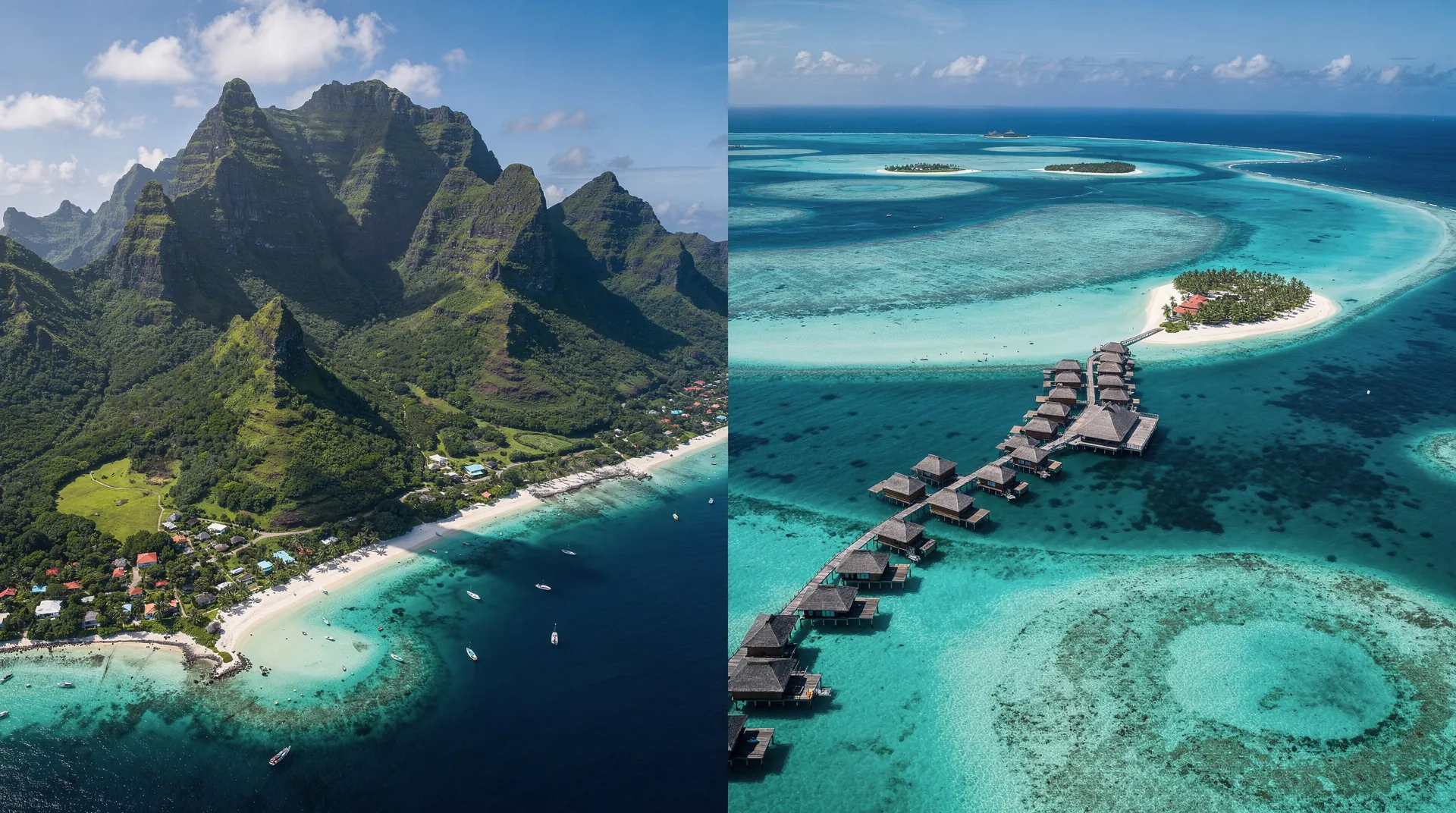
Mauritius is a volcanic island of 1,865 km², with relief, mountains (up to 823 m), tropical forests, towns, villages, a road network, diversified agriculture, and a population of 1.3 million.
The Maldives are an island nation made up of 1,200 small, very flat coral islands (maximum elevation: 3 metres), of which only 200 are inhabited. Total land area is under 300 km², spread across a maritime territory of 90,000 km².
This fundamental difference explains everything that follows.
What you can actually do
In Mauritius, activities are remarkably rich and varied:
- Hiking in the Black River Gorges National Park (primary forest, endemic wildlife)
- Visiting the capital Port-Louis (markets, museums, Creole culture)
- Excursion to the Pamplemousses botanical garden
- Road trip around the island through changing landscapes
- Mauritian cuisine at restaurants of every category — our gastronomy guide is a must
- Kitesurfing at Le Morne (a world-renowned spot)
- Quad biking through the sugar cane fields
- Visiting Hindu temples and mosques
- Diving, snorkelling, catamaran trips — notably the catamaran cruise to the northern islets
- Swimming with dolphins at Tamarin — the swim-with-dolphins excursion is a unique experience found nowhere in the Maldives
- Whale watching (July-November)
- Discovering the Seven Coloured Earths of Chamarel
In the Maldives, activities are centred on the sea:
- Snorkelling and diving (among the best in the world)
- Whale shark spotting (seasonal)
- Sandbank excursions
- Fishing
- Surfing (in certain atolls)
- Spa and hammam treatments at the resorts
- Beach time and reading
If you’re after variety of activities and discovering a local culture, Mauritius wins hands down. If you’re after total immersion in the marine world and complete disconnection, the Maldives are unbeatable.
Culture and authenticity
Mauritius is a nation with an exceptionally rich cultural identity. Its four main communities (Creole, Indo-Mauritian, Sino-Mauritian, Franco-Mauritian) have coexisted for centuries and created a unique culture — architecture, gastronomy, music, arts. Visiting Mauritius also means understanding this history. The markets and cultural festivals are the liveliest expression of this diversity.
The Maldives have a distinct local culture (the Dhivehi language, Islamic culture, craftsmanship, traditional fishing), but it remains largely invisible to tourists. Maldivian resorts are built on deserted islands or private motus, completely separated from local villages. You can spend 10 days in the Maldives without ever interacting with a Maldivian outside of hotel staff.
The budget
This is probably the most significant difference for many travellers. Our Mauritius budget guide and our article on the real cost of a trip give you precise figures.
In Mauritius:
- Accommodation: from €50/night (guesthouse) to €500+/night (5-star resort)
- Meals: from €3 (dholl puri at a street stall) to €150 (fine dining)
- Average daily budget (excluding accommodation): €50-120 per person
In the Maldives:
- Accommodation: from €100/night (guesthouse on a local island) to €2,000+/night (water villa at a resort)
- Meals: expensive at resorts (€50-150 per meal), cheaper on local islands
- Average daily budget (excluding accommodation): €100-300+ per person
The Maldives’ lower end is technically close to Mauritius, but the most affordable options in the Maldives mean staying on “local islands” (islands inhabited by Maldivians), which significantly limits access to private beaches and resort services.
For a stay in a water bungalow or villa (the emblematic Maldivian experience), expect a minimum of €600-800 per night — putting this kind of trip out of reach for many budgets. In Mauritius, comparable luxury accommodation is available for €200-400 a night — check our where to stay in luxury guide.
Accessibility and logistics
Mauritius is accessible by direct flight from Paris (CDG) in 11 hours, with Air Mauritius and Air France among others. No additional transfer once you land at SSR airport — your accommodation is directly reachable by car or taxi from the airport.
The Maldives require an international flight (usually via Dubai, Doha or Sri Lanka) to Malé airport (MLE), followed by a second transfer to your resort. This transfer can be:
- A speedboat: 30 minutes to 2 hours depending on the atoll
- A seaplane: 20 to 45 minutes of flying (stunning but expensive, €200-400 per person)
- A domestic flight to the more remote atolls
This extra logistics adds travel hours, complexity and costs. It can also create problems if your international flight is delayed.
The food
Mauritius: One of the richest and most diverse cuisines in the Indian Ocean. Creole cuisine, Indo-Mauritian cuisine (curries, briani, dholl puri), Sino-Mauritian cuisine (mines, wontons), Franco-Mauritian fine dining. The variety is endless, prices are affordable, quality is high. Our Mauritian gastronomy guide is your essential companion for exploring this culinary richness.
The Maldives: Local cuisine (mas huni, garudhiya, tuna curry) is interesting but hardly accessible from the resorts. Resort restaurants serve international food of variable quality at exorbitant prices. Gastronomy is clearly not the strong point of a Maldives trip.
What kind of traveller are you?
Choose Mauritius if you are:
- A curious traveller who wants to combine beach AND culture AND nature AND food
- A traveller with a “moderate” budget who wants access to some of the world’s best beaches without breaking the bank
- A family with young children looking for a variety of activities — our family itinerary is designed for you
- A couple on their honeymoon who wants to alternate romantic moments with active exploration — our honeymoon itinerary is your guide
- Someone who has never experienced this kind of tropical setting and wants a complete introduction
- A fan of varied water sports and hiking
Choose the Maldives if you are:
- A passionate diver or snorkeller who wants the best reefs in the world, full stop
- A honeymooning couple with a sizeable budget seeking total isolation in a luxurious bubble resort
- A traveller who has already done several “classic tropical” trips and wants to experience an over-water bungalow
- Someone looking for complete disconnection, with no interest in exploring a “country” (culture, city, market…)
- A traveller with no budget constraints, for whom €500-1,000/night is not a problem
The verdict: a draw… depending on your profile
There’s no objectively “better” destination — there’s the best destination for you.
Mauritius wins on: variety of experiences, value for money, cultural richness, gastronomy, logistical accessibility, land-based outdoor activities, coastal marine life accessible without a private boat.
The Maldives win on: the quality of the deep reefs, the isolation and intimacy of the resorts, the over-water bungalow experience, total disconnection.
If you have an unlimited budget and are after the unique experience of stilted bungalows above a transparent lagoon, the Maldives are incomparable. If you want a complete holiday — cultural, culinary and beach-focused — with excellent value for money, Mauritius is your destination.
What if you did both?
For travellers with the luxury of time and budget, some do both on the same trip. A popular pattern: 7 days in Mauritius to explore, discover and eat (our 7-day itinerary is perfect for this), then 5-7 days in the Maldives for the luxury beach bubble. Or the other way round.
The two airports are just 2h30 apart by flight — a logistically easy combination. And for those also comparing with Réunion, our article Mauritius or Réunion rounds out this overview of Indian Ocean destinations.
Entry requirements and practical preparation
One last point too often overlooked in comparisons: the administrative preparation is not the same. For Mauritius, a valid passport is enough for a short tourist stay, with no visa formalities beforehand — our entry requirements guide details the documents you’ll need. For the Maldives, a tourist visa is generally issued on arrival, but some resorts require a booking confirmation to present at immigration.
In both cases, travel insurance is strongly recommended, particularly to cover water activities and a possible medical repatriation — Mauritian public hospitals are decent, but the best private clinics are concentrated near Port-Louis, while in the Maldives the remoteness of the atolls makes medical evacuation considerably more expensive. Also think about connectivity: in Mauritius, a local eSIM is enough to stay connected anywhere on the island; at an isolated Maldivian resort, hotel wifi is often your only option, and sometimes it’s paid.
Finally, on accommodation itself, keep in mind that Mauritius offers a much wider and more flexible choice: our where to stay in Mauritius guide lists options for every budget and every area, whereas in the Maldives the choice is almost always limited to a single resort per island.