
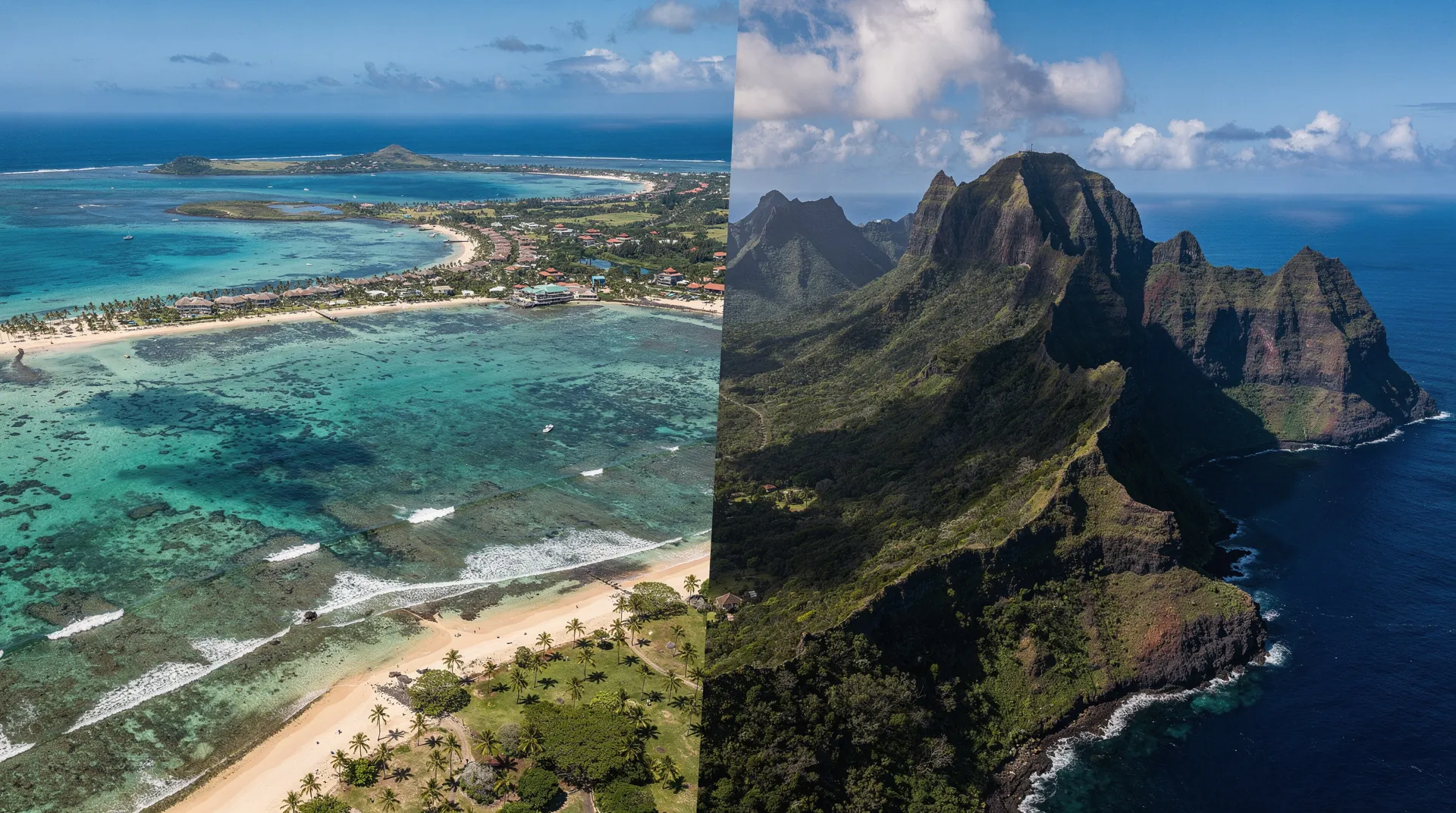
Mauritius or Reunion: How to Choose Between the Two Sister Islands
Updated: September 2023
The Question I Get Asked Constantly
Ever since I started writing about Mauritius, this is the question that comes up most in my messages: “I’m torn between Mauritius and Reunion — what would you recommend?” It’s a fair question. These two islands sit less than 200 kilometers apart in the Indian Ocean, share a French colonial past, a similar creole cuisine, and lush tropical nature. But they’re profoundly and fundamentally different.
I know both well. I’ve spent a total of nearly eight weeks in Mauritius and three weeks in Reunion. I’ll give you my honest take, without pushing my own preference — though I’ll admit I lean a little toward Mauritius. To understand what makes Mauritius unique beyond the beaches, our island discovery guide covers all the basics.
At a Glance
| Mauritius | Reunion | |
|---|---|---|
| Strong suit | Beaches, lagoon, budget | Hiking, volcano, cirques |
| Currency | Mauritian rupee (MUR) | Euro |
| Formalities | Valid passport, no visa for French citizens on short stays | None (French department) |
| Flight from Paris | About 11h, direct | About 11h, direct |
| Average budget (2 people, 1 week) | About 1,500-2,500 € all-inclusive | About 2,200-3,500 € all-inclusive |
| Best time to go | May to December (excluding January-February) | Year-round, with a preference for April-November |
| Combining both | Inter-island flight ~45 min | Inter-island flight ~45 min |
Quick Comparison by Travel Style
Beyond the broad trends already mentioned, here’s how the two islands compare on some very concrete criteria for planning your trip:
| Criteria | Mauritius | Reunion |
|---|---|---|
| Snorkeling and lagoon | Excellent, protected lagoon everywhere | Limited, few accessible reefs |
| Mountain hiking | Decent but secondary | Exceptional, UNESCO-listed |
| Nightlife | Well developed in Grand Baie | Low-key, nature-focused |
| Family travel with young children | Very well suited (calm beaches, equipped hotels) | More physically demanding |
| Sports and outdoor travel | Kitesurfing, diving | Hiking, canyoning, surfing |
| Cost of living on the ground | Notably cheaper | Mainland French prices |
| Car rental | Recommended, drive on the left | Standard, drive on the right |
Formalities, Connectivity, and Logistics: What Really Changes
One point often underestimated when choosing between the two islands: travel logistics. In Mauritius, as a French citizen, you only need a valid passport and a return reservation; no visa is required for a typical tourist stay. A local SIM card or eSIM is easy to find at the airport or in town, and our guide to internet and eSIM in Mauritius covers the best options.
In Reunion, there are no special formalities since it’s French territory: an ID card is enough, French SIM cards work normally, and there’s no currency to worry about.
To get around, car rental in Mauritius remains the best way to explore the island at your own pace, with the quirk of driving on the left inherited from the British era — something many French travelers find a bit intimidating at first, before getting used to it within half a day.
The Seychelles, the Third Option
Some travelers widen their search to include the Seychelles, often mentioned in the same breath as Mauritius and Reunion for their spectacular beaches, but with a notably higher budget. Our comparison Mauritius vs Reunion vs Seychelles breaks down the differences in budget, atmosphere, and accessibility between the three destinations if you’re still on the fence.
The Beaches: Advantage Mauritius
The comparison is clear-cut on this front. Reunion has few white-sand beaches and protected lagoons. Its coastline is mostly rocky, with black-sand beaches (beautiful, but hot underfoot) and a handful of white-sand beaches in the west that have been improving thanks to anti-shark measures.
In Mauritius, beaches are numerous, varied, and often stunning. The lagoon protected by the coral reef offers calm, clear waters, ideal for family swimming, snorkeling, and water sports. Our ranking of the 15 most beautiful beaches in Mauritius shows the richness and variety on offer — from the lively Trou aux Biches beach to the wild coves of Bel Ombre. Our Mauritius beach guide details each beach’s characteristics to help you find the one that suits you.
If beaches are your priority: Mauritius wins, hands down.
Mountains and Wild Nature: Advantage Reunion
Reunion is home to one of the most active volcanoes on earth (Piton de la Fournaise), cirques carved into rock that look like nothing else on the planet (Cilaos, Mafate, Salazie), cloud forests home to giant tamarind trees, and hikes that leave first-timers speechless.
Hiking the Mafate cirque — accessible only on foot — is one of the most intense experiences around. Three days of walking between villages cut off from the world, breathtaking terrain, mountain lodges run by Reunionese families.
Mauritius has its own natural draws — the Black River gorges, Le Morne Brabant, the plateau forests. Our Mauritius hiking guide covers the best trails for exploring this protected nature. But nothing rivals the sheer drama of Reunion.
If hiking and volcanic landscapes are your priority: Reunion wins.
The Budget: Advantage Mauritius
Mauritius is an independent nation. Reunion, as a French department, carries mainland French prices (and sometimes more, given the cost of shipping goods). A coffee in Reunion costs what it costs in Paris. A coffee in Mauritius costs half that.
Lodging in Reunion is more expensive for equivalent quality. Same for dining out. Only mountain activities (free hiking, the extended GR trail) come at no cost.
In Mauritius, small local eateries and table d’hôtes serve remarkable food at very accessible prices. The value for money on mid-range lodging is excellent. Our article on the real budget for a trip to Mauritius gives you concrete figures on what you’ll actually spend. Traveling to Mauritius on a tight budget is clearly possible and enjoyable.
If budget is a constraint: Mauritius offers more flexibility.
The Food: A Draw, But Different
The creole cuisines of Mauritius and Reunion share common roots and a few identical dishes — curry (cari) is everywhere on both islands, as are achards and rougailles. But their cuisines have diverged in interesting ways.
Reunionese cuisine is more directly influenced by mainland France, and its curry has a distinct character — richer, with rougail saucisse as a local institution.
Mauritian cuisine is more ethnically diverse — with Indian influences (dholl puri, biryanis, curries of all kinds), Chinese ones (dim sum, noodles, sweet-and-sour sauces), and creole ones. This mix gives it a culinary richness that Reunion, less multiethnic, doesn’t quite reach. Mauritius’s markets perfectly reflect this diversity — Indian spices, creole fish, and exotic vegetables side by side.
For culinary diversity: a slight edge to Mauritius.
Language and Communication: Advantage Reunion (for French Travelers)
Reunion is a French department. Everyone speaks French, signs are in French, the currency is the euro, and bank cards work everywhere. For a French traveler, there’s zero administrative or linguistic friction.
In Mauritius, French is one of the official languages and is very widely understood and spoken. In hotels, restaurants, and tourist areas, you’ll have no trouble at all. But the vernacular language is Mauritian Kreol, different enough from French to be hard to follow, and some situations off the beaten tourist path may call for a little patience.
For ease of communication: a slight edge to Reunion, though Mauritius is very accessible.
Tourism and Atmosphere: More Authenticity in Mauritius
Reunion has developed a tourism industry mainly built around hiking and ecotourism. Its hotel industry is less developed than Mauritius’s, with fewer beach resorts. It’s an island that still feels more inhabited by locals than by tourists.
Mauritius, by contrast, has invested heavily in upscale tourism since the 1980s. The north and west coasts are heavily touristy, with a concentration of resorts that can make the island feel built for visitors. The Grand Baie area is the clearest example of this.
Paradoxically, if you look a little, Mauritius reveals a surprising authenticity: its inland villages, its markets (especially the Mahebourg market on Monday mornings), its small local eateries, and its religious and cultural festivals offer contact with local life that mass tourism hasn’t managed to erase entirely.
For authenticity: both islands deliver, just in different ways.
Getting There from France
Mauritius is served from Paris by direct Air Mauritius and Air France flights, in about 11 hours. Some provincial cities occasionally have connecting flights.
Reunion is served from Paris by direct Air Austral and Air France flights, also in about 11 hours. Logistical advantage: flights to Reunion are often cheaper, Air Austral is competitive, and there are more departure options from provincial cities.
For accessibility: a slight edge to Reunion on price, equivalent on flight time.
Experiences Unique to Mauritius
Certain experiences are exclusive to Mauritius and unavailable in Reunion:
Swimming with dolphins: Tamarin Bay is one of the few places on earth where wild dolphins regularly visit coastal waters with such consistency. The dolphin-swimming excursion at Tamarin can be booked online before your departure.
Whale watching: From July to November, humpback whales pass by off Tamarin. Boat trips to watch them are a rare experience.
Ile aux Cerfs: This small white-sand paradise, a 10-minute boat ride from Trou d’Eau Douce, has no equivalent in Reunion. For a full day on the island, the catamaran excursion to Ile aux Cerfs with lunch on board is the ideal option.
Kitesurfing at Le Morne: The Le Morne Brabant peninsula is one of the most renowned kitesurfing spots in the world, with steady trade winds that create perfect conditions year-round.
Catamaran outings to the northern islands: Ile Plate and Ile Gabriel, reachable by catamaran from Grand Baie, are outstanding snorkeling spots.
Summary by Traveler Type
Choose Mauritius if you:
- Love beaches and lagoons (swimming, snorkeling, water sports)
- Are traveling with young children
- Have a limited budget and want great value for money
- Enjoy cultural diversity and mixed cuisine
- Are looking for romance (honeymoon, couple’s getaway) — our honeymoon itinerary is made for you
- Want luxury hotels without breaking the bank
Choose Reunion if you:
- Are a hiking and volcanic-landscape enthusiast
- Prefer mountain scenery to beaches
- Want the simplicity of a French department
- Are after a wilder, less touristy experience
- Are into sports (surfing, climbing, canyoning, mountain biking)
Why Not Both?
The best answer to “Mauritius or Reunion” is often “both, on the same trip.” The two islands are just 45 minutes apart by plane. Many travelers put together a combined trip: a week in Mauritius for beaches and relaxation (our 7-day itinerary is perfect for that), a week in Reunion for hiking and mountains.
Air Mauritius and Air Austral offer reasonable inter-island fares. It’s a formula that lets you enjoy the best of both worlds without having to choose. And if your budget only allows for one destination, the question becomes a different one: do you really know what you’re looking for from this trip?
The real answer to that question starts with knowing what you’re looking for from this trip. Mauritius and Reunion are both beautiful islands, but they don’t speak the same language. Know what you want, and the choice makes itself.