
Hiking Le Morne Brabant: the Story of an Unforgettable Climb
Updated: May 2023
A mountain you have to earn
| At a glance | |
|---|---|
| Where | Le Morne peninsula, south-west of the island — see the Le Morne region |
| Price | About 400 MUR (€8-9) per person, licensed guide compulsory |
| Time needed | About 3h30 round trip (2h30 up, 1h down) |
| How to get there | Rental car recommended; 45 min from Flic-en-Flac, 30 min from Tamarin |
| Best time to go | May to December for clear skies at the summit, departure between 6am and 7am year-round |
Le Morne Brabant can be seen from far away. This black basalt peak, rising 556 metres above the peninsula that shares its name in the island’s south-west, is one of the most iconic images of Mauritius — visible from the plane on landing, photographed from Flic-en-Flac beach on a clear day, featured on every naive-art painting sold in souvenir shops.
But there’s a fundamental difference between looking at Le Morne from the beach and climbing it. I went there one May morning in 2023, with a local guide I met through the tourist welcome office in the village of Le Morne. Here’s what I brought back from it.
This climb ranks among the most recommended experiences in our guide to hiking in Mauritius, not only for its physical challenge but for its unique cultural and historical depth.
Before you go: the history you can’t ignore
Le Morne Brabant is not just a picturesque mountain. It has been a UNESCO World Heritage Site since 2008, recognised for its exceptional historical value. And that history is dark, profound, and worth knowing before setting off on the climb.
In the 19th century, during the era of slavery, maroon slaves — that is, escaped slaves — took refuge in the near-inaccessible caves and cliffs of Le Morne Brabant. The mountain, with its vertical walls and isolation, offered natural protection against slave hunters. Entire communities lived there, hidden, for years.
In 1835, the abolition of slavery was officially proclaimed in Mauritius on 1 February. Soldiers were sent to announce the good news to the maroons of Le Morne. But the escaped slaves, seeing the soldiers climbing towards them, believed it was an attempt to recapture them. Rather than being caught again, several chose to jump from the cliffs.
Another tragedy in an already painful history. Le Morne carries this memory, and it is impossible to hike here without thinking of it. In Port Louis, the Aapravasi Ghat, another UNESCO site on the island, completes this historical picture with the story of the forced immigration of indentured Indian labourers.
The hike: practical organisation
Access: you must report to the hikers’ welcome office, located in the village of Le Morne, before starting the climb. Hiking Le Morne Brabant is not a free-access activity — it must be done with a licensed guide, and an entry fee is charged (about 400 MUR per person, or €8-9).
This rule may seem restrictive, but it’s justified. The mountain is dangerous, the slopes are steep and slippery, and several accidents have occurred over the years involving unsupervised hikers. The guide brings safety, but also knowledge — without one, the historical and cultural dimension of the site remains out of reach.
Timing: departure recommended between 6am and 7am. The heat becomes uncomfortable from 10am, and clouds tend to build up over the summit around midday, blocking the view. Arriving early gives you the best chance of clear skies.
Equipment: sturdy hiking shoes are compulsory (flip-flops and beach sandals are strictly forbidden, for good reason). A light T-shirt, cap, sun protection, and plenty of water (minimum 1.5 litres per person). A light windbreaker can be handy at the top — the breeze up there is often cool even when it’s hot below.
Fitness required: the hike demands a reasonable level of fitness. This is not a family stroll with a pushchair. The elevation gain is about 400 metres, the slopes are very steep in places, and the paths are sometimes exposed. People unused to physical effort may find it difficult. On the other hand, someone in generally good shape without mountain experience can manage it without trouble.
How to get there from the main tourist areas: from Flic-en-Flac, allow 45 minutes by car. From Tamarin, about 30 minutes. From the airport, 1 hour. Renting a car in Mauritius is almost essential to reach the site at the right time, as public transport isn’t practical for early morning departures.
The morning, hour by hour
To give you a realistic sense of the timing of a typical morning at Le Morne:
| Time | Stage |
|---|---|
| 6:00-6:30am | Arrival at the welcome office, paying the entry fee, meeting the guide |
| 6:30-8:00am | Climb through the vegetation then the steep slopes up to the first viewpoint |
| 8:00-9:00am | End of the climb, trickiest rocky sections, arrival at the summit |
| 9:00-9:30am | Break at the summit, 360-degree panorama, photos |
| 9:30-10:00am | Descent to the foot of the mountain |
| From 10:00am | Swim at Le Morne beach or a local lunch |
Who is this hike suited for?
This climb isn’t for every profile, and it’s better to know that before booking. Young children, people with knee problems or significant vertigo, and those who don’t do any regular physical activity will find the experience difficult, even risky, on the rocky sections near the summit. On the other hand, a teenager or an adult in average shape without mountain experience generally manages fine with a good guide.
If you’re travelling with young children or prefer gentler nature, the Black River Gorges offer much more accessible trails just a few minutes’ drive away. Also remember to check your travel insurance before you go: activities classed as “adventure”, like this hike over rough terrain, aren’t always covered by basic policies, and an incident on this kind of isolated terrain can require an evacuation.
The story of the climb
We set off at 6:30am, guide leading the way, in a relatively cool morning (24 degrees, a light breeze). My guide was called Vishal — a man in his forties, from the village of Le Morne, whose family has lived there for generations.
The first part of the path crosses the vegetation of the peninsula: casuarina forest, thorny bushes, a few screwpines. It’s pleasant and shaded, and it lets you warm up gradually before the slope that’s coming.
Then the mountain truly begins. The slopes steepen, and the trail sometimes becomes barely marked — more a route than a proper path. Vishal points out handholds, footholds, and the areas where you need to watch for slipping. The vegetation changes: more palmistes, tree ferns, plants endemic to the mountain.
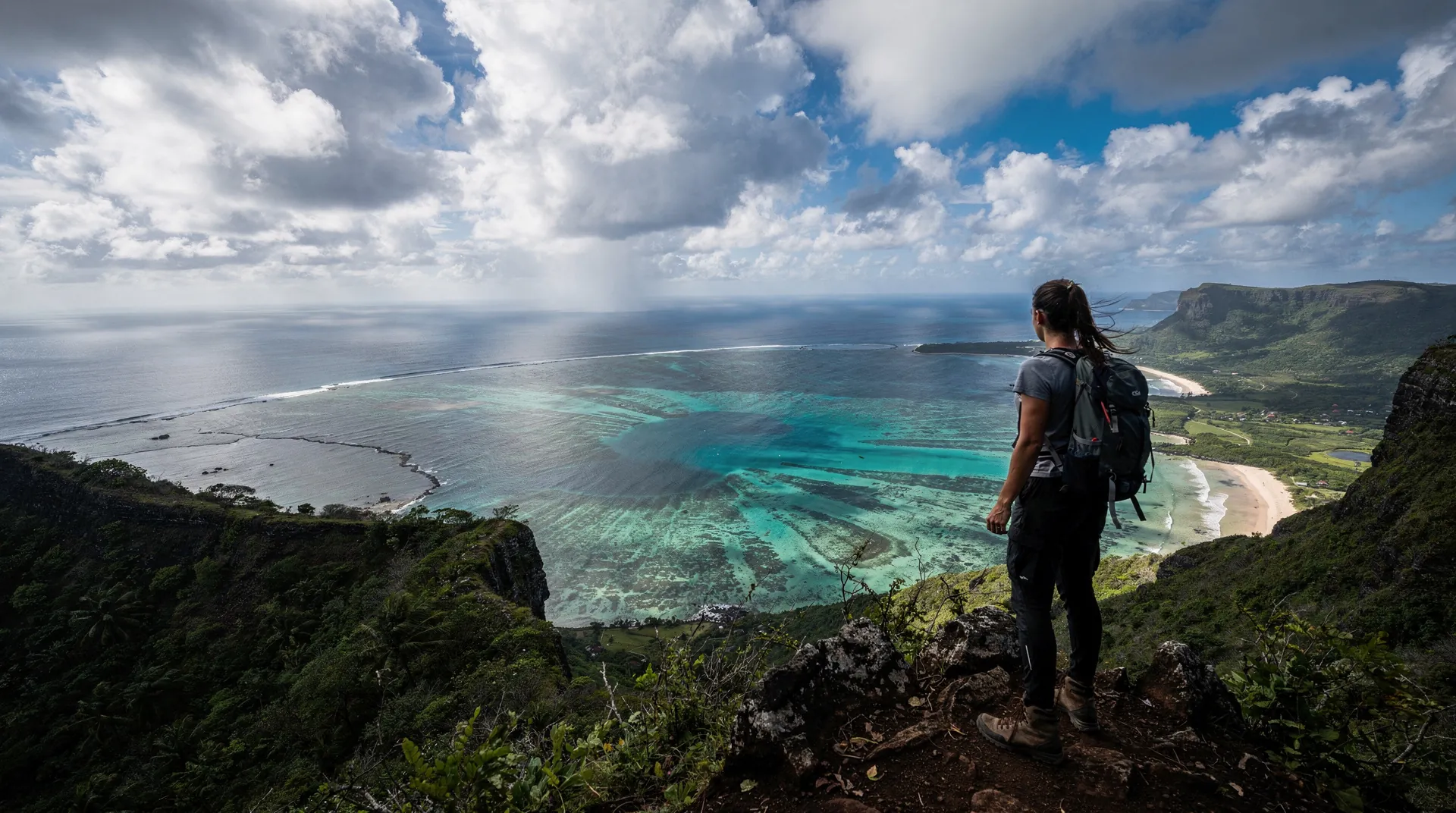
Halfway up, a first natural viewpoint offers an already breathtaking view over the Le Morne peninsula below, with its impossibly blue lagoon and the tongue of white sand reaching into the ocean. I paused, drank a little water, and looked at the landscape for five minutes without saying a word.
The upper section is the trickiest. The basalt rocks are slippery when wet with morning dew, and several passages require using your hands. Vishal shows me the entrance to one of the caves used by the maroon slaves — a crack in the rock, just wide enough for a man to squeeze through while bent over. Standing in front of this cave, he tells me the story of these hidden communities. The silence that follows is heavy.
The summit, reached about 2h30 after setting off, is a rocky platform from which the 360-degree view is absolutely spectacular. On one side, the Indian Ocean stretches to the horizon without a single break. On the other, Mauritius in its entirety — the intensely green sugar cane fields, villages nestled in the valleys, roads winding between the hills, and in the distance, the central plateau with the highlands of Curepipe in the haze.
On a very clear day, you can spot Réunion on the horizon — 200 kilometres of open sea. It’s one of the most powerful moments Mauritius has to offer.
The descent
If the climb is gruelling, the descent demands its own kind of concentration. Your knees take more strain, and the slippery sections that seemed manageable on the way up suddenly feel more intimidating facing forward. Vishal goes ahead of me on the tricky sections, guiding me step by step. His knowledge of the terrain is invaluable.
We’re back down by around 10am. Three and a half hours of hiking, about ten kilometres round trip, 400 metres of elevation gain. My legs are slightly shaking with fatigue, my arms marked with a few scratches from the thorny bushes, and I have a sense of physical and emotional satisfaction that few tourist activities provide.
The descent gives us views of the Le Morne peninsula lagoon from different angles. The shades of the water — from pale turquoise to deep blue — shift with depth and distance. It’s one of the most beautiful views on the island.
After the hike
The village of Le Morne and its surroundings offer plenty to help you recover after the effort.
Le Morne beach is a short walk from the welcome office. White sand, turquoise lagoon, few people on weekdays — perfect for swimming, resting in the shade of a screwpine and letting the cool lagoon water soothe your sore muscles. This beach ranks among the best in our guide to the beaches of Mauritius.
Route des Casernes, in the village, has a few local eateries serving hearty lunches at bargain prices. After a morning of hiking, chicken curry with rice and a cold glass of tamarind juice is divine. For the best addresses in the region, our Mauritius gastronomy guide lists a few authentic local spots in the south-west.
The Le Morne peninsula deserves an afternoon exploring by car: the kitesurfers launching into the south-west winds, the changing colours between the shallow lagoon and the deep ocean, and the late-afternoon light that turns golden on the mountain you just climbed. Le Morne’s kitesurfing spot is one of the most spectacular on the island — our kitesurfing and surfing guide to Mauritius covers it in full.
Chamarel and its Seven Coloured Earths are 30 minutes by car east of Le Morne. If you still have energy in the early afternoon, it’s a great combination for the day: Le Morne in the morning, Chamarel in the afternoon. Our Chamarel guide details this unique geological attraction.
Variations and alternatives
Hiking without a guide (not recommended but possible outside the paid zone)
The Le Morne peninsula can be explored on foot along its coasts and lower trails without paying for a guide. But the climb to the actual summit requires the licensed guide. Don’t try to get around this rule — the accidents are real and the terrain is serious.
Alternative hikes in the south-west
For those who want to hike in the region without the technical demands of Le Morne, the Black River Gorges (a 20-minute drive away) offer more accessible trails through a magnificent endemic forest. Our guide to hiking in Mauritius presents a full selection of routes by level and region.
Humpback whale watching
From June to October, humpback whales pass off the south-west coast of Mauritius, just a few kilometres from Le Morne. Boat trips are organised from the Le Morne peninsula to go and meet them. Our whale watching guide to Mauritius gives all the practical information for combining a hike with marine wildlife spotting.
Is it really worth the trip?
Yes, without a doubt. Le Morne Brabant is one of the most complete experiences Mauritius has to offer: physical effort, stunning scenery, historical depth, and the quality of the human connection with the guide.
It’s an experience that steps outside the usual beach-holiday framework and leaves something deeper than a simple memory. You come back down from Le Morne with the feeling of having understood something about this island — about its painful past, about the stubborn beauty of its landscapes, about the resilience of those who lived there.
Le Morne is included in our 7-day Mauritius itinerary as one of the standout experiences of a well-rounded trip. It also features in our honeymoon itinerary for couples seeking an intense shared experience beyond the beaches.
This summit deserves your sweat. Go for it.
Tips for preparing your climb
The night before
Sleep well. The Le Morne climb takes energy, and holiday mornings tend to tempt you into lingering in bed — resist. Pack your bag the night before: hiking shoes, water (minimum 1.5 litres per person), windbreaker, sun protection, an energy snack. Check the weather — Le Morne is often unpredictable, and low clouds can ruin the view from the summit.
The guide
Don’t skip the guide. Beyond safety, it’s the guide who gives the hike its meaning. Vishal told me stories about his family, the village, the maroon slaves who lived in these cliffs. Without him, I would have climbed a mountain. With him, I understood a fragment of history. The difference isn’t trivial.
Photography
Le Morne is an extraordinary photography subject. The summit offers 360-degree views that call for a wide-angle lens. Morning light (before 9am) is ideal — the mist rising over the valleys, the colours of the water in the lagoon, the sugar cane fields stretching as far as the eye can see. Bring a charged battery and plenty of memory card space.
Combining with other activities
Le Morne Brabant lends itself perfectly to a well-organised day. Hike in the morning (departure 6:30am, return around 10am), a swim in Le Morne’s lagoon or lunch at a local snack bar until 1pm, then an afternoon excursion. There are plenty of options depending on the season.
From June to October, a swim-with-dolphins outing at Tamarin can round off the morning hike nicely. Dolphins are present in the waters off Tamarin year-round, but outings are more frequent in the dry season.
Chamarel and its Seven Coloured Earths remain the most common excursion from Le Morne — the two sites are 30 minutes apart and make for a thematically coherent day between volcanic nature and history. Our Chamarel guide prepares you for this exploration of the south-west interior.
What Le Morne says about Mauritius
Every island has its symbolic places — the ones that condense the essence of what it is. In Mauritius, Le Morne Brabant is one of them. It’s not the island’s highest mountain (Pieter Both rises to 823 metres), nor the most accessible. But it’s the most charged with meaning.
Climbing Le Morne means joining a long history of human resistance. It means looking at the same cliffs as those escaped slaves who sought in the rocks the freedom the law denied them. It means understanding, physically and emotionally, why this island is what it is today.
The beaches of Mauritius are beautiful. The lagoons are turquoise. The rum is excellent and the Creole food generous. But Le Morne is something else — a depth that beach tourism doesn’t offer. And that’s why it’s recommended to anyone who wants to understand the island rather than simply consume it.
For a trip that combines both natural beauty and cultural depth in Mauritius, our 7-day Mauritius itinerary offers a balance of beaches, hikes and cultural experiences.
A memory that stays
On the way down from Le Morne, I thought of something Vishal had told me near the entrance to the maroon slaves’ cave: “These people had nothing and they had everything — freedom in their minds.” That sentence stayed with me long after I got home.
Le Morne Brabant is a physically demanding mountain, historically overwhelming, and visually stunning. It’s also a lesson in human geography: this island of 1,860 km², in the middle of the Indian Ocean, has packed more human stories — tragic, courageous, joyful, complex — into a few centuries than many far larger nations.
Climbing Le Morne means understanding through the body what history books explain through words. It’s one of the strongest and most genuine experiences Mauritius has to offer. It deserves your time, your energy and your full attention.
To plan your logistics, our car rental guide to Mauritius covers everything you need to know to reach Le Morne early in the morning from anywhere on the island.