
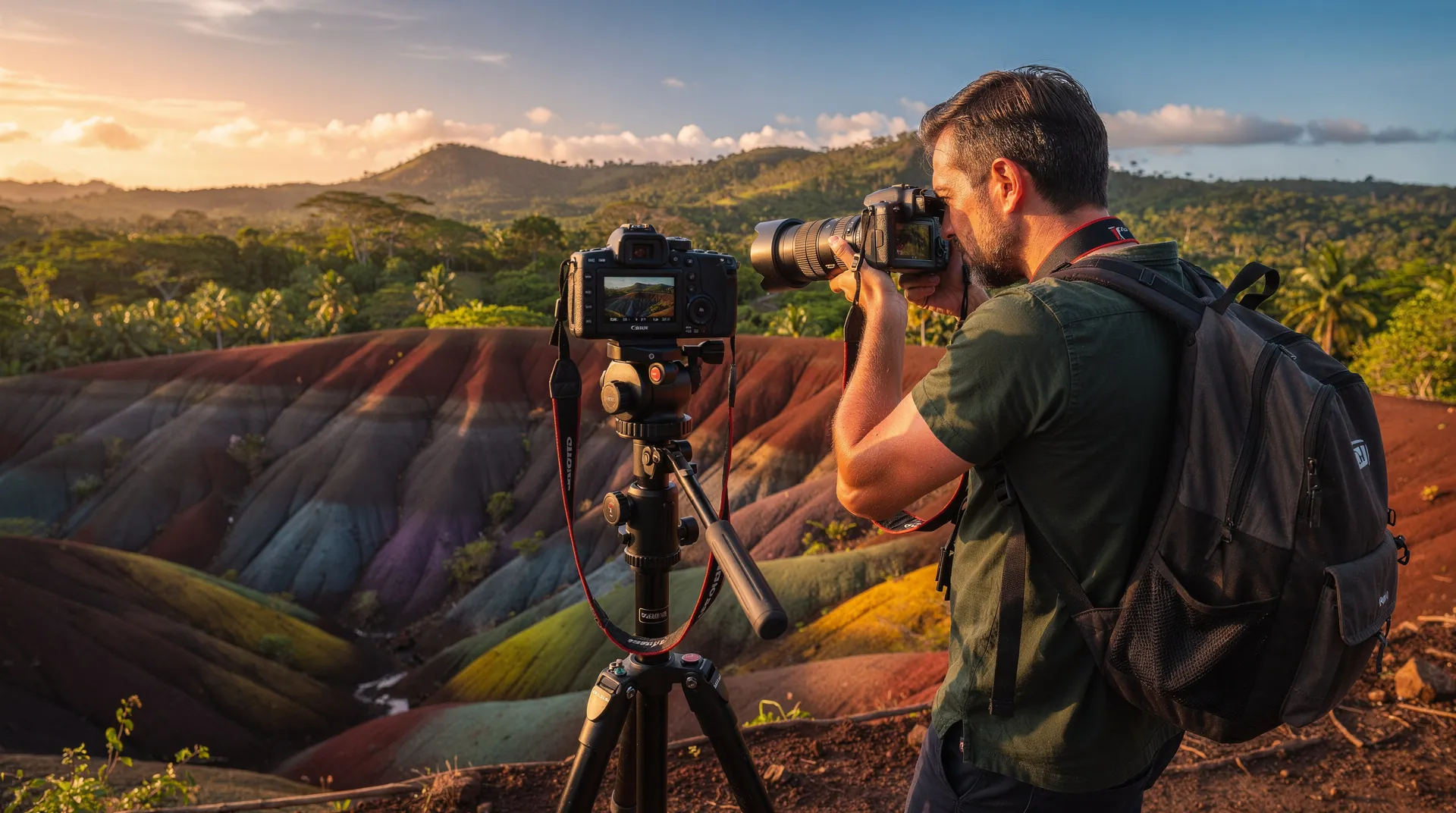
Photographing Mauritius: the best spots and tips
Updated: March 2026
Mauritius, an island made for photography
It’s no coincidence that Mauritius is one of the most photographed destinations in the Indian Ocean. The island packs an exceptional variety of subjects into a small space: turquoise lagoon, volcanic mountain, tropical forest, colorful villages, vibrant markets, marine wildlife, blazing sunsets. In a single week, a patient photographer can come home with a remarkably rich collection of images.
This guide is written from my own experience as a passionate amateur photographer — not a professional, but someone who has spent hours chasing the right light on this island and learning (often the hard way) what works and what doesn’t.
| Quick facts | |
|---|---|
| Where | The whole island, with highlights at Morne Brabant, Chamarel and the east coast |
| Best time to visit | May to December, clearer skies; avoid January-February (clouds and cyclones) — see our best time to visit guide |
| Recommended gear | Weather-sealed body, wide-angle lens, lightweight tripod, polarizing filter |
| How to get around | A rental car to stay free of fixed light-chasing schedules |
| Extra equipment budget | Little to no direct cost: most spots are public beaches or free viewpoints |
Light in Mauritius: understanding it before you shoot
Light is every photographer’s first subject. In Mauritius, it has its own distinct character.
Tropical midday light is harsh. Between 10am and 3pm, the sun sits almost directly overhead, shadows are short and contrasty, and colors look saturated but “blown out.” This is the least favorable period for landscape or portrait photography.
Morning golden hour — the sun rising over the island’s east coast — is remarkably good. The golden, low-angle light of the 30 to 60 minutes after sunrise turns every landscape into a painting. The east coast beaches (Belle Mare, Trou d’Eau Douce) are especially beautiful at this hour.
Evening golden hour is the most spectacular on the west coast. Flic-en-Flac, Tamarin, Le Morne — the entire west coast benefits from a sun setting over the ocean horizon that produces impossible colors.
Diffuse light on cloudy days is underrated. During the rainy season, clouds filter the direct light and create an ideal softness for portraits and market scenes. The colors of spices and fruit are especially true-to-life under veiled light.
The best photo spots in Mauritius
1. Le Morne Brabant from the beach or the summit
The Morne mountain is one of the island’s most photogenic subjects. From the beach on the Morne peninsula, in the late afternoon, the peak turns a reddish orange as the shadow lengthens over the lagoon. Use kitesurfers or small fishing boats as a foreground point of interest.
From the summit (if you do the hike), the 360-degree panorama offers compositions found nowhere else in Mauritius — the coastline unfurling in both directions, the endless ocean, and the sugar cane fields below.
Recommended time: sunrise for the mountain’s silhouette from the beach (from the east side of the peninsula). Late afternoon for the golden color on the mountain’s flanks.
Equipment: a wide-angle lens for the views from the summit. A moderate telephoto (70-200mm) to isolate details — distant kitesurfers, rocks in the waves.
2. Chamarel and the Seven Coloured Earths
The Seven Coloured Earths present an interesting photographic challenge: how do you capture the range of colors in these volcanic dunes without the image looking artificial or oversaturated? The guided tour to Chamarel’s colored earths and waterfall drops you at the site early in the morning with transport included — ideal for arriving before the tour buses.
A few tips: shoot early in the morning, before the crowds, when the low-angle light brings out the textures and relief. Avoid midday, when direct light flattens the contrast. Look for compositions that include some sky or the surrounding vegetation — they add scale and context.
The Chamarel waterfall, a few minutes away, is easier to photograph but requires a slow shutter speed (1/15 to 1/4 second) to create the silky blur effect of moving water. A tripod is essential.
Recommended time: 7-9am for the colored earths. Any time with soft light for the waterfall.
3. The Port Louis central market
A market is one of the richest and most challenging photographic subjects at once. The Port Louis market, with its colors, vendors, shoppers, and piles of spices and fruit, is a goldmine of images.
Two approaches work well. The first: the wide shot, capturing the overall atmosphere — the crowded aisles, the overlapping colors, the movement. The second: the tight portrait, the detail shot — a vendor’s hands weighing spices, an old woman’s face as she examines a mango, a pyramid of red chilies in a burlap sack.
Key tip: always ask before photographing people up close. A smiling “may I take your photo?” almost always gets a positive response, and often sparks a conversation that enriches the experience.
Equipment: a 35mm or 50mm lens for wide scenes. An 85mm or longer for discreet portraits from a distance.
4. Flic-en-Flac at sunset
Covered in detail in our dedicated article, the Flic-en-Flac sunset is a classic. For photography, here are a few angles less overused than the traditional “sun dipping into the sea”:
Palm tree silhouettes against the colored sky. Reflections of the twilight sky in tide pools. Fishing boats moored with a fiery sky behind them. Backlit human figures on the beach — couples, families, fishermen.
Equipment: a wide-angle lens for broad compositions. Expose for the sky, not the foreground — let the beach fall into silhouette.
5. The waters of Blue Bay from above
If you get the chance to take a microlight or helicopter flight (some operators offer scenic flights), the waters of Blue Bay seen from the sky are stunning. The gradients of blue and green in the lagoon, the dark patches of coral reef beneath the clear surface, the strip of white sand separating ocean from land — this is an aquatic geography only visible from above.
For photographers who prefer to stay at water level, the guided snorkeling excursions in Blue Bay let you photograph coral and turtles with a waterproof housing in the island’s best reef.
For those without access to a flight, a drone (if Mauritian drone regulations allow it at that specific spot — always check) can produce similar results.
6. The east coast at sunrise
Mauritius’s east coast faces the rising sun. At Belle Mare, Trou d’Eau Douce, Mahebourg — the sun rises over the ocean and bathes the lagoon waters in exceptional golden hues for a short 20-to-30-minute window.
The challenge: getting up early (5:30-6am depending on the season). The reward: an empty beach, extraordinary light, colors you won’t see again come midday.
7. The inland villages: Mauritian authenticity
The villages of the central plateau — Mahebourg, Curepipe, Quatre Bornes, the small towns scattered among the sugar cane fields — offer a valuable counterpoint to the lagoon landscapes. Weathered, colorful Creole houses, neighborhood shops, Tamil temples covered in colorful carvings, plainly built mosques, children playing in the streets on their way home from school.
This kind of photography demands time, respect and discretion. Put your camera down sometimes, talk to people, then ask if you can take a photo. The strongest images come from a connection, however brief.
Technical tips specific to Mauritius
Overexposed sand and water
Mauritius’s white sand and turquoise water reflect an enormous amount of light. Your camera will tend to underexpose to avoid “blowing out” these bright areas — which leaves the rest of the image too dark.
The fix: use exposure compensation (+0.7 to +1.5 EV depending on the situation) or shoot in RAW and correct in post-processing.
Protecting your gear from sand and water
Sand and salt water are your camera gear’s natural enemies. A few basic precautions: never set your camera body directly on the sand. Carry your gear in a waterproof or at least splash-resistant bag. On windy beaches, protect your lens when you’re not shooting. If you’re shooting underwater or snorkeling, a waterproof housing or case is essential.
Underwater photography
For divers and snorkelers, underwater photography in Mauritius is a constant temptation. Compact waterproof cameras (Olympus TG-7, Sony RX0) or waterproof smartphone cases give decent results at shallow depths.
The golden rule underwater: get as low as possible and shoot upward — you’ll get the surface light behind your subject, giving images of fish or coral a beautiful natural halo.
Animals and marine wildlife
Sea turtles, dolphins, seabirds — the rule is always to never alter their behavior for the sake of a photo. No flash on nocturnal or sensitive animals. Don’t chase a dolphin to get a closer shot. Appreciate the chance to observe it, and if you have the time and the right angle, photograph it discreetly.
When to go photograph Mauritius: a season-by-season calendar
The quality of light and the crowds at each site vary a lot by month. Here’s a reference for planning a photo trip, to cross-check with our best time to visit Mauritius guide and our weather guide.
| Period | Weather and light | What you gain photographically |
|---|---|---|
| May to September (austral winter) | Clear skies, drier air, crisp light | Best visibility for panoramas from Morne Brabant, sharp colors at Chamarel |
| July to November | Same, plus humpback whales offshore in the southwest | A unique chance to photograph a whale watching trip |
| October to December | Transition period, rising heat, still little rain | Very clear lagoon, a good compromise before peak tourist season |
| January to March (rainy season) | Frequent clouds, possible showers, cyclone risk | Interesting diffuse light for portraits and the Port-Louis market, but the Morne summit is often clouded in |
| April | End of the rainy season, skies gradually clearing | Good transition period, vegetation still very green after the rains |
Exploring the island’s regions for varied images
A successful photo trip to Mauritius avoids getting stuck in a single zone. The north, around Grand Baie and Cap Malheureux, offers lively beach scenes and the famous red-roofed chapel. The west, with Flic-en-Flac and Tamarin, is the domain of sunsets and early-morning dolphins. The south, wilder, offers cliffs and a less-photographed coastline that feels more original. Also check our ranking of the island’s most beautiful beaches to plan your routes.
Drones in Mauritius: what to know before you fly
Drone use is regulated in Mauritius: prior authorization may be required depending on the zone, and flying over certain sites (airport, military zones, protected nature parks, crowds) is prohibited or restricted. Before bringing a drone, check with your accommodation or a local operator about which zones are permitted during your stay, and never fly over a crowded beach or a place of worship without explicit permission. It’s worth the effort: aerial views of Blue Bay’s lagoon or the Morne peninsula rank among the most spectacular images the island has to offer.
Gear: what’s actually worth bringing
For a photo trip to Mauritius, here’s my personal kit:
A versatile camera body (mirrorless or DSLR), ideally weather-sealed. A wide-angle lens (16-35mm or 24-70mm) that covers 80% of situations. A discreet telephoto lens (70-200mm or 100-400mm) for birds, wildlife, and street portraits.
A lightweight, compact tripod for sunsets and waterfalls. Spare memory cards (heat and humidity can sometimes cause issues). An extra battery (heat drains batteries faster).
And the polarizing filter, often overlooked, which makes a dramatic difference on tropical waters by cutting reflections and bringing out the colors of the seabed.
One last thought
The best photos of Mauritius may not be the ones you planned for. They’ll be the unexpected sunset from a country road, the old fisherman who smiled at you at the Mahebourg market, the light filtering through the leaves of a badamier tree above a picnic table.
Be ready. Keep your camera accessible, not buried at the bottom of a bag. The best images reward those who stay attentive to the world around them, not just those chasing Instagram spots.
Mauritius will give you beautiful images. Let them come to you.