
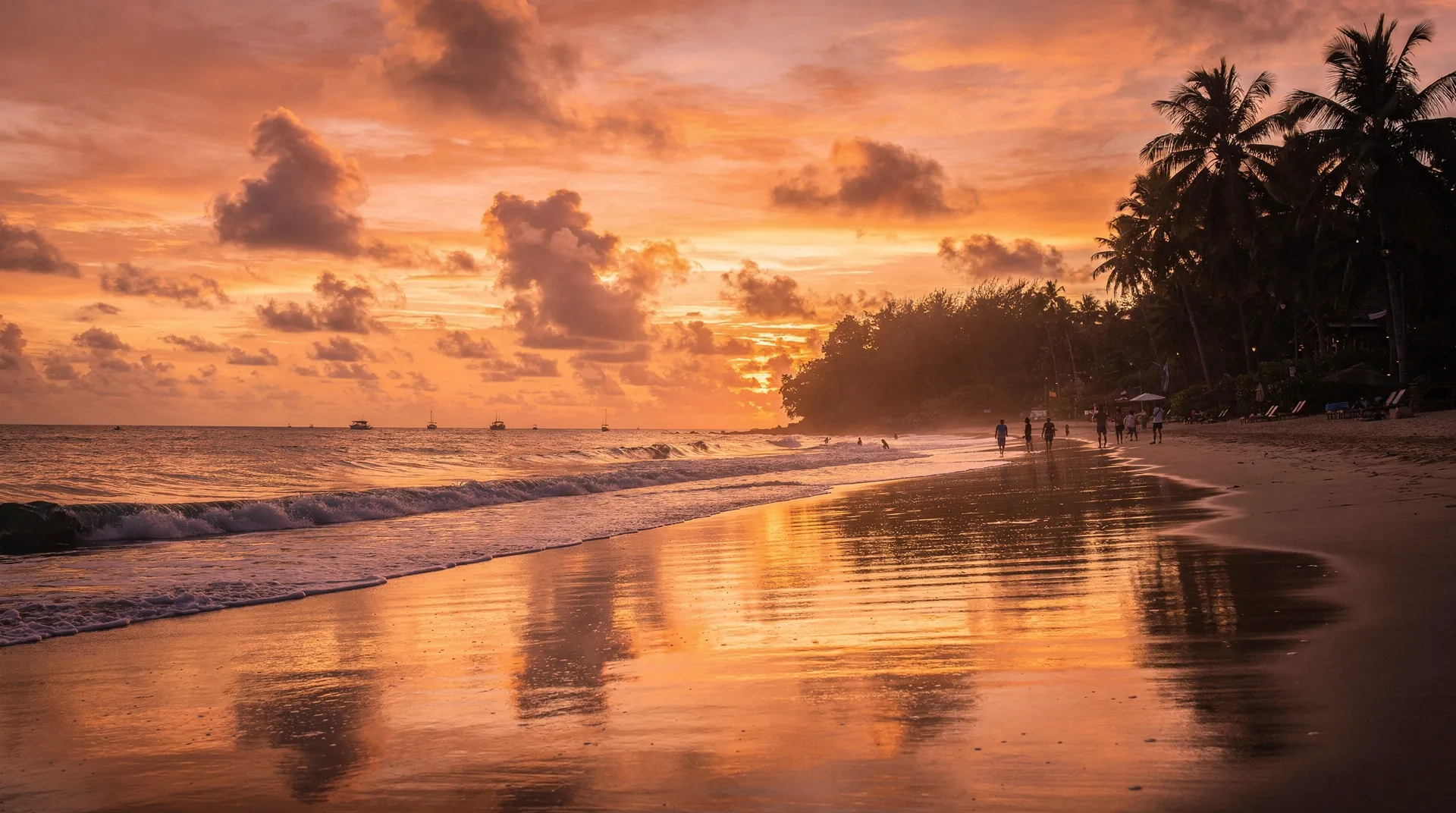
The Most Beautiful Sunsets in Flic-en-Flac
Updated: December 2019
Flic-en-Flac and the sunset ritual
It’s 5:45pm. The beach at Flic-en-Flac is starting to empty of swimmers and beach volleyball players. Coconut vendors pack up their carts. And gradually, a different crowd takes over the sand: couples settling onto sarongs, photographers setting up their tripods, regulars who come every evening the way others might sit down to watch the evening news.
It’s sunset time at Flic-en-Flac, and it’s one of the most beautiful moments this island has to offer. This daily ritual is one of the reasons Flic-en-Flac remains one of the most popular beach towns on the west coast, and one of the destinations we recommend first in our couples’ activities guide to Mauritius.
Quick summary
| Where | Public beach at Flic-en-Flac, Mauritius’s west coast |
| Price | Free — the beach is public, only a drink at a beachside bar is an optional extra |
| Time needed | Arrive 45 minutes before sunset, allow 1 to 1.5 hours on site |
| How to get there | Rental car, taxi, or on foot if you’re already staying nearby |
| Best time | May to September for clear skies and pure tones; November to March for more dramatic sunsets (but less reliable) |
Why Flic-en-Flac?
Mauritius is oriented in a particular way: the west coast faces west, toward the open horizon of the Indian Ocean, with no land between you and Madagascar, 700 kilometers away. It’s this due-west exposure that makes Flic-en-Flac the sunset capital of Mauritius.
On the east coast — Belle Mare, Trou d’Eau Douce, Blue Bay — the sun sets behind you. You see the colors in the sky, but you don’t see the solar disc plunge into the water. That’s a fundamental difference for anyone who loves watching sunsets.
At Flic-en-Flac, the sun descends straight toward the ocean horizon. No mountain, no island, no obstacle — just the endless line of water, and a sun that takes its time drowning in a fireworks display of color.
The entire west coast benefits from this advantage. Tamarin to the north, La Gaulette to the south, and Le Morne at the tip of the peninsula also offer spectacular sunsets. But Flic-en-Flac remains the benchmark: the beach is long, access is easy, and the infrastructure (restaurants, bars, hotels) lets you turn this moment into a genuine evening ritual.
The ideal times by season
Mauritius doesn’t experience the dramatic seasonal swings in daylight that Europe does with its latitude. But there are still notable differences.
In the southern summer (November to March), the sun sets around 6:30-7:00pm. Sunsets are often more spectacular because atmospheric humidity creates clouds that turn orange and red in the last rays. On the other hand, late-afternoon downpours can spoil the show without warning. To find the best periods by season, our Mauritius weather guide will help you plan your evenings.
In the southern winter (May to September), sunset comes earlier, around 6:00-6:30pm. The air is drier, the sky clearer, and the sunset tones are often purer — a gradient of blue, gold, and coral with no clouds to obscure it. It’s my favorite season for this ritual.
As for the precise timing, I recommend arriving on the beach at least 45 minutes before sunset. The show doesn’t start when the sun touches the horizon — it starts well before, when the light begins to turn golden and the palm trees become silhouettes against the sky.
Our favorite spots on Flic-en-Flac beach
The beach at Flic-en-Flac stretches for several kilometers. Not every point along it is equal for sunset-watching.
The north end of the beach: quiet and green
The northern stretch of Flic-en-Flac beach, near the turn-off to Wolmar, is the least crowded. The coconut palms are denser here, creating natural frames for photos. The lack of beachfront restaurants makes the spot feel wilder. This is where serious photographers go for compositions with foliage in the foreground.
The downside: it’s a bit farther from amenities, and once night falls, the walk back in the dark isn’t always straightforward.
The center: the epicenter of the action
Facing the main restaurants and bars of Flic-en-Flac — La Bonne Marmite, Zub’s, Le Domino — the central beach is where all the energy gathers at sunset time. It’s loud, lively, social. Mauritians come here in groups, tourists linger.
This is where the sunset almost becomes a collective celebration. When the sun touches the horizon, spontaneous applause sometimes breaks out in the crowd. An atmosphere you won’t find anywhere else in Mauritius.
The Wolmar promontory
At the northern edge of Flic-en-Flac, a small rocky promontory rises slightly above the beach and offers a slightly elevated vantage point. It’s not dramatic in terms of height, but the change of angle is enough to completely alter the composition. From here, you can see both the distant ocean horizon and the curve of the beach sweeping south.
This is my favorite spot when I want to be relatively alone and get a different perspective.
The beach toward La Gaulette and Le Morne
For the wildest sunsets, driving south from Flic-en-Flac and stopping at one of the small beaches between Tamarin and La Gaulette is a remarkable alternative. The silhouette of Le Morne backlit at sunset is a strikingly beautiful sight. These beaches are less accessible but nearly deserted.
What you can see and do during sunset
Golden light on the fishing boats
In the late afternoon, fishing boats return to the port of Flic-en-Flac. These small, colorful vessels, lit by the low light of the setting sun, make for beautiful photographic subjects. Fishermen unload their catch on the dock while tourists watch the horizon — two worlds coexisting side by side.
The bats (yes, really)
A little-known phenomenon: at nightfall, colonies of fruit bats — the Mauritian flying foxes, with their orange-tinged wings — leave their roosts in the trees to go hunting. These animals, with wingspans of about a meter, cast incredible silhouettes against the twilight sky.
Mauritians call them “flying foxes” — their faces do resemble a fox’s. Watching them fill the sky at sunset, by the dozens, is a sight just as memorable as the sunset itself.
A drink with your feet in the sand
Several establishments in Flic-en-Flac set up tables directly on the sand for sunset. Order a ti-punch, a coconut punch, or simply a nice cold Phoenix beer, and watch the show from a comfortable seat. A few bars also feature live music on Friday and Saturday evenings — you can move straight from sunset into dinner to the sound of local music.
For couples, this moment is one of the most romantic of an entire trip to Mauritius. Our honeymoon itinerary includes a sunset evening at Flic-en-Flac among the key moments of a successful honeymoon.
Late-afternoon snorkeling
Just before sunset, between 4:30pm and 6pm, the afternoon light still penetrates the lagoon perfectly, creating extraordinary lighting effects underwater. If you go snorkeling in the hour before sunset, coming back up to the beach with the show about to begin on the horizon makes for a perfect transition.
Flic-en-Flac is one of the best areas on the island for snorkeling and diving, with exceptional visibility and remarkable marine life.
Sunset at Flic-en-Flac by weather condition
The rainy season (November to April) doesn’t mean permanent clouds and overcast skies. Tropical downpours are often brief and intense — and it’s precisely after these downpours that sunsets are at their most spectacular.
The humidity in the air refracts light in a particular way. The residual clouds after a downpour take on impossible hues: carmine orange, deep violet, fluorescent pink. If you’re lucky enough to catch a post-shower sunset at Flic-en-Flac, you’ll see something you’ll remember for a long time.
On the other hand, if the sky is uniformly overcast with no distinct clouds, the sunset will be flat and unremarkable. That’s the luck of the draw — but in Mauritius, fully overcast days remain rare even during the rainy season. The Windy app, recommended in our guide to useful apps in Mauritius, lets you check weather conditions hour by hour.
Other unmissable sunsets on the west coast
Le Morne Brabant
The silhouette of Le Morne stands out spectacularly backlit at sunset. From the peninsula’s beach, the show is unique. Climbing to the summit of Le Morne in the late afternoon for sunset is technically possible but requires careful planning with a licensed guide — departures stop early in the day.
Tamarin
The village of Tamarin offers a sunset from the beach with surf breaking in the foreground. The vibe is more laid-back than Flic-en-Flac, with surfers coming in from their last sessions, café terraces coming alive, and a very different feel from the big tourist resorts.
The Souillac coast
The southern coast at Souillac isn’t ideal for sunsets (it faces more toward the southwest), but the last hours of light on the basalt rocks and powerful open-sea waves create a unique photographic scene.
Beyond the sunset
What makes Flic-en-Flac appealing isn’t just the sunset. It’s a beach town that has kept a local soul. The beach is popular with Mauritians from the west of the island on weekends — whole families who come to picnic and play beach volleyball, young people swimming and laughing.
This local presence gives Flic-en-Flac a different character from the more exclusively touristy resorts of the north or east. You feel like you’re somewhere that truly belongs to its residents — where visitors are welcome, but which hasn’t been entirely redesigned for them.
The food scene in Flic-en-Flac is also remarkable. The seafood restaurants lining the main street serve fresh fish and grilled lobster at very reasonable prices. Our Mauritian food guide mentions several Flic-en-Flac restaurants among the best addresses on the west coast.
To plan your stay in Flic-en-Flac, our Mauritius hotels guide presents the best places to stay on the west coast, from small local guesthouses to resorts with pools. Car rental in Mauritius is recommended for exploring freely along the coast between Flic-en-Flac and Tamarin as you chase the sunsets.
One last piece of advice
If you’re in love and looking for the most romantic moment of your trip to Mauritius, here’s your answer: sunset at Flic-en-Flac, feet in the sand, two chilled coconuts in hand, and the horizon blazing in front of you.
Few things in the world were quite so well designed to be enjoyed as a couple. Our honeymoon itinerary in Mauritius opens and closes with this sunset ritual on the west coast — the best way to end a memorable trip on a perfect note.
Planning your trip around the sunsets
If you’d like to make sunsets a running theme of your trip to Mauritius, here’s an approach that works very well.
Spend a few days on the west coast — Flic-en-Flac or Tamarin — for seaside sunsets. Then head north for a few nights in Grand Baie or Trou aux Biches. Then head down south — the sunset over the Le Morne peninsula is one of the most spectacular on the island, with the mountain’s black silhouette carved against a blazing sky.
Golden-hour light for photography
Photographers know that the golden light of the two hours before sunset — the “golden hour” — is the most beautiful of the day. In Mauritius, this light takes on a particular quality as it passes through air heavy with ocean humidity. The sugarcane fields glow a deep gold, the lagoons shift from turquoise to lavender, the basalt peaks turn shades of red and orange.
A few golden-hour photo spots in Mauritius: the northern breakwater at Flic-en-Flac with the lagoon in the foreground, La Gaulette beach with Le Morne in the background, the Chamarel highlands overlooking the west coast, and the Grand Baie pier, from which you can watch the sun descend toward the northern islets.
Sunset by catamaran
One of the most memorable experiences on the west coast is watching the sunset at sea, aboard a catamaran. Some operators offer dedicated late-afternoon trips — two hours at sea as the sun descends toward the horizon, a drink served on board, the coast of Mauritius gradually receding. A sunset catamaran cruise from Grand Baie or Trou d’Eau Douce is one of the most romantic activities on the island.
What you’ll see in the sky
The Mauritian sunset isn’t always the same. It depends on the season, cloud cover, and air humidity. Here’s what to expect by time of year.
May to November (dry season): sunsets are often spectacular thanks to high clouds that catch the colors — intense reds, deep oranges, violets. The sky can turn into a shifting painting for 20 to 30 minutes after the sun touches the horizon.
December to April (hot, humid season): the sky can be more uniformly cloudy, but the late-afternoon downpours sometimes give way to sunsets of fractal beauty — rainbows, shafts of light piercing the clouds, greens and yellows that sometimes precede the red of dusk.
The “green flash”: this rare optical phenomenon — a flash of green light at the precise moment the sun disappears below the horizon — is occasionally spotted at Flic-en-Flac on very clear evenings. If you see it, it’s considered a sign of good luck.
Going further
Sunset is often the best time to strike up a conversation with Mauritians. On the beach at Flic-en-Flac at the end of the day, groups of locals settle in, bring out homemade ti-punch, and watch the sun go down together. If you’re open to meeting people, a few words in French or Kreol can turn into an impromptu evening around a neighborhood barbecue.
It’s in these unplanned moments that Mauritius reveals what’s most precious about it: a human warmth and joie de vivre you won’t find in travel brochures. Our Mauritian food guide and local restaurant recommendations will point you toward the best late-evening tables after this free and unforgettable natural show.
Sunset month by month
To plan your evening at Flic-en-Flac precisely, here’s a month-by-month overview of what to expect. These pointers complement our best time to visit Mauritius guide.
| Period | Approximate time | Typical conditions |
|---|---|---|
| January - February | 6:45 - 7:00pm | Hot and humid, risk of downpours, sometimes spectacular sunsets after rain |
| March - April | 6:30 - 6:45pm | Still warm, sky more stable toward the end of the season |
| May - June | 6:00 - 6:15pm | Clear skies, pure tones, drier air |
| July - August | 5:45 - 6:00pm | Coolest, driest season, excellent visibility |
| September - October | 6:00 - 6:15pm | Transition, sky still very clear |
| November - December | 6:15 - 6:45pm | Return of humidity, colorful but less predictable sunsets |
Where to stay in Flic-en-Flac to enjoy the sunset every night
If the sunset ritual is a priority for your trip, your choice of accommodation matters more than you might think. Staying a few minutes’ walk from the beach lets you go back every evening without any transport hassle, rather than depending on a car ride just as traffic thickens along the coast road. Our where to stay in Flic-en-Flac guide lists the best-located accommodation relative to the beach, from budget options to beachfront resorts. For an overview of the beach itself, its length and access points, see our Flic-en-Flac beach guide.
Flic-en-Flac or the east coast: which to choose for sunsets
If your itinerary is still torn between several bases on the island, know that this sunset criterion tips structurally in favor of the west coast. Our comparison of Mauritius’s east coast and west coast covers the other differences between these two sides of the island — beaches, crowds, wind, access to excursions — to help you decide based on your priorities for the trip.
Getting great sunset photos
Beyond the golden-hour tips above, a few simple settings make a real difference for amateur photographers. Turn off the flash and automatic HDR mode on your smartphone, which often flatten the colors of the sky. Instead, use manual exposure or a “pro” mode if your phone offers one, slightly underexposing to preserve the sky’s colors rather than the details of the beach. Our photo guide to Mauritius expands on these techniques with other iconic spots on the island not to miss during your trip.