
Swimming with Dolphins in Tamarin: Our Experience and Tips
Updated: March 2024
The west coast and its dolphins
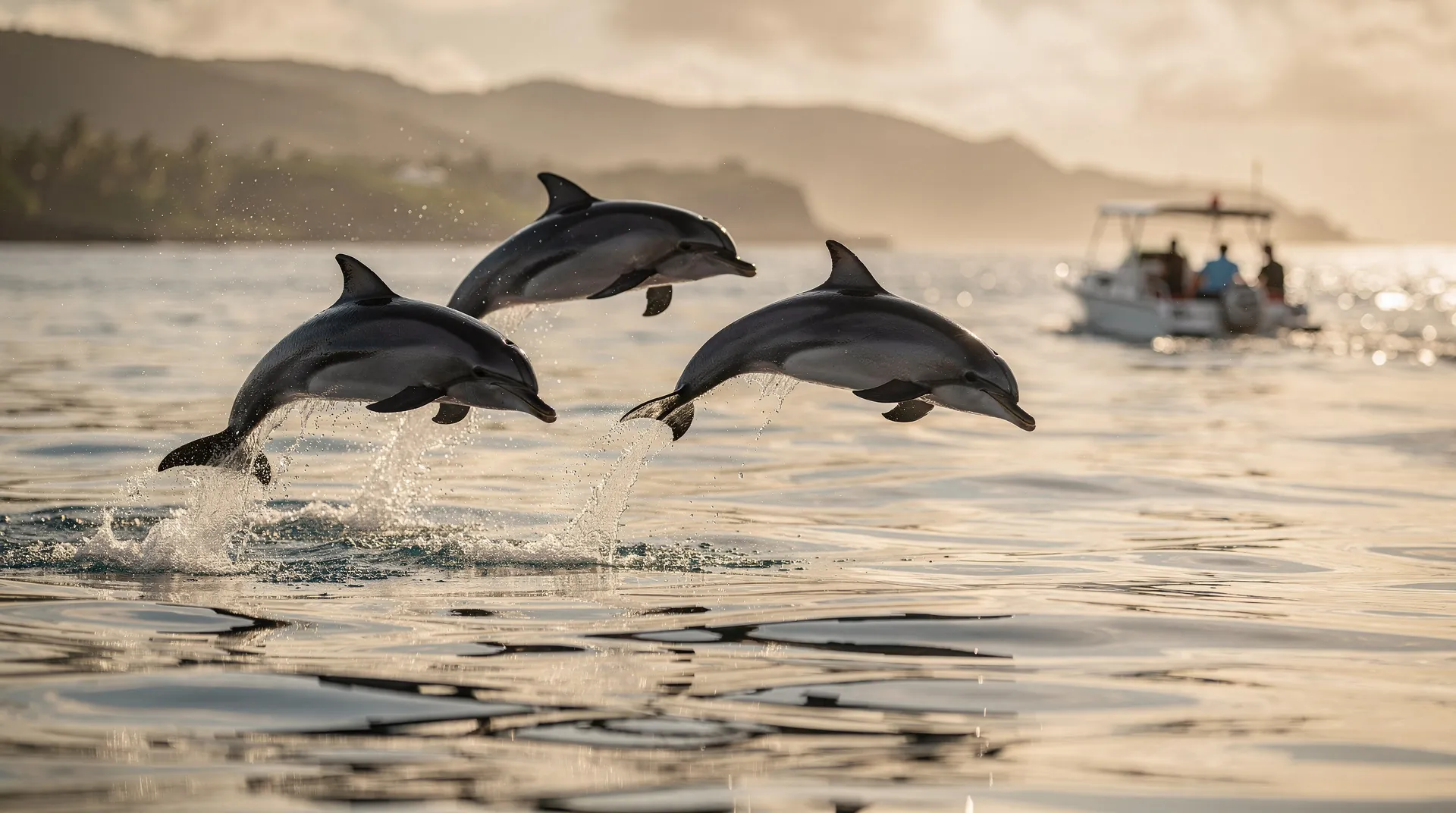
The bay of Tamarin, on the west coast of Mauritius, is one of the rare places in the world where spinner dolphins (Stenella longirostris) regularly frequent the coastal waters. These cetaceans live in large groups — sometimes several hundred individuals — and have made Tamarin Bay one of their favourite spots to rest and socialise.
The experience of swimming with wild dolphins has gradually grown since the 2000s, to the point of becoming one of the island’s most popular activities. And as always when tourist popularity takes off, questions arise about the environmental impact and the quality of the operators.
I’ll tell you honestly what I experienced, what gave me pause, and how to choose a responsible operator to enjoy this experience in the best possible way.
| At a glance | |
|---|---|
| Where | Tamarin Bay, west coast |
| Price | Roughly 35 to 80 euros per person depending on the operator |
| Time needed | A morning (about 3h to 3h30, departure around 6:30am) |
| How to get there | By car from Grand Baie (about 45 min) or Flic en Flac (about 20 min); our car rental guide helps you plan the trip |
| Best time to go | Year-round, with calmer seas from May to December |
Our morning with the dolphins
We boarded at 6:30am from the small port of Tamarin. The operator we’d chosen (a small family outfit with two boats, a world away from the big mass-tourism operators) had asked us to be there at sunrise.
The reason is simple: spinner dolphins are nocturnal. They hunt at night in deep water, then return to the shallow coastal waters of Tamarin Bay in the early morning to rest, socialise and tend to their young. It’s during this resting period that they can be approached — and that’s also why it’s crucial not to disturb them excessively.
Tamarin Bay is sheltered from wind and swell by the coral reef, making it a calm stretch of water — ideal for resting dolphins, and for swimmers not used to waves.
Searching for dolphins: our guide scanned the horizon with binoculars from the bow of the boat. Within 20 minutes he’d spotted the telltale signs of a pod — gulls diving in one area (a sign of fish near the surface), and a few discreet leaps. The engine slowed.
The approach: a responsible operator doesn’t approach the dolphins directly or at full speed. The engine is cut a hundred metres or so from the pod, and the dolphins are left to decide whether they want to come closer. In our case, a group of about twenty individuals came towards us — curious, as these highly social animals often are.
Getting in the water: our guide slipped us into the water discreetly — one at a time, without splashing or commotion. Kitted out with masks, snorkels and fins, I put my head under.
What struck me first was the sound. Dolphins communicate through a series of clicks and whistles that carry underwater for several metres. It’s a strange, almost musical sound that seems to come from everywhere at once.
Then I saw them. About ten grey shapes gliding through the blue water, 3 to 5 metres down. They didn’t come close enough to touch, but stayed a few metres off, watching us — in every sense of the word. A young calf, with its mother, arced around me. Ten seconds of wild intimacy I won’t soon forget.
How long does the experience last?
Our outing lasted about 3h30 in total. Roughly 2 hours at sea, with several rounds of getting in the water depending on the dolphin encounters. Back at the port mid-morning.
Some operators extend the trip with a snorkelling stop on a coral reef. If you’d like to take that option, our snorkelling and diving guide points you to the best spots on the west coast. It’s a pleasant add-on if you have the time.
The boat usually returns to Tamarin before noon, leaving you the afternoon free to explore the area, go surfing, or simply relax on the beach.
What concerned me: the ethical question
I have to mention something I observed that morning that’s worth thinking about.
Alongside our small boat, several much bigger boats — some with 20 or 30 people aboard — were literally chasing the same pods of dolphins. High-speed approaches, mass entries into the water with floats for weak swimmers, commotion in the water. Dolphins that had come to rest were being disturbed over and over.
Scientific research has shown that repeated disruption of the morning rest period of Tamarin’s spinner dolphins has real consequences for their health and reproduction. Some Mauritian biologists are pushing for stricter regulation of dolphin excursions. Our guide to swimming with dolphins covers this ethical question in detail and helps you choose a responsible operator.
This reality doesn’t mean the experience should be banned — but it should be done with the right operators, following clear ethical principles.
How to choose a responsible operator
The good practices you should demand from your operator:
A limited number of people per boat: beyond 8 to 10 people, the experience loses quality and the impact on the dolphins increases. Be wary of trips packing in 15, 20 or 30 people.
A non-intrusive approach: the operator should cut the engine before approaching the dolphins and let the animals decide whether to come closer. No boat should ever charge straight at the pod.
No forced contact: dolphins shouldn’t be chased to keep them near swimmers. If a pod moves away, that decision should be respected.
A clear briefing on behaviour at sea: a good operator explains to participants how to behave — no sudden movements, no noise, no attempting to touch the animals.
Certification or membership of a charter: some operators belong to local dolphin protection associations or are certified “responsible dolphin watch”. Always ask.
Tamarin Bay beyond the dolphins
If you’re passing through Tamarin for this experience, take the time to explore the area. The bay is one of the most beautiful on the west coast — framed by cliffs, with an estuary where flamingos sometimes spend the southern winter.
Tamarin village itself is worth a stroll. It’s a fascinating mix of long-established Mauritian families and expats (Australian, South African, French) drawn by the surf. Tamarin’s wave is renowned — a fine left-hander forms on certain days, and international surfers sometimes make the trip just for it.
About ten kilometres to the south, Le Morne Brabant is one of the island’s most spectacular sites — a magnificent beach, a UNESCO-listed table mountain, and an intensely blue lagoon where kitesurfers glide about all day.
Heading north from Tamarin, Flic en Flac offers its famous sunsets and seafront restaurants — a perfect way to end the day after your morning at sea.
Prices and booking
Prices for dolphin excursions in Tamarin vary considerably from one operator to another:
- Small, responsible independent operators: 35 to 60 euros per person
- Larger tourism outfits: 50 to 80 euros per person (sometimes more, for a service of lesser ethical quality)
- “Dolphins + catamaran + lunch” packages: 80 to 120 euros per person. Our catamaran outings guide pairs well with this excursion.
Booking ahead (24 to 48 hours) is recommended, especially in high season. Your hotel may suggest operators, but keep in mind that hotels sometimes earn a commission and don’t always select on ethical grounds. You can also book the swim-with-dolphins excursion in Tamarin directly online before you leave, to guarantee your spot. Ask operators directly about their responsible-conduct policy.
What to bring and how to prepare
A swimsuit under your clothes (the early start leaves little time to change on the boat), a towel, waterproof sunscreen applied before departure (the early-morning sun is already strong), and if you’re prone to seasickness, a tablet taken the night before rather than the same morning — swell can build up outside the sheltered lagoon. Many operators provide mask, snorkel and fins, but if you have your own gear and prefer it, bring it along: comfortable equipment makes a big difference to the experience underwater.
Also plan for a light breakfast before boarding rather than a heavy meal, and a bottle of water. Most boats have no toilets on board, so plan ahead. A waterproof camera or a simple waterproof phone pouch will let you capture a memory, but keep in mind that the priority should be the observation itself — many swimmers regret spending more time filming than watching.
Is it suitable for everyone?
The activity requires a decent level of swimming: you need to be comfortable in deep water, out of your depth, sometimes with a bit of current. Children from around 8-10 years old who swim well can generally take part, but each operator has its own minimum age rules — check when booking. For younger children or less confident swimmers, some boats let you stay aboard to watch the dolphins leap without getting in the water, which is a lovely experience in itself.
Pregnant women and people with heart or respiratory conditions should consult a doctor before booking, given the sometimes brisk pace of getting in the water and possible chop outside the lagoon.
Are dolphin sightings guaranteed?
Dolphins are wild animals. Their presence in the bay isn’t 100% guaranteed, even though it’s very regular (estimated at 90-95% of working days). If you don’t see dolphins on your morning out, almost all serious operators offer either a partial refund or a replacement trip.
Weather can also affect the outing. In swell or strong wind, some trips are cancelled for safety reasons. Check our weather guide to find out which period is most favourable.
Combined with a trip to watch whales (from July to November), the marine experiences of Tamarin make for an exceptional programme for lovers of the marine world.
What really stays with you
Swimming with wild dolphins is an experience that touches something deep. Not the thrill of a theme park ride, but something calmer and more lasting. The sudden awareness that the sea is inhabited, that non-human intelligences are living their lives just metres away from us, and that for a few minutes, we got to share their world unconditionally.
That’s why Mauritius, with its bay of Tamarin, remains unique. No other destination in the Indian Ocean offers this encounter with such likelihood and such beauty. Whether you come as a family (see our family itinerary), as a couple (our honeymoon itinerary includes this experience), or solo, meeting the dolphins of Tamarin is a memory that lasts.
Do it. But do it right.