
First dive in Mauritius: a beginner's story and tips
Updated: September 2022
The fear, first
I have to admit something: I was afraid of the water. Not a paralysing fear, but that dull unease felt by people who grew up far from the sea and struggle to picture what happens beneath the surface. I can swim, but the idea of strapping a tank to my back and descending into the depths felt like an adventure reserved for other people.
It was in Mauritius, on my third stay on the island, that I finally took the plunge. And it’s in Mauritius that I’d advise you to do the same if you’re in the same boat.
This account of a discovery dive complements our snorkelling and diving guide to Mauritius, which gives an overview of all the underwater options on the island for every level.
| At a glance | |
|---|---|
| Where | PADI centres in Flic-en-Flac, Trou aux Biches, Blue Bay and Grand Baie |
| Price of a discovery dive | Around 50 to 80 euros depending on the centre and area |
| Time needed | Half a day (briefing, boat trip, dive of about 30 minutes) |
| How to book | Directly with a local PADI centre, the day before or same morning in low season |
| Best time | Year-round, water between 23 and 28 degrees; visibility often better in the southern winter (May to October) |
Why Mauritius is ideal for beginners
Several factors make Mauritius a prime spot for beginner diving.
The protected lagoon. The coral barrier that surrounds much of the island creates inner zones where the water is calm, shallow and clear. No strong currents, no rolling swell — just crystal-blue water with visibility sometimes exceeding 20 metres. The Flic-en-Flac and Blue Bay areas are particularly well suited to beginners for this reason.
Water temperature. Around 26 to 28 degrees in summer, 23 to 25 degrees in the southern winter. No need for a thick wetsuit — a light 3mm suit is enough in winter, and none at all in summer. Diving stays comfortable and pleasant.
The marine richness. It would be a shame to learn to dive in an underwater desert. In Mauritius, even the first few metres are teeming with life: clownfish in their anemones, parrotfish grazing on coral, rays gliding over the sandy bottom, schools of blue fusiliers swirling around. You don’t need to descend to 30 metres to see something.
The diving centres. The island has numerous clubs and PADI centres, with experienced instructors who speak French. Training standards are generally high, equipment is well maintained, and supervision is thorough. The main clusters of diving centres are found in Flic-en-Flac, Trou aux Biches, Blue Bay and Grand Baie.
For snorkelling without diving, conditions in Mauritius are also excellent. A guided snorkelling trip in Blue Bay lets you explore the island’s best-preserved marine park without any diving gear.
The discovery dive: how it works
I chose my diving centre after reading several online reviews and checking a few traveller forums. I went with a small independent centre in Flic-en-Flac — a dozen tanks, two boats, three instructors — rather than a large, industrial tourist operation.
Booking. I booked the day before by phone. The centre asked whether I had any medical conditions (asthma, heart problems, ear problems) and whether I had dived before. A short medical form to fill in on site in the morning.
The briefing on shore. The instructor — a Mauritian man in his forties, calm and a natural teacher — spent about 45 minutes explaining the basics. How to breathe (slowly, deeply, never holding your breath). How to control buoyancy underwater (by inflating or deflating the buoyancy vest). How to signal a problem to the instructor. How to manage your ears (the famous “equalising” that compensates for pressure as you descend).
He was clear about one thing: if at any point I didn’t feel comfortable, we’d go back up. No pressure, no judgement.
Getting in the water. We took the boat to a dive site about 10 minutes from shore. Entry is a backward roll off the boat — not as dramatic as it sounds. The instructor was right beside me the whole time.
Underwater. It’s hard to describe. In the first few seconds, I had the instinct to want to surface — the sensation of being underwater with air available from a tank on your back is biologically counterintuitive. Then I followed the instructions: breathe slowly, watch the instructor, let myself sink gently.
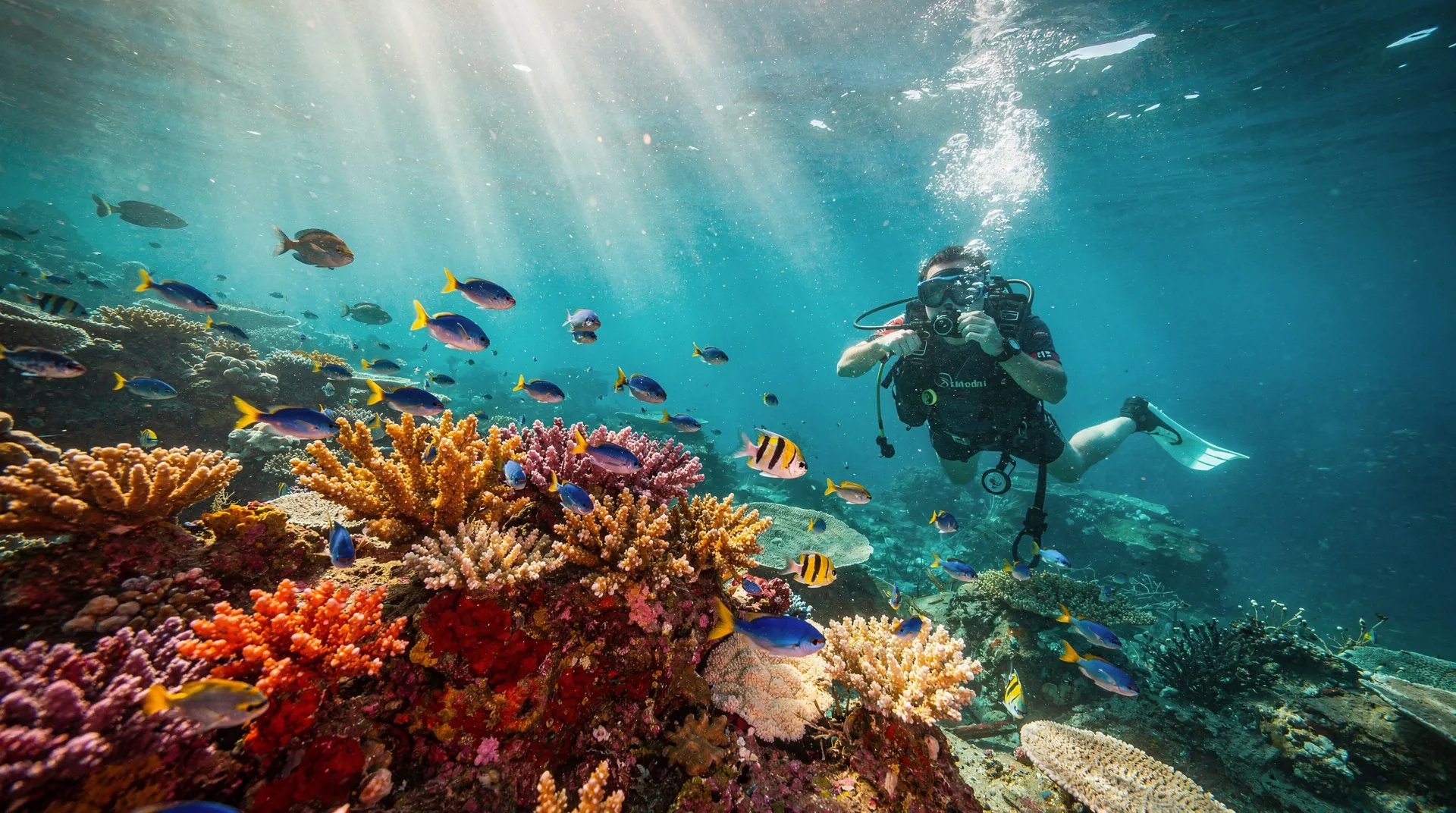
And then, something happened. The underwater world of Mauritius appeared to me all at once, in all its density and beauty. A coral garden in impossible colours. Fish that ignored me entirely, going about their business as if I were just another reef feature. Striped light filtering down from the surface in dancing columns.
We went down to 8 metres — the maximum depth for a discovery dive. We swam for about 30 minutes. On the way back up, my eyes were wide and I had a smile the regulator couldn’t hide.
Beginner-friendly dive sites in Mauritius
Every coastal area of Mauritius has its own dive spots, but some are particularly suited to beginners. Our snorkelling and diving guide details all these spots, including depth, current and observable wildlife.
Flic-en-Flac is often cited as the island’s best diving area, with exceptional visibility and a wide range of sites. Shallow sites like Rempart l’Herbe (8-12 metres) or the Tamarin Pass are perfect for discovery dives. More advanced divers will also find Coin de Mire (to the north) and Flat Island for deeper dives.
Blue Bay, in the southeast, with its protected marine park, offers magnificent seabeds and abundant wildlife. The water there is particularly clear and the coral reefs well preserved. It’s one of the best spots to see sea turtles. A guided snorkelling trip in Blue Bay lets you explore these waters in the best conditions.
Grand Gaube, in the north, offers varied spots, sometimes including wrecks accessible to more confident beginners. The proximity of Trou aux Biches and the northern coral barrier provides a range of shallow sites.
Tamarin on the west coast has less crowded dive spots than Flic-en-Flac, with equally interesting marine life. It’s also the area best known for dolphin encounters — an experience you can enjoy while diving or swimming with dolphins at the surface.
Rodrigues, the satellite island, deserves a special mention for its diving — its waters are considered among the most pristine in the Indian Ocean, with sometimes extraordinary visibility and an impressive density of marine life.
The marine wildlife you can see
That’s the question everyone asks before getting in the water. In Mauritius, depending on the area and depth, you might spot:
The regulars: clownfish and anemones, lionfish, triggerfish, surgeonfish, parrotfish, scorpionfish, moray eels in their crevices. These species are found at shallow depths and accessible to beginners.
The stars: sea turtles (mainly green turtles) are relatively common, especially at Blue Bay and around Le Morne. Manta rays occasionally pass near the channels. Dolphins, present at Tamarin and in the west, sometimes come to visit divers.
The coral life: the hard and soft corals of Mauritius are a spectacle in themselves. Healthy coral reefs burst with colours and textures, and the microscopic organisms that inhabit them are fascinating to observe up close.
Sharks: yes, there are some in Mauritius. Mainly blacktip and whitetip reef sharks — completely harmless to divers and very wary of humans. Encountering one is a moment of grace, not panic.
What to know before booking
Certification. A discovery dive requires no prerequisites — anyone who can swim can do it. If you want to go further, the PADI Open Water course (the first recognised certification) takes 3 to 4 days and afterwards lets you dive to 18 metres with relative autonomy. Diving centres in Flic-en-Flac and Grand Baie offer this course during a stay.
Insurance. Check that your travel insurance covers diving. Most standard policies cover discovery dives, but not necessarily deep dives or Decompression Sickness (DCS). DAN (Divers Alert Network) offers dive-specific insurance at very reasonable rates.
Health. Certain medical conditions (severe asthma, heart problems, chronic ENT conditions, pregnancy) rule out diving. If in doubt, consult your doctor before departure.
Time before your flight. Don’t dive within 18 hours of a flight — the decompression and pressure changes on board can cause accidents. Plan your last dive at least the day before. If you’re leaving Mauritius after a week of intensive diving, schedule your final session 24 hours before your flight.
The budget for diving in Mauritius. A discovery dive costs between 50 and 80 euros depending on the centre and area. A single dive for certified divers costs 40-60 euros. The full PADI Open Water course costs between 300 and 400 euros. Our Mauritius budget guide factors these costs into different travel profiles.
Snorkelling as an accessible alternative
For those still hesitant about diving with a tank, snorkelling is an excellent way in. The lagoons of Trou aux Biches, Belle Mare and Blue Bay offer a fabulous underwater world accessible right from the surface, with no training or complex equipment needed.
Our snorkelling and diving guide to Mauritius presents the best snorkelling spots by region, with optimal conditions and species to look out for. For a structured experience, a guided snorkelling trip in Blue Bay with a guide includes transport, equipment and local knowledge of the best spots.
What I took away from it
This discovery dive in Flic-en-Flac remains one of the most memorable experiences from my trips to Mauritius. Not because it was extraordinarily deep or technical — it was, on the contrary, a classic beginner dive. But because that first time underwater revealed a world I had ignored for decades.
I retook my Open Water certification six months later in a swimming pool in France, then went back to Mauritius the following year to dive independently. The loop was closed.
If you’re still hesitating, go for it. The worst that can happen is that you don’t enjoy it and surface after five minutes. But there’s a good chance you’ll do what I did: come back up with an overwhelming urge to go back down.
Diving in Mauritius is one of the activities we wholeheartedly recommend in our 7-day Mauritius itinerary. It transforms your perception of the island: the seaside space suddenly stretches across two dimensions instead of one, and the island becomes twice as big and twice as beautiful.
Diving and other marine experiences in Mauritius
Diving fits naturally into a wider set of marine experiences that make Mauritius a top-tier destination for underwater life enthusiasts.
From dolphins to whales
The west coast of Mauritius is known for the dolphins that live in semi-freedom in the lagoon waters. In Tamarin, boat trips let you swim alongside them in their natural habitat. Our guide to swimming with dolphins in Mauritius presents the best excursions and the operators who respect the animals.
Even more spectacular: from June to October, humpback whales pass off Le Morne Brabant. Boat trips are organised to observe them. The possibility of combining a hike up Le Morne Brabant in the morning with whale watching in the afternoon makes for one of the island’s most intense days.
Night diving
For divers looking to extend the experience, night diving in Mauritius reveals a completely different set of wildlife. Octopuses hunt, lobsters emerge from their hiding spots, moray eels roam the reef. Some centres in Flic-en-Flac and Grand Baie offer these night outings for certified divers. It’s an unsettling experience at first — navigating by torchlight in the absolute silence of the seabed — and an unforgettable one.
After the dive: recovery and food
Diving works up an appetite. The diving centres of Flic-en-Flac are a stone’s throw from the fish restaurants on the main street — grilled barracuda, prawns sautéed in butter and lemon, a well-earned cold Phoenix beer after the morning’s effort. Our culinary guide to Mauritius presents the best tables on the west coast for these post-dive lunches.
Frequently asked questions before a discovery dive
Do you need to know how to swim? Yes, comfort in the water is necessary. You don’t need to be a strong swimmer, but being at ease in the water at the surface is essential. If you have doubts, start with snorkelling to get used to the mask and snorkel before moving on to diving.
What’s the minimum age? Generally 8 to 10 years old, depending on the centre and conditions. Some offer discovery dives adapted for children from age 8, in very shallow water.
Can you dive if you wear glasses? Yes. Most centres offer diving masks with corrective lenses, or you can bring your contact lenses.
Is diving dangerous? Supervised by a competent professional and with good general health, diving is a very safe activity. Accidents are very rare on a discovery dive. Follow the instructions, report any discomfort to your instructor, and the dive will be a peaceful experience.
Is it better to book before departure or on site? Both work well in Mauritius. During high season (July-August, December-January), booking a few days ahead secures your slot with the best instructors. In low season, booking the day before from your hotel or directly at the centre is enough.
Do you need to bring your own equipment? No, that’s not necessary for a discovery dive. Mauritian diving centres supply all the equipment (wetsuit, mask, vest, tank) as part of the price. Only regular certified divers benefit from investing in their own mask and fins for extra comfort.
For everything related to planning a stay in Mauritius — budget, accommodation, activities, itineraries — our car rental guide to Mauritius and our Mauritius budget guide give you all the practical information to organise your stay independently.
What stays with you afterwards
A discovery dive in Mauritius is often the beginning of something. An awakened curiosity, a transformed relationship with water, the urge to understand this parallel world stretching beneath every lagoon.
Several travellers I met in Mauritius who were doing their discovery dive contacted me months later to say they’d taken their PADI certification in a swimming pool in France. Then that they’d gone back to Mauritius — or off to Reunion, the Mediterranean, the Red Sea — to dive independently.
That’s the Mauritius effect. The island makes you want to come back, and diving makes you want to go deeper. Together, it’s a hard combination to resist.
For travellers who want to build diving into a full stay, our guide to Mauritius hotels lists accommodations that partner with quality diving centres. Choosing a hotel in Flic-en-Flac with direct access to a PADI centre can greatly simplify the logistics of your diving week.
How to choose your diving centre in Mauritius
Not all centres are equal, even though most display a PADI or CMAS certification. A few simple criteria help you sort through the options before booking.
Group size. For a discovery dive, look for a ratio of one instructor per one or two beginners at most. Large operations that take six discovery dives out with a single instructor dilute attention and safety.
The state of the equipment. A serious centre maintains its tanks and regulators and won’t hesitate to show you its equipment before the trip. Visibly worn or poorly maintained gear is a warning sign worth taking seriously.
The instructor’s language. Most Mauritian centres have French-speaking instructors, but check before booking if clear communication matters to you — it often does for a first dive.
Proximity to your accommodation. A centre a few minutes from your hotel simplifies logistics and cuts down boat travel time. Our car rental guide to Mauritius helps you estimate travel times if you’re staying away from the west coast.
| Quick comparison | Supervised discovery dive | Free snorkelling |
|---|---|---|
| Prerequisites | Ability to swim, no certification needed | None |
| Depth | Up to 8 metres, supervised | Surface only |
| Indicative price | 50 to 80 euros | Free to a few euros (mask rental) |
| Marine life observable | Richer and closer | Good in shallow lagoons like Blue Bay |
| Who it’s for | Those wanting a real immersion | Those still hesitant or travelling as a family |