
Mauritius after Covid: what changed for travelers
Updated: October 2021
| At a glance (2026 situation) | |
|---|---|
| Covid requirements | None: no test, no vaccination, no health declaration required |
| General requirements | Valid passport, standard entry requirements to check before you leave |
| Flights from France | Numerous, direct from Paris CDG, Nice and Lyon via connection |
| Price levels | Higher than before 2020, stable since 2022-2023 |
| Best time to book | Outside of July-August and December-January for gentler rates |
A long-awaited return
On October 1, 2021, Mauritius reopened its borders to vaccinated travelers after eighteen months of near-total closure. For thousands of people who’d had Mauritius on their mind and in their hearts since the start of the pandemic, this was news they’d been waiting for.
I was among the first travelers to set foot back on the island in October 2021. And I want to tell you honestly what I found — what had changed, what had come through well, and what deserved attention before booking your ticket.
Update note (2026): This article was written at the time of the 2021 reopening. By 2026, all health-related restrictions have long since been lifted. Mauritius welcomes travelers with no Covid-related constraints whatsoever. This article remains interesting as a record of a pivotal period, and the observations about what fundamentally changed in Mauritius remain relevant.
What had changed at the time of reopening
Entry requirements (2021 context)
At the October 2021 reopening, Mauritius required travelers to have:
- A complete recognized vaccination course (two doses of Pfizer, Moderna, AstraZeneca or Johnson)
- A negative PCR test less than 72 hours old
- An online health declaration before boarding
These requirements then evolved rapidly. By January 2022, they had already been eased. By mid-2022, Mauritius had removed nearly all health-related restrictions for travelers. If you’re planning your trip today, there’s no longer any Covid-related constraint — always check the official conditions with the Mauritius Tourism Office before leaving.
For up-to-date entry requirements and all the practical advice on arriving at SSR Airport, see our guide to arriving at Sir Seewoosagur Ramgoolam Airport.
The overall mood: relief and rebuilding
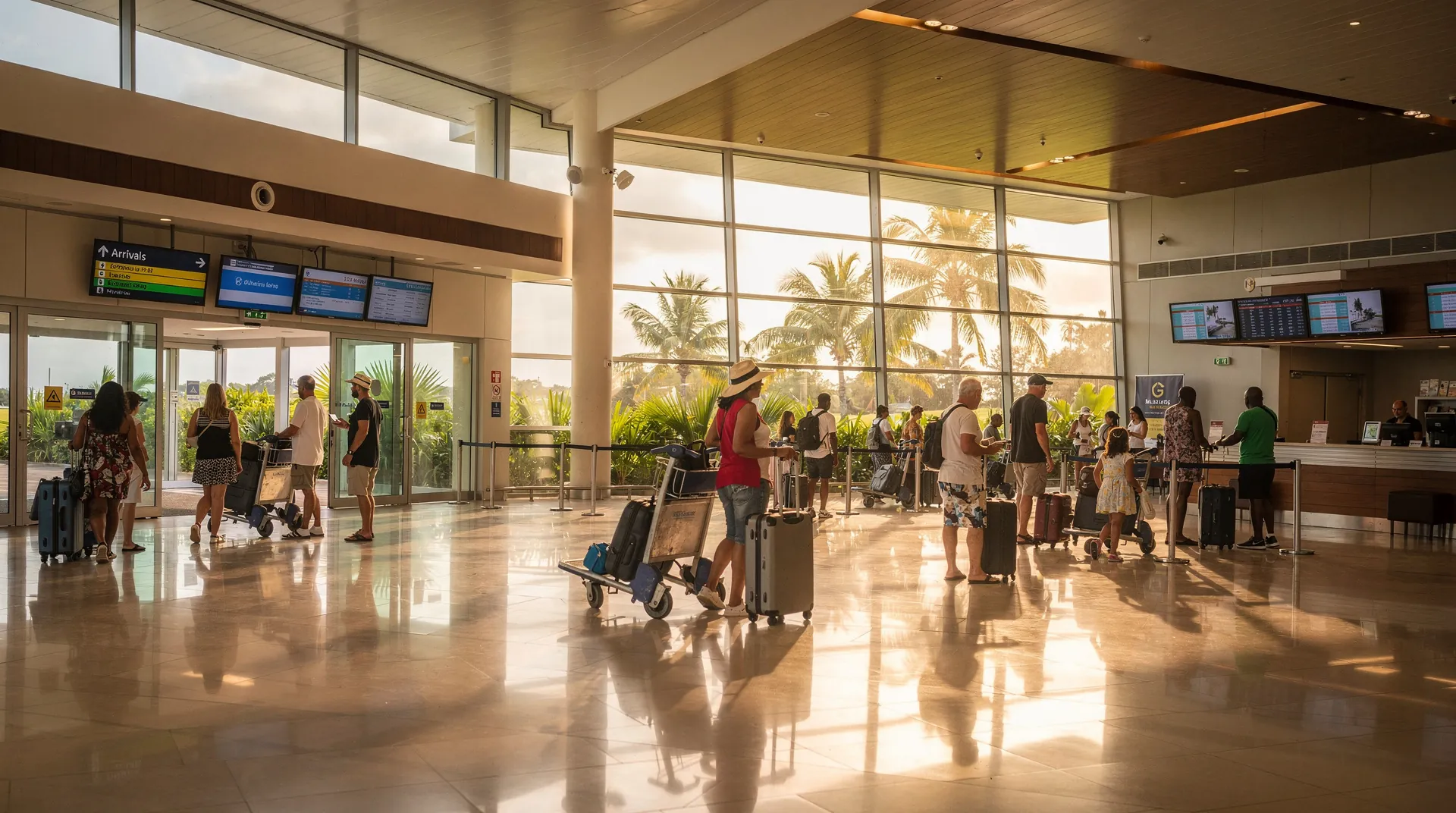
What I felt arriving at SSR Airport in October 2021 was a particular atmosphere — like a country catching its breath after a long time holding it. Immigration officers were more relaxed than expected. Taxi drivers waited with their signs, smiling.
For a stress-free arrival, booking a private airport-to-hotel transfer in advance avoids any haggling on arrival. Hotels, delighted to welcome guests again, had clearly invested in upkeep during the closure.
Mauritians had suffered economically. The tourism sector accounts for around 25% of the island’s GDP. Eighteen months without tourists was a disaster for thousands of families who depend directly or indirectly on tourism: hoteliers, drivers, artisans, restaurateurs, guides, fishermen selling to restaurants.
My first impression walking the streets of Port Louis or along the seafront in Grand Baie: shops had reopened, cafes were bustling, but something fragile and precious hung in the air — the collective awareness of an island getting back on its feet.
What had changed in the hotels
Hotels had largely used the closure to renovate. Several properties redid their rooms, upgraded their facilities, revised their offerings. Some adjusted their policies — more flexible cancellations, more half-board or room-only options for a market that had grown wary of all-inclusive deals.
Prices, though, were surprising. Everyone expected big promotions to relaunch tourism — and there were some, especially in the first months of reopening. But by late 2021 and early 2022, rates had climbed back up, sometimes above pre-pandemic levels. Pent-up demand and higher operating costs pushed prices upward. This upward trend has since stabilized, but overall price levels in Mauritius remain high — our Mauritius budget guide gives you the current figures for 2026.
Resorts in iconic areas like Bel Ombre, Belle Mare and Le Morne were among the first to sell out. Demand for the island’s luxury destinations was strong from the moment it reopened.
Dining out: losses and new arrivals
The pandemic sadly took down some restaurants, especially the smallest operations that couldn’t weather 18 months without revenue. A few places I loved were gone by the time I got back.
But others had emerged. Mauritians who had lost their jobs in tourism had launched their own ventures — table d’hôtes, local meal delivery, food trucks. Some of this necessity-born creativity had survived and taken root.
In 2021-2022, the food scene in Tamarin and Flic-en-Flac saw the emergence of several new eateries offering quality contemporary Mauritian cuisine. These places are now among the recommended addresses in our Mauritius food guide.
What hadn’t changed (and that’s reassuring)
The warmth of Mauritians
I secretly feared that the pandemic, the economic hardship it had caused, and the sudden return of tourists after 18 months of emptiness might create some tension, maybe even resentment, toward visitors. That wasn’t the case.
The Mauritians I met — in hotels, in markets, in local restaurants, on the road — were just as before: warm, curious, proud to show off their island. Several told me explicitly how much they’d missed having tourists around, not just for economic reasons, but for the human contact, the variety of encounters, the feeling of being connected to the world again.
This human warmth is one of the constants of Mauritius that nothing changes. You find it in small fishing villages like Mahébourg just as much as in the shopping districts of Port Louis, in family-run guesthouses just as much as in the grand estates of Bel Ombre.
Nature, back with a vengeance
One unexpected effect of the pandemic: nature had reclaimed its space. The beaches, free of tourist crowds for 18 months, had seen marine life return. A few local fishermen told me they’d spotted more dolphins and sea turtles than before the pandemic in certain parts of the lagoon.
The forests, nature reserves and protected areas had benefited from the absence of people. Vegetation was lush, birds plentiful. If the pandemic showed anything positive, it was how quickly ecosystems bounce back when left alone.
The coral reefs of Blue Bay and the protected areas of Le Morne showed remarkable signs of regeneration. Local divers described patches of coral they hadn’t seen this dense and colorful in years.
Local food
Mauritian cuisine, for its part, hadn’t budged an inch. Dholl puris still just as delicious, curries still just as spicy, Phoenix rum still just as refreshing. The markets had picked back up. The table d’hôtes had found their customers again.
The morning market in Mahébourg, the central market of Port Louis, the roadside snack stalls in inland villages — everything had reopened with the same culinary generosity. For travelers looking for authentic Mauritian food, the reopening hadn’t changed anything essential.
The beaches and lagoons
The beaches of Mauritius hadn’t changed. The sand at Belle Mare was still just as white, the lagoon at Trou aux Biches still just as turquoise, the casuarinas at Mont Choisy still just as shady. The beauty of the coastal landscapes is one of the absolute constants of this island.
What still needed watching
The supply chain
In 2021-2022, Mauritius, like the rest of the world, was affected by global supply chain disruptions. Some products were occasionally out of stock in supermarkets. Spare parts for rental cars took longer to find. Delivery times for anything imported had gone up.
For travelers, this meant somewhat less varied menus in some restaurants, somewhat sparser shelves in some shops. Nothing dramatic, but worth mentioning for context.
Tourism staffing
Many tourism professionals — guides, activity leaders, hotel staff — had to retrain during the pandemic. Some never came back to the sector. Hotels struggled to rebuild teams of the same caliber as before. Service quality at some establishments suffered slightly as a result.
This eased over the following months as tourism picked back up and jobs were refilled. By 2022-2023, the sector had largely regained its pre-crisis skill level. By 2026, staff at the major hotels are generally at the highest level of professionalism.
The verdict: was it better to wait?
Some travelers deliberately waited until late 2022 or 2023 to return to Mauritius, thinking conditions would be better once the dust had settled. Was that the right call?
My take: neither entirely yes nor entirely no. Those who left as soon as it reopened in October 2021 experienced something rather particular — an island waking up, at times a bit hesitant, but deeply authentic and grateful. Those who waited until 2022-2023 found a well-oiled island, with rates sometimes higher.
Both were good trips. Mauritius is a destination solid and beautiful enough to offer a rewarding experience in any context.
What this crisis taught us about Mauritius
The pandemic exposed the fragility of an economy so dependent on tourism. It also showed the resilience and adaptability of the Mauritian people. The Mauritian government launched several initiatives to support the local population, develop agriculture and diversify the economy. Some of these projects have had lasting effects.
For travelers, it’s a reminder that our presence on the island has a real impact on people’s lives. Choosing to eat at a local restaurant rather than the hotel buffet, buying souvenirs from an artisan rather than a chain store, staying in a family-run guesthouse rather than a resort — every euro spent that way goes directly into the local economy.
This is all the more relevant today, in 2026, as responsible tourism has become a central concern in the island’s tourism strategy. Mauritius is working toward sustainability certifications and encourages visitors to adopt behavior respectful of the environment and local communities.
Mauritius in 2026: an island that has bounced back well
Looking back five years on, the outcome of the 2021 reopening is a positive one. Mauritius has not only regained its pre-pandemic tourist numbers, but has also used the opportunity to modernize its offering and diversify its appeal.
New flight routes from several European cities, the rise of boutique hotels and eco-lodges in less touristed areas like Chamarel and Souillac, and the development of more structured cultural tourism in Port Louis are all signs of an island that has evolved positively since reopening.
Mauritius deserves to be visited with this in mind. And it has, more than ever, earned our return.
To plan your trip, our 7-day Mauritius itinerary incorporates all the newest additions and best addresses on the island into a balanced program. And if you’re traveling with family, our family itinerary is designed so every age finds something to enjoy.
What this return changed in how we travel
Returning to Mauritius after a long absence — whether it’s been two years since the pandemic, or simply since your first trip — often means discovering something different from what you remembered. The island has changed, but so have you.
On my return in 2022, I felt something I hadn’t expected: a strong urge to slow down. After months without travel, Mauritius no longer felt like scenery to consume quickly, but a place to inhabit for a while. I rented an apartment in Tamarin for ten days, bought my vegetables at the neighborhood market, learned the baker’s name. I stopped chasing the “must-dos” and started listening more to what the island wanted to show me.
This way of traveling — slower, more local, less scripted — is exactly what the pandemic reinforced in many travelers. And Mauritius lends itself particularly well to it.
Responsible travel in Mauritius
Responsible tourism in Mauritius isn’t just about avoiding plastic on the beach. It’s also choosing local providers over multinationals, eating at neighborhood snack stalls rather than international chains in shopping malls, staying in family-run guesthouses rather than resorts.
In practical terms: every time you choose a table d’hôtes in Mahébourg over the hotel buffet, part of your spending goes directly into the local economy. Every time you rent a car in Mauritius instead of a resort vehicle, you’re supporting a local business. These choices, multiplied across the thousands of visitors arriving every month, have a real impact.
Regions that deserve more attention
After the pandemic, some parts of the island used the drop in visitor numbers to reinvent themselves. The south coast, between Souillac and Bel Ombre, has seen the rise of a few boutique properties offering an experience different from mass tourism. The northeast around Roches Noires and Grand Gaube remains under the radar despite having some of the island’s wildest beaches.
Port Louis itself has benefited from investment in showcasing its historic heritage. The Caudan Waterfront district has been partly redeveloped, and guided cultural discovery tours have sprung up around the colonial buildings and places of worship downtown.
What to know before leaving in 2026
In 2026, traveling to Mauritius is simple and smooth. No health forms, no tests, no restrictions. The country is fully open and welcoming. Flight connections from France (Paris CDG, Nice, Lyon via connection) are numerous, and prices, while higher than pre-pandemic levels, remain affordable outside the high season of July-August and December-January.
To plan a precise budget, our Mauritius budget guide breaks down current costs for accommodation, meals, transport and activities by travel style. To choose your accommodation, our Mauritius hotels guide presents the best options in every region and price category.
Requirements to check before leaving in 2026
Even though the health-related side has disappeared, a trip to Mauritius still involves checking a few standard administrative points: passport validity (generally six months beyond the return date), a possible electronic boarding pass form to fill in online before the flight, and travel insurance recommended to cover medical costs and repatriation. Our guide to Mauritius entry requirements covers all the up-to-date procedures, and our travel insurance guide helps you compare options based on your profile.
What has really changed in practical terms since 2021
Five years after reopening, a few concrete developments are worth noting for anyone planning a trip today. Internet connectivity has improved significantly, with handy eSIM options available right on arrival — our internet and eSIM guide for Mauritius explains the options.
The rental car fleet has also been modernized following the supply difficulties of 2021-2022; our car rental guide remains the go-to resource for organizing your travel. Lastly, the range of apartment and villa accommodation has expanded, driven by demand from travelers seeking more independence than the traditional hotel format — see our guide to apartments in Mauritius.