
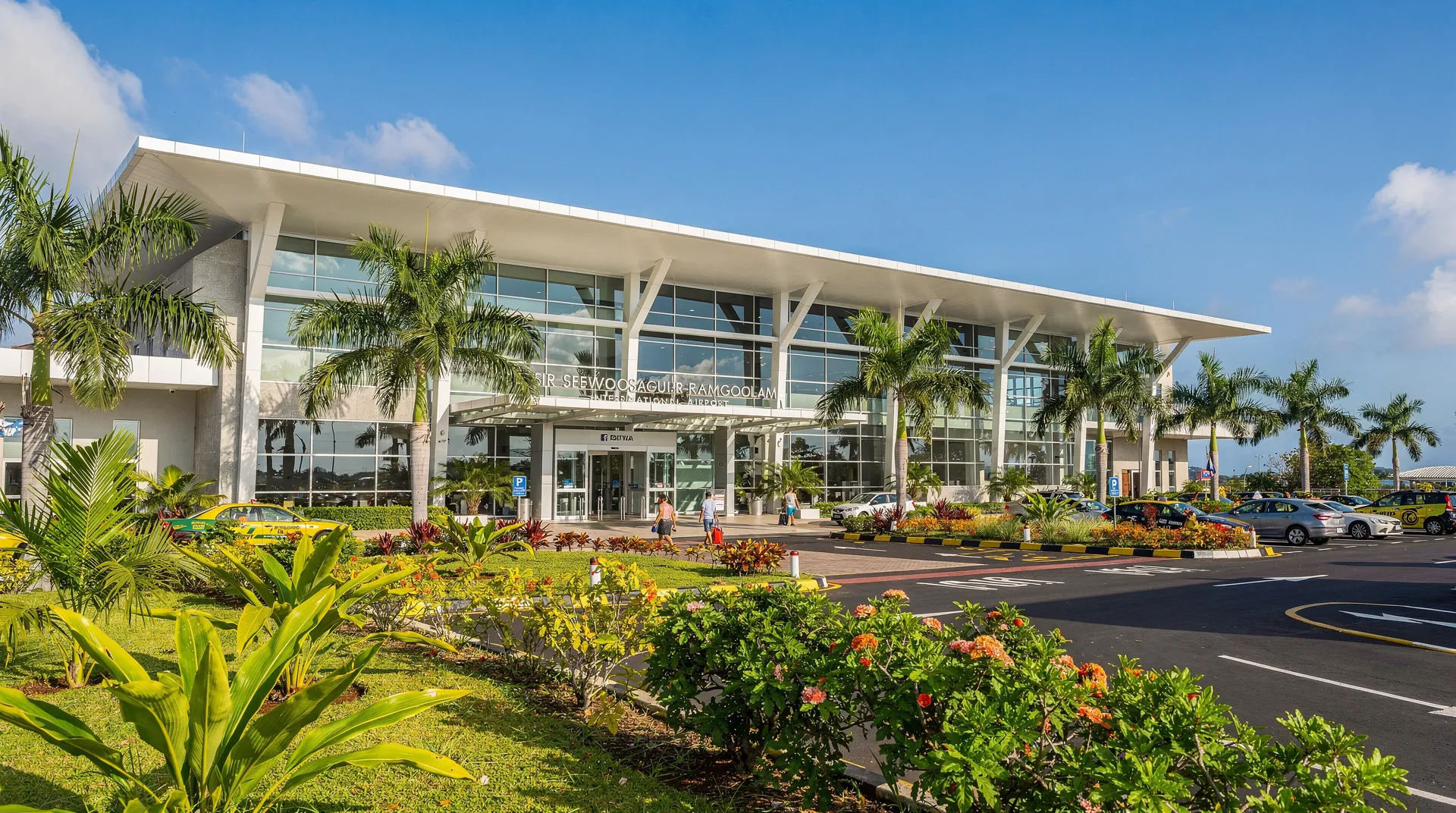
Arriving at SSR Airport: what to know before you land
Updated: December 2021
SSR Airport: your first contact with the island
Sir Seewoosagur Ramgoolam International Airport — SSR to regulars — is located in the southeast of the island, in the Plaisance area. It’s the entry point for practically every international traveller, and if your first experience of the island starts on the right note, your whole trip gets off to a good start.
This guide grew out of personal frustration: on my first trip to Mauritius, I lost two hours wondering how to find a reliable taxi, where to change money without getting ripped off, and how to get to my accommodation in the north of the island without going wrong. Here’s everything I wish I’d known when I landed.
SSR Airport is just 15 minutes by car from Mahébourg and the beautiful beach of Blue Bay. For those staying in the north of the island (around Grand Baie or Trou aux Biches), the taxi ride takes about 1h to 1h30 depending on traffic.
At a glance
| Where | SSR Airport (MRU), Plaisance area, southeast of the island |
| Transfer to the north | around 1,500-1,800 MUR by taxi, 1h30 journey |
| Formalities | passport valid 6 months, arrival form, no visa needed up to 90 days for most European nationalities |
| First move | change a bit of money and buy a local SIM card before heading out |
| Best time to visit | May to December, avoiding January-February |
Before landing: the arrival form
On the plane, crew usually hand out an Arrival Card to fill in before landing. Don’t lose it — you’ll need it at passport control.
Information required:
- Name, surname, date of birth, nationality
- Passport number
- Address of your accommodation in Mauritius
- Length of planned stay
- Purpose of visit (tourism, in your case)
If you don’t yet have a precise address (multi-stop trip), give your first night’s accommodation. Also keep the contact number for your first accommodation handy. As of 2026, some airlines offer this form in digital form — check with your carrier.
Passport control
Nationals of the European Union, the United Kingdom, Canada, Australia and many other countries don’t need a visa to stay in Mauritius for up to 90 days.
Have your passport ready (valid for at least 6 months beyond your return date), your completed arrival form, and ideally proof of accommodation and a return or onward ticket.
The immigration officer may ask how much money you have for your trip — not always, but have an answer ready. In practice, few European travellers are refused entry.
The passport control queue can be long when several flights arrive together. Expect to wait — it can take 30 to 60 minutes. Morning flights, often overnight arrivals from Paris, frequently land at the same time as flights from other destinations, creating peak congestion at control.
Baggage claim
The baggage carousels are to the left as you exit immigration. SSR Airport has several carousels, and your carousel number is shown on the display screens (matched to your flight). Look for your flight number on the screen at the entrance to the baggage area.
Bags usually arrive fairly quickly for direct flights from Europe. If you have a connecting flight, check that your bags are checked all the way through to Mauritius before departure — connections via Réunion or Paris can sometimes cause issues.
If a bag is missing or damaged: go straight to your airline’s counter in the baggage claim area, before leaving the customs zone. Keep your baggage receipt (tags) handy.
Customs
For tourists, clearing customs is generally very quick. European nationals go through the “nothing to declare” line if they’re not carrying goods beyond the usual allowances (alcohol, tobacco, gifts).
A few things to know:
- Fresh produce (fruit, vegetables, fresh meat) is banned from import
- You can bring in up to 1 litre of alcohol tax-free
- Medications need a prescription for larger quantities
- Diving gear, kitesurfing equipment and other sports gear pose no problem
Changing money: where and how
Main recommendation: change a small amount at the airport for your first taxi, and the rest at banks or ATMs in town.
Bureaux de change at the airport offer slightly less favourable rates than banks in town, but the difference is manageable. Not having any Mauritian rupees on arrival is an unnecessary source of stress — change the equivalent of 50 to 100 euros to cover the taxi and initial expenses.
Mauritian rupees (MUR) can be obtained:
- At the airport’s bureaux de change (open around the clock)
- At ATMs with your European bank card (Visa and Mastercard work well)
- At banks in town (slightly better rates)
Avoid changing large sums with individuals or in shops — even if you’re offered a better rate, fake or outdated notes do exist.
To plan your overall budget for Mauritius, our Mauritius budget guide gives precise estimates for all typical expenses.
Getting from the airport
This is the point that generates the most questions and confusion. Here are your options.
Option 1: official taxi
Official taxis have meters (or fixed rates depending on the zone). At the airport, licensed taxis wait in the designated area at the arrivals exit.
Indicative rates from SSR Airport (as of 2026):
- To Grand Baie (north): around 1,500 to 1,800 MUR (30 to 38 euros), 1h30 journey
- To Flic-en-Flac (west): around 1,200 to 1,500 MUR (25 to 32 euros), 1h journey
- To Port Louis: around 800 to 1,000 MUR (17 to 21 euros), 45-minute journey
- To Mahébourg (close to the airport): around 500 to 700 MUR (10 to 15 euros), 20-minute journey
- To Blue Bay or Pointe d’Esny: around 400 to 600 MUR (8 to 13 euros), 15-minute journey
Tip: negotiate the price before getting in the taxi if you’re not sure about the meter. An honest driver will happily confirm the price upfront. If someone approaches you aggressively in the arrivals area, walk on.
Option 2: private transfer booked in advance
For travellers who want to avoid any stress on arrival, a private transfer from the airport with a driver waiting for you at baggage claim is the most comfortable solution. The price is slightly higher than a standard taxi, but the peace of mind is often worth the difference.
Option 3: your hotel or accommodation
Most hotels and many guesthouses offer an airport transfer service. It’s often pricier than an individual taxi, but more convenient and free of unpleasant surprises. Book this service when confirming your accommodation. Our Mauritius hotels guide notes for each property whether this service is available.
Option 4: car rental from the airport
Several rental agencies (Avis, Hertz, Budget, as well as local operators) have counters at SSR Airport. If you’re planning to rent a car, starting straight from the airport is convenient. Reminder: Mauritius drives on the left. Our car rental guide for Mauritius covers all the practical information for this.
Option 5: bus
Mauritius’s public bus network serves the airport. It’s by far the cheapest option (just a few rupees), but also the least practical if you have luggage and arrive exhausted after a long flight. Buses to Mahébourg run regularly. To go further (Port Louis, Grand Baie, Flic-en-Flac), you’ll generally need to change at Mahébourg or Curepipe.
The local SIM card: get one at the airport
As you exit the baggage area, you’ll see shops for local phone operators — mainly My.T (Orange) and Emtel. Buying a local SIM card is highly recommended.
For around fifteen euros, you’ll get a local number, several gigabytes of data and unlimited local calls. It’s much cheaper than using your European plan on roaming, and it makes getting around far easier (GPS, calling restaurants to book, coordinating with tour operators via WhatsApp).
Have your passport with you — registering a SIM card requires ID.
Once your SIM is activated, download the apps recommended in our guide to useful apps in Mauritius: Maps.me for offline use, Waze for traffic, Windy for weather.
The duty-free shop: what’s worth buying
SSR Airport has a decent duty-free selection. Products genuinely worth buying at the airport:
Mauritian rum: bottles of Chamarel, New Grove and Saint Aubin are available at reasonable prices. If you didn’t have time to visit the distilleries during your trip, this is your chance. Our guide to Mauritian rum will help you choose.
Bois Chéri tea: Mauritian tea is one of the island’s signature products. Gift boxes make perfect presents.
Spices: turmeric, cardamom, Mauritian cinnamon — available duty-free at fair prices.
On the other hand, perfumes, cosmetics and electronics are generally less of a deal than in Europe.
The first hours after landing
You step out of the arrivals area. It might be 6am, you’ve had 3 hours of sleep on the plane, it’s already 28 degrees, and you’ve got two suitcases to wrangle.
Here’s what I’d suggest doing, in order:
- Head to the restroom and freshen up
- Withdraw cash at an ATM or change a bit of money at the bureau de change
- Buy your SIM card
- Find your taxi or hotel transfer (or pick up your rental car)
- Grab a coffee or juice at the airport bar if you need to wait
Don’t leave the airport exhausted and empty-handed. The first decisions go better with local currency in your pocket and a working phone.
SSR Airport itself
The airport has undergone significant renovations in recent years. The main terminal is modern, air-conditioned, and has several restaurants, cafés and duty-free shops. The selection of Mauritian products in duty-free is decent (rum, tea, spices), but prices are generally higher than in town.
Business lounges are accessible to business-class travellers or holders of certain premium bank cards (Platinum, Infinite). If you have a long layover in Mauritius, the lounge offers a much better experience than the seats in the main waiting area.
For travellers arriving very early in the morning or late at night, the airport is open around the clock and has a few rest areas. The closest hotels to the airport are in Mahébourg and Blue Bay, 15 minutes away by taxi — useful if your connection is too short to reach your main accommodation.
Planning your itinerary from the airport
The airport’s location in the southeast of the island offers an interesting option: you can choose to start your stay on the southeast coast (close to the airport), then gradually move north over the following days — or the reverse, depending on your priorities.
Our 7-day Mauritius itinerary takes the airport’s location into account to optimise your travel. Our family itinerary offers a pace suited to travellers with children, starting with the calm beaches of the southeast before exploring the livelier areas of the north.
Have a good landing, and welcome to Mauritius.
What travellers often forget on arrival
After 11 hours on a plane, your mind can be a little foggy. Here are the classic mistakes to avoid during your first hours in Mauritius.
Forgetting to withdraw rupees. The airport ATMs work well and the exchange rate is fair. Leave without any Mauritian cash, and you’ll be relying on bank cards — which aren’t accepted everywhere, especially at street snack stalls and local markets.
Accepting the first taxi offer. Drivers who offer their services right at the arrivals exit often charge inflated rates. Compare with your inDriver app or ask your accommodation for the going rate before agreeing.
Not buying a local SIM card. Travelling without a local number in Mauritius means cutting yourself off from WhatsApp as a way to communicate with locals, from up-to-date maps, and from online services. Emtel or Mauritius Telecom SIM cards are easy to buy at the airport for under 10 euros.
Leaving without sunscreen. SSR Airport is open-air, the exit is sometimes in full sun, and if your accommodation is 45 minutes away by car, you’ll already have caught some sun before your first swim. Keep your sunscreen in your cabin bag.
The transition from the airport to your accommodation
The drive from SSR Airport to your first accommodation can be a first taste of the island if you take your time.
The road to Grand Baie or Trou aux Biches in the north runs along the M2 motorway, following the east coast before crossing the centre of the island. If you’re not too exhausted, look out the window — the sugar cane fields, colourful villages, and temples and mosques that follow one another along the road give a first genuine impression of the island’s cultural density.
For those staying on the west coast (Flic-en-Flac, Tamarin), the road crosses the highlands — Curepipe, Quatre Bornes — with a noticeable change in altitude and a welcome coolness after the heat of arrival.
Your first meal in Mauritius
Don’t eat at the airport if you can avoid it. Prices there are higher and the food has little character. Wait until you’re at your accommodation or at a local restaurant.
If you arrive in the morning, your first Mauritian meal could be a warm dholl puri bought from a local snack stall — a flatbread made from split pea flour with bean curry and coconut chutney. For under 1 euro, it’s the perfect introduction to Mauritian street food.
If you arrive in the evening, look for a neighbourhood restaurant in your accommodation area. Our guide to local restaurants in Mauritius lists the best places to eat authentic Mauritian food from your very first hours.
For everything related to the practical logistics of your trip — budgeting, accommodation, getting around — our Mauritius budget guide is the most complete resource for planning your trip.
Travelling without a car from the airport
If you’re not planning to rent a car, SSR Airport remains entirely manageable. The bus serves Mahébourg directly, with connections to Curepipe and the rest of the island, and taxis remain a reliable option for longer trips if you negotiate the price before getting in. Our 7-day carless itinerary details how to string together transfers, buses and organized tours from your arrival to your last day, including the trip back to the airport.
Time difference and the first few hours
Mauritius isn’t hugely out of sync with Europe (2 to 3 hours depending on the season), but after an overnight flight, fatigue sets in as soon as you step off the plane. Avoid planning any physical activity on the day you arrive — instead, save your first half-day for the pool or the beach in front of your accommodation. Our guide on time difference in Mauritius explains how to limit travel fatigue, especially for families with children.