
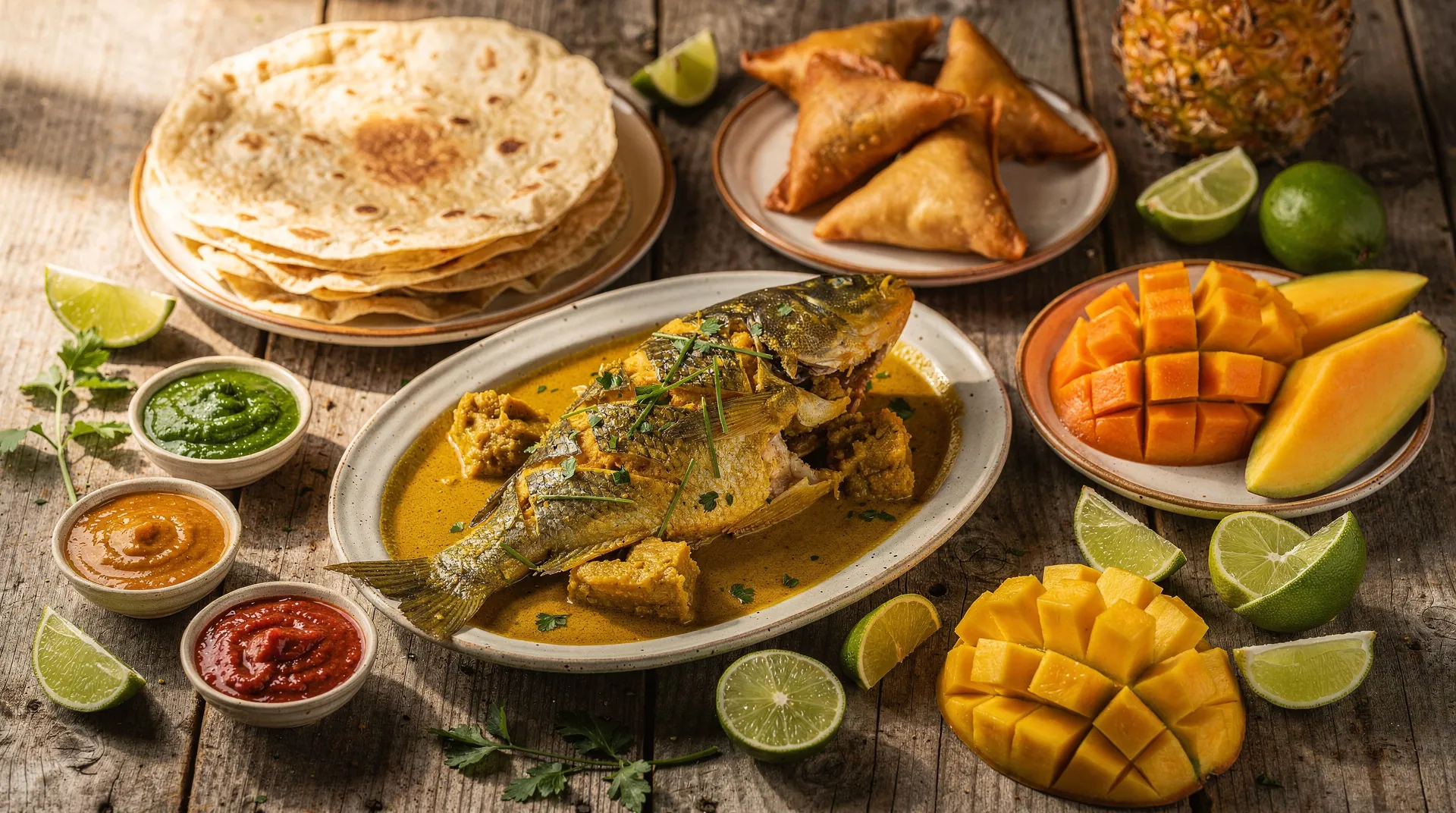
10 local restaurants and table d'hôtes for authentic Mauritian food
Updated: March 2019
Eating Mauritian food: why it’s one of the best decisions you’ll make on your trip
Let’s start with a somewhat blunt observation: the restaurants in Mauritius’s big hotels are often disappointing given what they cost. All-inclusive buffets lack personality, and the “Creole nights” put on for tourists are often Creole in name only. Meanwhile, just a few kilometres away, Mauritian families are serving meals of real culinary quality for a fraction of the price.
Mauritian cuisine directly reflects the island’s history: a crossroads of Indian, African, Chinese, French and Creole cultures that has produced a gastronomy of exceptional richness. Spiced caris, fragrant rougailles, crunchy achards, garlic-sautéed brèdes, morning dholl puris — flavours well worth discovering in their natural setting, far from the standardised buffets. Our guide to Mauritian gastronomy offers a full picture of this culinary richness.
Here are ten addresses — table d’hôtes, neighbourhood restaurants, gargotes loved by locals — that have stayed with me over the course of my trips.
At a glance
| Details | |
|---|---|
| Where | Table d’hôtes and gargotes across the country, from the south (Mahébourg) to the centre (Curepipe) |
| Average price | About €4-15 for a gargote or table d’hôte, €20-50 for a more refined restaurant |
| Booking | Essential for table d’hôtes, often via WhatsApp |
| Getting there | A rental car is recommended for most addresses away from tourist areas |
| Best time to go | Year-round — local cuisine isn’t seasonal |
Quick comparison of the addresses in this article
| Address | Town | Approximate budget | Best for |
|---|---|---|---|
| Chez Rosy | Mahébourg | ~€15/person | Convivial meal at a shared table |
| Le Comptoir | Port Louis | €4-6/person | Quick, authentic lunch |
| Le Batelage | Tamarin | €20-30/person | Romantic setting, lobster |
| Chez Max | Quatre Bornes | ~€1/dholl puri | Street food on a small budget |
| Le Barachois | Blue Bay | €20-30/person | Fresh fish of the day |
| La Chaumière du Lac | Curepipe | €40-50/person | Special dinner, polished setting |
What to know before hunting down these addresses
Many of these restaurants and table d’hôtes are located outside the usual tourist areas, in villages or residential neighbourhoods rarely visited by tourists. A rental car makes it much easier to reach these addresses, especially those in the south such as Rivière des Anguilles or Mahébourg, which are poorly served by tourist buses. If you’re travelling without a car, a day taxi is still a viable way to combine several of these lunches with exploring a region.
Cash remains the norm at gargotes and many table d’hôtes — always keep some rupees on you, as bank cards aren’t always accepted.
1. Table d’hôte Chez Rosy, Mahébourg
Rosy is a legendary figure in the world of Mauritian table d’hôtes. This lady in her sixties welcomes guests into her large Creole house in Mahébourg as if they were family. The meal is taken around one big shared table, often with other travellers.
The menu changes daily depending on what’s fresh and Rosy’s mood, but it invariably revolves around the same delights: home-spiced chicken cari, fish daube, steamed rice, lentils, crunchy and spicy vegetable achard, and to finish, a passion fruit or guava dessert. Expect to pay around €15 per person, including local wine.
Mahébourg is one of the most charming towns in southern Mauritius, with its Monday morning market and Naval Museum. Combining a town visit with lunch at Rosy’s makes for a perfect day.
Booking essential — spots are limited and Rosy doesn’t like waste. Contact her via WhatsApp.
2. Le Comptoir, Port Louis
In the centre of Port Louis, Le Comptoir is the lunch spot for local office workers and civil servants. It was a taxi driver’s recommendation that I followed blindly — and never once regretted.
Here, they serve slow-cooked dishes prepared from dawn. Sausage rougaille, Creole red beans, coral lentil cari with basmati rice and small fried fish pieces on the side. Everything is cooked to be eaten at midday — there’s no evening service. The setting is unpretentious — a few formica tables, a ceiling fan — but the food is dazzling.
Price: around €4-6 for a full meal. Yes, you read that right.
Make the most of your time in Port Louis by exploring the central market and the Caudan Waterfront before or after lunch. Our Port Louis guide covers the capital’s must-sees.
To experience the island’s gastronomy in an immersive way, a street food tour of Port Louis central market plunges you into the capital’s authentic flavours with a local guide. To learn how to recreate these flavours at home, a Mauritian cooking class with tasting is available from Grand Baie.
3. Le Batelage, Tamarin
Tamarin is a surfer-and-expat town with a distinctive character. Le Batelage, set on the Tamarin River, combines a romantic setting — a terrace on stilts, boats drifting by — with genuinely excellent Creole cooking. It’s one of those addresses halfway between a fine-dining restaurant and a family table, which ends up being the most satisfying of all.
Their grilled lobster in local herb butter, served with broken rice and a Creole salad, remains in my memory as one of the best meals on the island. Portions are generous, service relaxed and warm.
Tamarin is also the best base for swimming with dolphins early in the morning. Pair the morning excursion with lunch at Le Batelage for a memorable day.
4. Chez Max, Quatre Bornes
Inside the Quatre Bornes market, Chez Max is an institution. It’s a gargote in the noblest sense of the word: a few tables outside, a counter where Max and his two staff bustle about in a haze of cari steam, a chalkboard listing the day’s dishes in Kreol.
Max’s dholl puri is legendary in town. These soft split-pea flatbreads, served filled with bean curry, coconut chutney and a spoonful of condiments, are THE breakfast or THE snack of Mauritius. For 50 rupees (about €1), you’ll get the most satisfying dholl puri of your travels.
Quatre Bornes sits halfway between Port Louis and Curepipe, making it a natural stop on a tour of the highlands.
5. Table d’hôte Chez Mémé Thérèse, Rodrigues
Yes, I know — Rodrigues isn’t exactly nearby. But if you’re smart enough to catch the ferry or the flight to this small satellite island, Mémé Thérèse’s address in Port Mathurin is well worth the detour.
Mémé Thérèse is an exceptional cook who prepares traditional Rodriguan recipes: shrimp “civet,” “cotomili” (coriander-spiced dishes), and the famous Rodriguan “piment roussi.” Rodriguan cuisine is spicier and more rustic than mainland Mauritian food. A full meal here — starter, main, dessert and homemade ti-punch — comes to around €12.
6. Le Barachois, Blue Bay
Blue Bay is famous for its lagoon and beach. But few tourists know about Le Barachois, a fish restaurant in the neighbouring fishing village. The owner sources directly from local fishermen every morning.
Fish captain in court-bouillon, fish in a vierge sauce with tomatoes and local capers, garlic-sautéed prawns — the menu changes with the day’s catch, and that’s exactly its charm. Budget €20-30 per person with a glass of Phoenix beer or Cape wine.
Blue Bay is one of the most complete destinations in the southeast, with its remarkable marine park. Pair a morning of snorkelling with lunch at Le Barachois for a memorable day.
7. Chez Linda, Rivière des Anguilles
This table d’hôtes is hard to find — it’s not listed in the major guides and Linda has no online presence. A fellow hotel guest slipped me the address during a conversation. Linda is a lady in her fifties who hosts guests at her home in the village, in the sugar-growing region of the south.
Her specialities are her grandmother’s dishes: octopus cari with tomato and turmeric, sticky rice with lima beans, rum-flambéed bananas for dessert. What makes this meal exceptional is the conversation — Linda never runs out of things to say about the region’s history, her community’s culinary traditions and stories from her life on this island she adores.
Call ahead before showing up — she only hosts by reservation. Rivière des Anguilles is halfway between Souillac and Mahébourg, in the sugar-growing region of the south.
8. Dolce Vita, Flic-en-Flac
Flic-en-Flac is the liveliest seaside resort on the west coast, and its main street is lined with restaurants targeting tourists with five-language menus and laminated photos. Dolce Vita, tucked away from the main hustle, is the exception.
Run by a family of Italian descent settled in Mauritius for three generations, this restaurant blends Creole cooking with Italian tradition with remarkable finesse. Prawn risotto with coconut milk, fresh pasta with goat cari, Rodrigues-vanilla tiramisu — sincere fusion cuisine, not showy at all.
Make the most of your evening in Flic-en-Flac by catching the sunset before dinner — it’s one of the most memorable experiences on the west coast.
9. La Cambuse du Marin, Mahébourg
Mahébourg has a Friday night market that draws the whole local population. La Cambuse du Marin has held a fixed stall there for years — plastic tables and chairs, a grill smoking away nonstop, a constant queue.
Grilled fish, prawn skewers marinated in lime and green chilli, chunks of barracuda grilled over charcoal — it’s simple, it’s wild, it’s extraordinary. Share a table with Mauritians, order a nice cold bottle of Phoenix, and you’ll have had as authentic an evening as few guidebooks know how to offer.
10. La Chaumière du Lac, Curepipe
Finally, an address that departs a little from Creole cooking to offer a more classic Franco-Mauritian cuisine, in an enchanting setting. La Chaumière du Lac sits on the edge of an artificial lake in the heights of Curepipe, and its large wood-panelled dining room with a fireplace (yes, it does get cool in Curepipe during the austral winter) creates a unique atmosphere.
The cooking is refined, with local produce taking pride of place — palm heart, lagoon fish, tropical fruit. The meal is a little more formal and pricier (€40-50 per person with wine), but for a special dinner in the island’s interior, it’s an address we recommend without hesitation.
Curepipe deserves a full day: the Trou aux Cerfs crater, the colonial architecture, the botanical gardens. La Chaumière du Lac is the perfect way to end this day in the highlands.
Practical tips for eating local in Mauritius
Booking
Most table d’hôtes only operate by reservation — and sometimes only via WhatsApp. Contact your chosen addresses the day before or two days ahead of your visit. Many cooks prepare based on the number of guests announced and don’t like to improvise.
Communication
A little Kreol or English is enough at most local establishments. French is understood everywhere, but making the effort to speak Kreol — even just a few words — is always appreciated and opens doors.
Opening hours
Local restaurants keep strict hours: lunch between 11:30am and 2pm, dinner before 9pm. Avoid showing up at 2:30pm hoping to still get a meal — you risk finding the door closed or a reduced menu.
Markets as an alternative
Local markets are an affordable and lively way to grab a bite. Port Louis’s central market, the Flacq market on Wednesdays, and Mahébourg’s Friday night market are experiences in themselves. Samosas fried right in front of you, dholl puris for €1, fresh fruit juice, curry to go wrapped in a banana leaf — Mauritian street food is a culinary adventure of its own.
What these addresses have in common
None of these ten addresses appear in the major tourist guides. None has a marketing department or an active social media presence. They survive and thrive on word of mouth, the loyalty of their local customers, and the quality of what they serve.
That’s what eating Mauritian food is about: stepping out of your comfort zone, getting a little lost, eating somewhere that doesn’t look like much from the street. And discovering, behind an unassuming door or around a formica table, a culinary generosity that often far outshines the most highly rated establishments.
To dig deeper, our guide to Mauritian gastronomy covers the must-know specialities, the standout dishes of the island’s different communities, and the best markets on the island. And if rum interests you as much as food does, our guide to Mauritian rum will point you towards the best distilleries and bottles to bring home.
Eat local. You won’t regret it.
What you’ll be eating in Mauritius
To prepare you for these culinary discoveries, here’s a quick glossary of the dishes you’ll find at these addresses.
Cari (or curry) is the centrepiece of Mauritian cuisine. Made from meat or fish slow-cooked in a blend of turmeric, ginger, garlic and chilli, it comes in endless varieties: chicken cari, fish cari, octopus cari, vegetable cari. Served with basmati rice, dal (lentils) and achards.
Rougaille is a Creole tomato sauce flavoured with ginger and chilli. Sausage rougaille is Mauritians’ ultimate comfort food. Served with rice and dal, it makes a complete and inexpensive lunch at any local snack bar.
Dholl puri is Mauritius’s iconic street food: a soft split-pea flatbread, served filled with sautéed beans, coconut chutney and spicy condiments. Eaten in the morning or as a snack at any time of day.
Briani (or biryani) is a fragrant rice dish of Indo-Mauritian inspiration, cooked with meat (chicken, mutton) and a complex blend of spices. It’s the ultimate celebration dish in the island’s Muslim and Hindu communities.
Achard is a condiment of vegetables pickled in vinegar and spices. Vegetable achard (cabbage, carrot, beans) accompanies almost every Creole dish. Crunchy, tangy and spicy, it perks up any meal.
Brèdes are leafy vegetables (pumpkin, morelle, chayote, taro leaves) sautéed in garlic and oil, lightly spiced. A healthy and tasty side dish, very popular in Creole cooking.
The question of spice
Before heading to a Mauritian table d’hôtes, a word on chilli. Authentic Mauritian food is spicy — often more than palates unused to it can comfortably handle. Local cooks tend to season according to their own preferences, which are often quite fiery.
Two tips: first, don’t hesitate to mention when booking that you prefer dishes “less spicy” or “mild” — most cooks are happy to adjust. Second, spicy achards and condiments are often served on the side — help yourself according to your own tolerance rather than mixing everything in.
Children in particular can struggle with overly spicy food. Our family guide to Mauritius includes tips for managing meals with young children at local restaurants.
Eating alone vs. in a group in Mauritius
Mauritian table d’hôtes are designed for sharing. This shared-table format, where you eat alongside other travellers and sometimes with the family hosting you, is one of the most rewarding aspects of the Mauritian culinary experience.
Travelling solo isn’t a drawback — quite the opposite. Eating alone at a local gargote or table d’hôtes naturally makes you more approachable for conversation and more likely to connect with locals. Some of my best food memories in Mauritius have been solo lunches that turned into impromptu group meals.
For renting a car in Mauritius so you can reach these off-the-beaten-path addresses, our practical guide covers everything you need to know — including for travellers who’ve never driven on the left before.