
Visiting Port Louis Central Market: Colors, Spices and Street Food
Updated: January 2023
A market that hasn’t changed in fifty years
There are places in the world that resist time and change with a joyful stubbornness. Port Louis Central Market is one of them. Built in the late 19th century by the British colonial authorities to organize local trade, it remains to this day the beating heart of the city — a maze of colors, smells and sounds that grabs you the moment you walk in.
I come back here every time I’m in Mauritius. Not just to buy things, but to look, to smell, to eat standing at the counter of a food stall, to listen to vendors bantering in Kreol with unfailing good humor.
| At a glance | |
|---|---|
| Where | Port Louis city center, between Queen Street and Farquhar Street |
| Price | Free entry; budget 200 to 500 rupees per person for a street food tasting, more depending on your spice and textile purchases |
| Time needed | 1.5 to 2.5 hours for a full visit (hall + street food + textiles) |
| Getting there | On foot from Caudan Waterfront, by bus from major towns, by taxi, or by car with paid parking nearby |
| Best time | Tuesday or Saturday morning, between 8am and 11am; open every day except Sunday, year-round |
How to get there
The central market sits right in the heart of Port Louis, a few minutes’ walk from Place d’Armes and the Waterfront. It’s easy to find: it occupies an entire city block in the historic district, between Queen Street and Farquhar Street. If you’re coming from a tourist base, an excursion to the north of Mauritius usually includes a stop at the central market and Pamplemousses garden, with transport from your hotel.
By taxi from your accommodation: just ask for “the Port Louis central market.” Every driver knows it.
By bus: buses from Grand Baie, Curepipe, Quatre Bornes and all major towns converge on the central bus terminal in Port Louis, right next to the market. It’s the cheapest option.
By car: possible, but parking in central Port Louis takes patience. Stick to the paid car parks around Caudan Waterfront.
Opening hours: when to go
The market is open every day except Sunday, roughly from 6am to 5pm. Sunday stalls are more limited.
The best time: Tuesday or Saturday morning, between 8am and 11am. That’s when the market is running at full tilt — vendors have their full range of products, the crowd is thick but not yet stifling, and the energy is at its peak.
Best avoided: after 2pm on weekdays. The heat is oppressive, some vendors start packing up, and the atmosphere is less lively.
The architecture: a building with history
Before diving into the aisles, take a moment to look at the building itself. The central hall, with its metal pillars and glass roof letting in a golden light, has an intact Victorian charm. Fruit and vegetable merchants occupy the ground floor, while textiles and craft shops take up the upper level.
Outside the main building, vendors spill onto the surrounding pavements, creating an informal extension of the market — the best street vendors are often found there, in the shade of an umbrella, next to a polystyrene cooler full of ice and fresh fruit juices.
Spices and dry goods
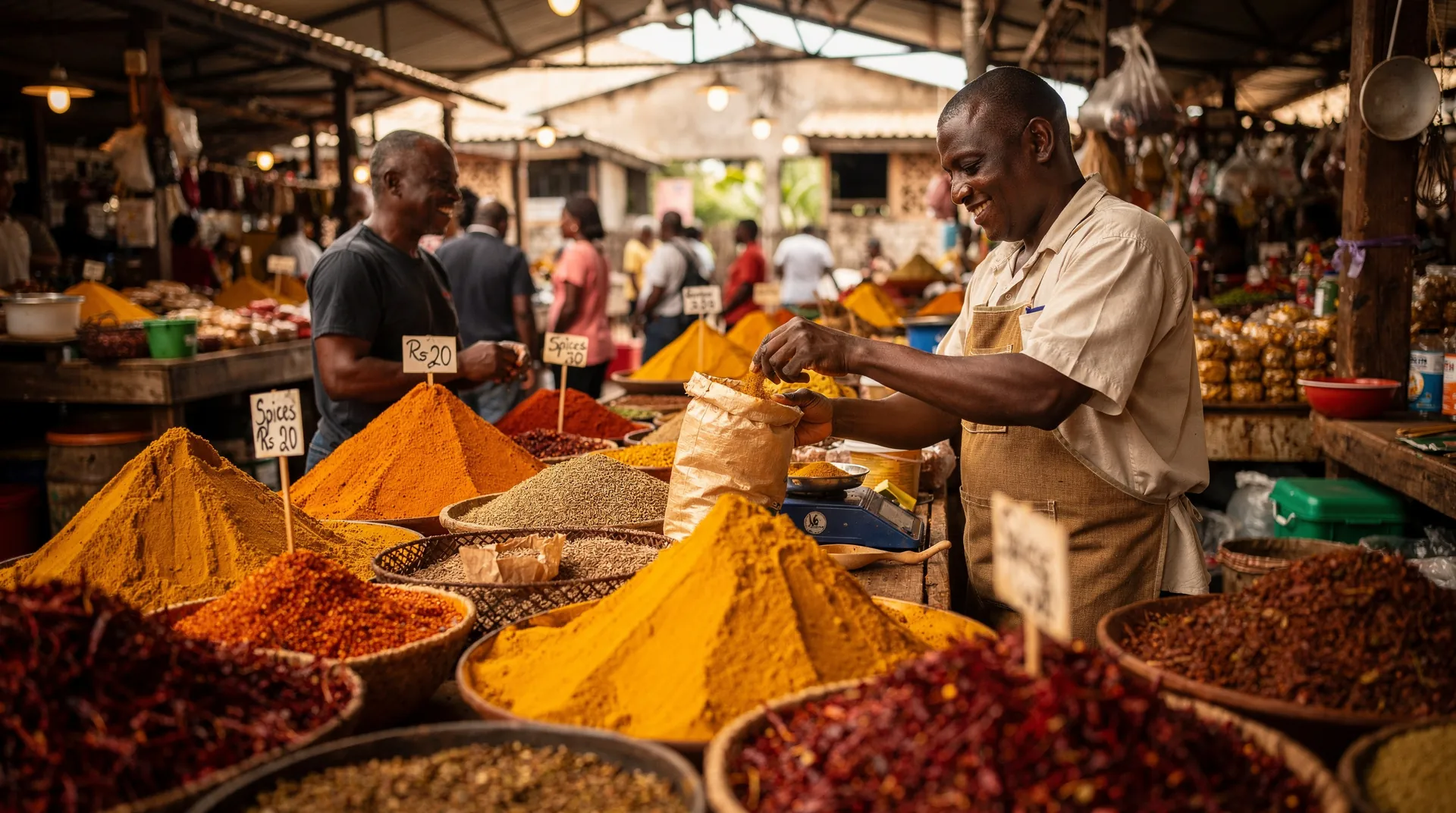
This is the section that fascinates me the most. Spice merchants set out their wares on tables covered with open sacks and glass jars, forming a palette of colors ranging from the yellow of turmeric to the red of chili powder, by way of the green of pandan and the deep brown of cinnamon.
What to buy:
Mauritian fresh turmeric is exceptional quality. Unlike the powdered turmeric sold in Europe, fresh turmeric has a livelier, more floral scent and impressive coloring power. A few rhizomes are enough to flavor an entire curry.
Mauritian vanilla isn’t produced in large quantities (the main growing region is Rodrigues), but you can find fresh pods at the market. Mauritian vanilla is oily, aromatic, and infinitely superior to the industrial vanilla sold in Europe.
Local saffron (powdered local turmeric) and ground ginger are staples of Creole cooking. Bring some home — they’re cheaper and better quality than what you’ll find in France.
Curry spice blends (called “masala” or “cari poudre”) are hand-mixed by each vendor to their own recipe. Ask which one is for fish, which for chicken, which for vegetables — vendors love explaining.
Fruit and vegetables: tropical abundance
The ground floor of the market is dominated by fruit and vegetables, and it’s a sight in itself. The abundance, the colors, the smells — mangoes, papayas, lychees (in season), rambutans, jackfruit, guavas, star fruit…
A few fruits absolutely worth trying if you get the chance:
Mauritian lychee (in season from November to January) is considered by many to be the best in the world. Its flesh is more fragrant, more delicate than the imported lychees found in Europe. A punnet of fresh lychees bought at the market for a few rupees, eaten in the shade of a tree — that’s Mauritius’s simple happiness.
Star fruit (carambola), this five-pointed star-shaped fruit, is common in Mauritius and delicious as juice or simply eaten fresh with a pinch of salt and chili.
Jackfruit is the largest fruit in the world — some specimens weigh over 20 kg. Its golden flesh is sweet and fragrant. Vendors usually sell it already cut up.
Street food: eating standing up, eating well
Port Louis Central Market is one of the best places on the island to eat genuine Mauritian street food. A few must-try stalls:
Dholl puri and farata
Dholl puri is Mauritius’s classic street food flatbread — a thin split-pea flour crepe, cooked on a hot griddle, served rolled with bean curry, coconut chutney and a spoonful of spicy condiments. It’s one of the most typically Mauritian dishes, and at Port Louis market you’ll find excellent ones for a few dozen rupees.
Farata (or paratha) is the flaky version — the dough is folded several times to create crispy layers. Paired with a lentil curry, it’s a champion’s breakfast.
Gâteaux piments (chili cakes)
These little balls of split-pea, chili and turmeric batter, deep-fried to order in a wok of hot oil, are the “Proust’s madeleine” of every Mauritian living abroad. Crispy outside, soft inside, lightly spicy — you can’t stop at just one.
At the market, look for the vendor with the longest queue. It’s invariably the best.
Brèdes and achards
In a section less frequented by tourists but beloved by locals, women sell homemade preparations: achards (Mauritian pickles in mustard oil), brèdes (prepared leafy greens), chatinis (homemade chutneys). Ideal for bringing authentic flavors home in your luggage, if they survive the trip.
Fresh fruit juices
Juice vendors set up outside the market press mangoes, soursop, guava, papaya and passion fruit fresh to order. A big glass of chilled soursop juice, lightly sweetened, is one of the most refreshing drinks on earth.
Textiles and souvenirs
The upper floor of the central market is devoted to textiles, clothing and souvenirs. You’ll find batik-printed fabrics, colorful sarongs, Creole dresses, linen shirts at reasonable prices.
Rule number one: negotiate. The prices displayed are starting prices for tourists. A hint of hesitation, an “that’s a bit pricey…” said with a smile, and the price can drop by 20 to 30%. Don’t negotiate aggressively — do it with good humor, it’s a game vendors enjoy.
What’s really worth buying: rolls of madras cloth, that multicolored checked cotton typical of the Indian Ocean, have real Mauritian and Creole identity. A nice piece of madras cloth can be turned, once you’re home, into a tablecloth, curtain or dress by any tailor.
A few practical tips
Money: bring cash in Mauritian rupees. Few vendors accept cards, and prices are always better in cash.
The heat: come early and wear light clothing. The market is partially covered, but the outdoor aisles can get very hot in the middle of the day.
Safety: Port Louis is generally a safe city, but as in any busy market, keep an eye on your belongings. Keep your bag in front of you in the busiest aisles.
The sounds: Mauritian Kreol rings out on all sides, vendors’ calls mixing with radio and street noise. Let yourself be carried along by this urban symphony.
The market as a mirror of the Mauritian soul
If you only had one hour to spend in Port Louis, this is where I’d send you. The central market concentrates everything that makes Mauritius unique: cultural diversity, human warmth, culinary generosity, a love of colors and flavors.
Here, an elderly Hindu lady sells her turmeric next to a young woman of African descent laying out bundles of brèdes leaves, while a Chinese-Mauritian gentleman weighs his dried mushrooms and a young Muslim man prepares dholl puris at the counter across the way.
This is Mauritius in miniature. It’s the best place to start understanding it.
What to budget for a visit
The market itself is free — you only pay for what you buy. To give you a realistic idea: a full street food tasting (dholl puri, gâteau piment, fresh fruit juice) rarely comes to more than 150 to 300 rupees per person. A bag of spices to take home (turmeric, local saffron, masala blend) costs between 50 and 150 rupees depending on quantity. Budget more if you fall for a piece of madras cloth or a craft item upstairs — prices are negotiable, and the range depends entirely on your haggling skills. To build a full travel budget, our Mauritius budget guide breaks down the usual costs on the island.
Combining the visit with the rest of Port Louis
The central market lends itself well to a broader morning of exploring the city. Many travelers follow it up with a coffee by the sea at Caudan Waterfront, then a wander through the historic district to see the Aapravasi Ghat and the colonial buildings. If you’re based further north, our guide to the Port Louis region lists other must-sees in the capital to combine with your market morning.
And if the experience has made you want to dig deeper into Mauritian cuisine, our Mauritius food guide and our selection of best local restaurants and table d’hôtes are the natural next step. Rum lovers can also use their time in Port Louis to plan a distillery stop, covered in detail in our guide to Mauritian rum.
What not to bring home
Some tempting products at the stalls don’t survive the trip or run into customs issues. Fresh brèdes and preparations containing meat or fish generally won’t clear European customs. Powdered spices and dried vanilla pods, on the other hand, travel very well in an airtight container. If in doubt about what’s allowed for import, it’s safest to stick to dry, packaged goods.