
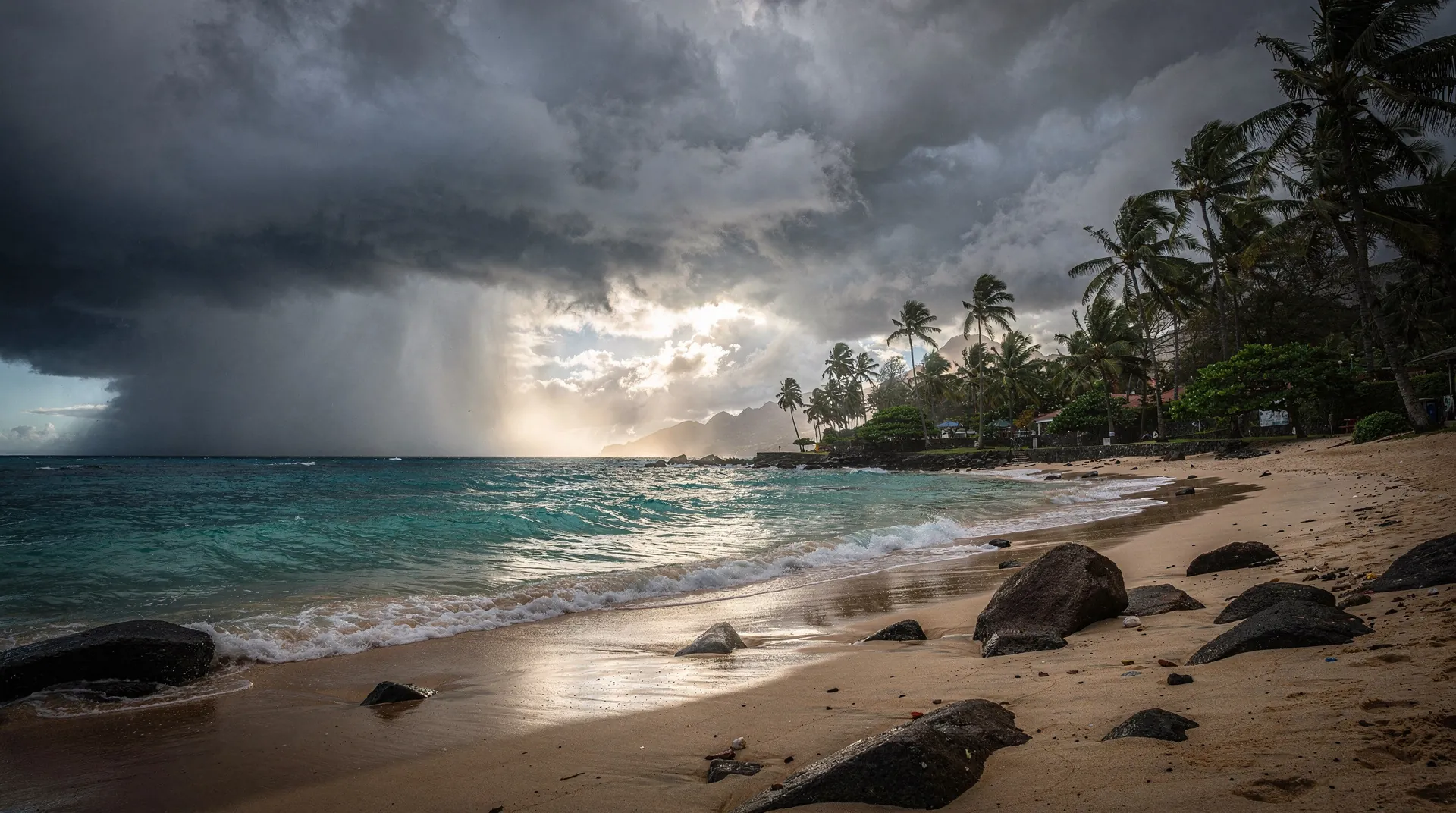
Travelling during cyclone season: good idea or bad idea?
Updated: June 2025
The question everyone asks
“I’d like to go to Mauritius in January, but I’m worried about cyclones. What would you suggest?” It’s one of the most common questions I get. And as with many travel topics, the honest answer is neither “no risk at all, go ahead” nor “absolute danger, don’t go.”
Here’s what I really think, after several trips to Mauritius during cyclone season and a serious look at the weather data.
At a glance
| Period covered | 15 November to 15 May |
| Peak risk | January to March |
| Chance of a direct cyclone hit over 10 days | About 3 to 5% |
| Main upside | Prices 40 to 60% lower than high season |
| Best risk-free period | May to November, see our weather guide |
Cyclone season: the facts
The cyclone season in the southern Indian Ocean officially runs from 15 November to 15 May. It’s the period during which atmospheric conditions (warm waters, tropical instability) favour the formation and intensification of cyclones.
What this actually means for Mauritius:
Cyclones that directly hit Mauritius are rare. On average, a cyclone directly strikes the island roughly once every 5 to 7 years. “Directly” means passing over or very close to the island — causing violent winds, heavy rain and significant damage.
Tropical depressions (weaker cyclones) and more moderate tropical storms pass nearby more often — perhaps once a year on average — without necessarily hitting the island directly, but still capable of bringing heavy rain and wind.
Recent years:
- Some cyclone seasons pass without any notable incident in Mauritius
- Others see cyclones pass a few hundred kilometres away, causing swell and rain but no major damage
- Major cyclones have hit the island in the past (Claudette in 1979, Hollanda in 1994), but these remain relatively rare events on the scale of an individual trip
Warning systems in Mauritius
Mauritius has a well-oiled and effective cyclone warning system. Alerts are issued by the Mauritius Meteorological Services (MMS) and broadcast on radio, TV and mobile apps.
The system has four warning levels:
- Class 1: A cyclone is possible within the next 60 hours. Residents are alerted and prepare. Normal activities are still possible, but caution is advised.
- Class 2: A cyclone or storm is likely within 48 hours. Outdoor activities should be scaled back. Boats return to port.
- Class 3: Violent gusts are expected within 24 hours. Staying indoors is recommended. Hotels secure their facilities.
- Class 4: Absolute emergency. Mandatory shelter-in-place. All outdoor activity is banned.
For a traveller, being in Mauritius during a Class 1 or 2 warning isn’t particularly dramatic. Class 3 or 4, on the other hand, is a real disruption to your trip — even though hotels are built to withstand these conditions and staff are trained to manage them.
The real odds of being affected
If you go to Mauritius for 10 days between November and April, here’s an honest estimate of the odds:
Chance of a normal trip with no significant weather disruption: about 70 to 80%. Most trips during cyclone season pass without any notable weather incident, with beautiful sunny days (occasionally interrupted by brief tropical showers).
Chance of being affected by a disturbance (strong swell, heavy rain, a few days of scaled-back activities) without a direct cyclone: 15 to 20%.
Chance of facing a direct or very close cyclone: about 3 to 5% over a 10-day stay. Low, but not zero.
These figures are estimates based on historical frequencies, not guarantees. Every season is different.
Month by month: what to really expect
Not every month of cyclone season is the same. Here’s how I’d rank them, alongside our detailed monthly guides:
| Month | Cyclone risk | Vibe |
|---|---|---|
| November | Low, early in the season | Still fairly dry, a transition month (November guide) |
| December | Low to moderate | Peak tourist season regardless (December guide) |
| January | The highest of the year | Hot, humid, but good prices outside the holidays (January guide) |
| February | High | Peak heat and humidity (February guide) |
| March | Still high | Frequent but brief showers (March guide) |
| April | Decreasing | Often the best price-weather trade-off of the hot season (April guide) |
This table confirms a simple intuition: if you absolutely must travel during cyclone season, April and November are statistically the mildest months.
How to track the weather before and during your trip
Before leaving, check the Mauritius Meteorological Services forecasts two to three weeks before your flight — beyond that, models aren’t reliable enough to predict a specific cyclone. Once on the island, keep the useful apps for travelling in Mauritius close at hand — they include the most relevant weather-tracking tools for the island. If your trip happens to fall over the year-end holidays, our story Christmas and New Year in Mauritius explains how to handle this particular period, straddling high season and the start of cyclone season.
The upsides of cyclone season
Paradoxically, the November-April season has real advantages that travellers who systematically avoid it end up missing.
Prices. Low season (outside December-January) offers noticeably lower prices — sometimes 40 to 60% cheaper than high season. A 4-star hotel at 150 euros a night in March instead of 300 euros in August. Flights at 500 euros instead of 800.
The vegetation. Mauritius in the southern summer is a deep, lush green. Waterfalls swell, forests drip, gardens overflow with flowers. It’s the island at its most tropical.
Warmer water. With temperatures between 27 and 30 degrees, the lagoon water in summer is warmer than in winter. Diving and snorkelling are particularly enjoyable then.
Spectacular showers. Tropical downpours in the rainy season are often brief (20-30 minutes), intense, and followed by bright sunshine. The skies after the rain are remarkably beautiful for photography. And post-shower sunsets in Flic-en-Flac can be extraordinary.
The quiet. Outside December-January, low season means fewer tourists, less crowded beaches, restaurants with room to spare, and excursions that feel less packaged for groups.
The real drawbacks
Unpredictability. This is the real issue. Not the absolute risk of a cyclone, but the impossibility of knowing 6 months in advance whether your specific week will be sunny or stormy. In rainy season, one week can be glorious and the next rainy.
Disrupted sea activities. When the swell rises or the wind picks up, sea excursions (catamaran trips, dolphin watching, diving) get cancelled for safety reasons. If your trip is short and you’re counting on these activities, you might miss out. That said, on the good-weather days, a full-day catamaran trip to Ile aux Bénitiers with dolphin watching feels even more rewarding after a few days of bad weather.
Higher humidity. The southern summer is more humid, and the air can feel oppressive on some days, especially in low-lying coastal areas.
What I’d genuinely recommend
For stays of two weeks or more: cyclone season is a perfectly reasonable option. Over two weeks, you have a good chance of enjoying beautiful days, and even if you get a few bad ones, you have plenty of time to make up for it.
For short stays (under a week): cyclone season carries more risk of ruining your short trip. In good-weather low season, every day counts for more.
In December-January: this is technically cyclone season but also peak tourist season. Prices are high, the island is lively, and the cyclone risk is statistically similar to other months. There’s no reason to rule out December-January because of cyclones — the risk exists but remains limited.
The truly ideal season: May to November, with a sweet spot in June-September. Near-zero cyclone risk, pleasant temperatures (24-28 degrees), calm sea, gentle winds. The only genuine weather low season.
If a cyclone hits during your stay
Let’s be practical. If a cyclone is heading toward Mauritius during your trip:
Stay calm. Mauritian hotels have well-established emergency procedures. Your front desk team will guide you.
Stock up on supplies. Bottled water, non-perishable food for 2-3 days, batteries and torches (power cuts are possible).
Stay informed. The MMS (Mauritius Meteorological Services) app and local radio stations broadcast weather updates in real time.
Contact your insurer. If your flight is cancelled or your trip disrupted, your travel insurance should cover the extra costs — check your policy’s terms before you leave.
Look on the bright side. Being “stuck” in a Mauritian hotel during a cyclone, with food, water and films, is infinitely better than being stuck at an airport. Several travellers have told me that riding out a cyclone in Mauritius was an intense, human experience, almost enriching in the unexpected sense of solidarity it created among travellers.
The bottom line
Travelling to Mauritius during cyclone season: yes, with conditions. A flexible budget (in case of flight cancellation), solid travel insurance, a stay long enough to absorb a few bad days, and above all a calm attitude toward weather unpredictability.
If you need a guarantee of good weather, wait for June to September. You’ll then have access to the best sea excursions with no risk of cancellation — including the catamaran cruise to the northern islets under ideal conditions. If you’re after the best prices and a less touristy island, January to March could suit you. If you’re on your honeymoon and everything needs to be perfect, avoid cyclone season.
The weather in Mauritius is, as in any tropical destination, a variable you can’t control. The wise traveller prepares for it rather than hoping to dodge it.