
Where to Stay in Mauritius Without a Car: Walkable Areas and Practical Accommodation
Updated: August 2026
Can you visit Mauritius without a rental car?
Yes, as long as you choose the right base. Grand Baie in the north, Flic-en-Flac in the west, and Mahebourg in the southeast are the most practical car-free areas: shops, beach, and restaurants within walking distance, plus a good bus network for excursions.
Traveling around Mauritius without a car: is it really possible?
This question comes up often on travel forums and in trip-planning conversations. Is Mauritius a viable destination without renting a car? The honest answer is: yes, if you choose the right place to base yourself. No, if you’re hoping to freely explore every corner of the island from an isolated hotel.
To understand the scope of the debate and weigh the pros and cons of both options, our with-or-without-a-rental-car comparison gives you the full picture. This guide focuses on the practical question: if you decide to go without a car, where should you stay to make it actually work?
At a glance
| Where | Grand Baie, Flic-en-Flac, or Mahebourg — areas where the beach, shops, and buses are all within walking distance |
| Price | savings of 25 to 40 EUR/day compared to a rental car |
| Time needed | any length of stay, including 1-2 weeks, as long as you accept a less spontaneous pace |
| How to get around | local buses, day taxis, and organized tours as a complement |
| Best time to go | year-round, but allow more flexibility during the summer rainy season |
Why some travelers choose not to rent a car
Several reasons can push travelers toward a car-free trip in Mauritius. Cost comes first: a rental car runs between 25 and 40 EUR per day, or 175 to 280 EUR over a week — a significant line item in the budget. On top of that come insurance, fuel, and occasional parking hassles.
Then there’s the stress of driving: driving on the left on roads that are sometimes narrow, with local road rules that are quick to learn but unfamiliar to many, isn’t relaxing for every traveler. Our guide to driving in Mauritius has all the practical advice for those who want to give it a try anyway.
Finally, there’s the appeal of simplicity: for a trip built around the beach and the pool, with a few organized excursions thrown in, a car isn’t essential. A well-located place to stay often delivers the freedom that people wrongly credit to a rental car.
The Mauritian bus network: what you need to know
Mauritius has a fairly dense public bus network run by the National Transport Corporation (NTC) and private operators. Buses cover the vast majority of inhabited areas on the island for under 1 EUR per ride — one of the cheapest ways to get around anywhere in the Indian Ocean.
The main lines run from roughly 5:30am to 10:30pm. Buses are frequent on the main routes (Port Louis-Grand Baie, Port Louis-Curepipe, Port Louis-Mahebourg) and less frequent on secondary roads. Outside of peak hours, waits rarely exceed 20 to 30 minutes.
Our guide to buses in Mauritius covers every route, fare, and practical tip for using the network efficiently. Google Maps and Moovit both include Mauritian bus routes, which makes planning from your phone much easier.
Grand Baie: the most self-sufficient area without a car
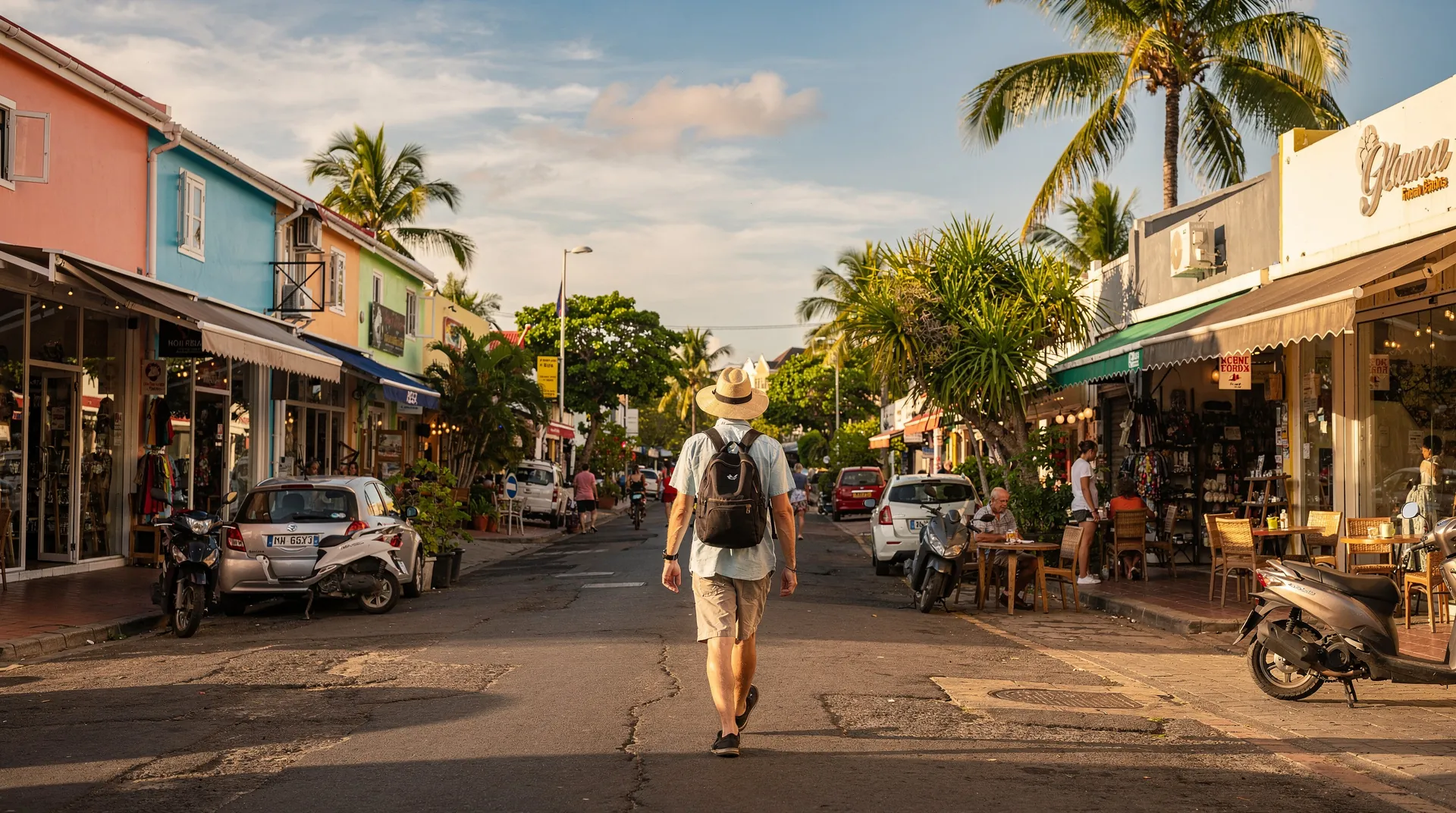
Grand Baie is probably the most comfortable destination for a car-free stay in Mauritius. It’s the north’s main tourist hub, packing an impressively complete range of services into just a few streets: supermarkets (Super U, Jumbo), pharmacies, restaurants for every budget (from a 3 EUR snack to a 60 EUR fine-dining meal), shops, tour agencies, a public beach, and the departure point for catamaran trips along the north coast.
Grand Baie’s public beach is pleasant for swimming, even if it’s less spectacular than an isolated resort beach. The bay is sheltered and the water is calm. You can rent kayaks, try stand-up paddleboarding, or simply swim without any risk.
Accommodation in Grand Baie covers every budget: guest houses from 40 EUR a night on the side streets, mid-range hotels from 80 to 180 EUR, and a handful of upscale hotels with pools and bay views. The ideal car-free base is in the village itself, within a 10-minute walk of the beach and the shopping area.
For excursions from Grand Baie without a car: catamaran tours heading north to the islets are sold right on the beach. Buses run regularly to Port Louis (30 to 40 minutes). Shared taxis and tuk-tuks circulate through the streets for local trips. The Pamplemousses botanical garden is 20 minutes away by bus.
For an excursion to the north of the island, you can also book an organized tour directly from Grand Baie: guided tour of the north of Mauritius.
Recommended car-free accommodation in Grand Baie
Look for accommodation explicitly located in the heart of Grand Baie, on Royal Road, rather than “5 minutes from Grand Baie” — which can mean 5 minutes by car. Listings that mention “walking distance to the beach” and “town center” in their descriptions are the most reliable for a car-free stay.
Flic-en-Flac: the west coast on foot
Flic-en-Flac is the largest beach resort on the west coast, about 25 kilometers south of Port Louis. It’s a long, linear area stretching several kilometers along the beach, with a fairly well-equipped village center: grocery stores, beachfront restaurants, bars, rental agencies, a few souvenir shops, and a pharmacy.
Flic-en-Flac’s beach is long and often ranked among the island’s most beautiful for its fine sand and calm lagoon. It’s directly accessible from the main road that runs along the seafront. For travelers without a car, the best bet is to choose accommodation in the central part of the village, where the concentration of services is highest. Avoid accommodation at the northern or southern ends of Flic-en-Flac — the streets empty out quickly and restaurants become scarce.
The bus network serves Flic-en-Flac from Port Louis and Quatre Bornes. Connections to Tamarin to the south and to Le Morne are less direct, sometimes requiring a transfer. With a bit of organization, it’s entirely possible to spend a week in Flic-en-Flac without a car by combining local buses, taxis for excursions, and boat trips organized by local agencies.
Divers should note that Flic-en-Flac is also the best snorkeling and diving area on the west coast. Dive centers generally offer shuttles from local accommodation to the dive sites — a real advantage for car-free travelers.
Mahebourg: local charm without a car
For those seeking authenticity over touristy concentration, Mahebourg is an interesting alternative to Grand Baie. The town is compact and easy to explore on foot: market, local restaurants, waterfront, history museum, supermarkets — all within a 15 to 20-minute walk of the center.
Mahebourg’s own beach isn’t exceptional, but Blue Bay — one of the island’s most beautiful beaches, with its marine park — is just 15 minutes away by local bus. That regular, cheap ride makes Mahebourg a perfectly viable base for beach days without a car, as long as you’re willing to make that daily trip.
The downside is that Mahebourg is quieter in the evenings than Grand Baie, and the range of tourist restaurants and nightlife is more limited. But for a traveler seeking Mauritian authenticity and wanting to spend significantly less, it’s a very sound choice.
Trou aux Biches: a quieter northern alternative
Just south of Grand Baie, Trou aux Biches is a calmer alternative for car-free travelers who still want a beautiful beach. The village has a handful of restaurants, small grocery stores, and local agencies, and the beach — protected by a shallow lagoon — is among the finest in the north.
The downside: Trou aux Biches is less concentrated than Grand Baie, and some accommodation is set back from the village. The bus network is thinner, and without a car, evenings can feel limited if your accommodation isn’t well placed. It’s an option worth considering for couples looking for the perfect beach who don’t plan on moving around much — a pure beach stay rather than an exploration of the island.
Areas to avoid without a car
Some parts of the island are difficult, if not inadvisable, without a car. The Le Morne peninsula, for instance, is entirely dominated by luxury resorts and has no village within walking distance. If you’re not staying at an all-inclusive resort with its own shuttle, getting around Le Morne without a car is slow and expensive.
Likewise, Belle Mare and the east coast in general are areas where accommodation is spread out along a long stretch of coastline with few shops within walking distance. Luxury resorts work perfectly well without a car here (everything is included in the package), but independent accommodation requires regular trips for meals and groceries.
The highlands (Curepipe, Quatre Bornes, Vacoas) are well served by bus but don’t offer easy beach access — they’re inland residential areas that aren’t meant for beach holidays.
Taxis: your essential complement
If you go without a car, taxis become your main way of getting to excursions. Taxis in Mauritius run either at a fixed rate (negotiated before you get in) or by meter. For long day excursions, it’s common to negotiate a flat rate with a driver: expect to pay between 60 and 100 EUR for a full day with a private driver who takes you on a circuit.
That’s more expensive than a day with a rental car (25 to 40 EUR), but it includes the driver — so zero stress about navigation or left-hand driving. For families or groups, the per-person cost becomes very reasonable.
For short trips (airport to accommodation, excursion to a nearby beach), prices are set in advance based on known zones. Always negotiate before getting in, and ask your accommodation for the going rates for common trips — guest house owners know the standard prices and will flag it if a driver asks for an excessive fare.
Ride-hailing apps are now available in Mauritius, giving you a price estimate before you set off — handy as a reference point when negotiating.
Organized tours: the solution for major excursions
To visit the island’s major sites without a car, organized tours are an efficient solution. Agencies in Grand Baie, Flic-en-Flac, and at most large hotels offer guided minibus circuits covering the must-sees: the north of the island, Chamarel and its colored earth, the south coast, and more. A tour of the south taking in Chamarel and Grand Bassin is a perfect fit without a car: full-day tour of the south — Chamarel and Grand Bassin.
These tours generally include transport from your accommodation, a guide, and sometimes meals. Prices vary by duration and itinerary but remain reasonable — often cheaper than a day with a rental car once you factor in fuel and site entrance fees.
The downside is the rigid schedule: you follow the group’s program, with no chance to linger at a site you particularly enjoy or to change the itinerary. For independent travelers who like to be in control, this style of visit can feel frustrating.
Budget comparison: with vs. without a car
Without a rental car, here’s how transport costs break down:
- Local buses: 0.50 to 1 EUR per ride
- One-off taxi (e.g., airport to accommodation): 25 to 40 EUR depending on distance
- Full-day taxi for an excursion: 60 to 100 EUR
- Half-day organized tour: 30 to 50 EUR per person
- Full-day organized tour: 50 to 80 EUR per person
Comparing this to the cost of a rental car (25 to 40 EUR per day plus fuel = 35 to 55 EUR per day), the math depends on your excursion pace. If you plan to move around every day, a rental car often works out cheaper. If you’re looking at 4 or 5 beach days plus 2 or 3 excursions over a week, going car-free can be competitive. Our Mauritius budget guide will help you run the numbers for your own trip.
Practical tips for a successful car-free stay
Choose your accommodation very precisely. A place “in Grand Baie” could be a 10-minute walk or 3 kilometers from the center. Check Google Maps for the exact walking distance to the beach, shops, and bus stops. Don’t trust vague descriptions.
Keep the numbers of 2 or 3 trusted taxi drivers. Your accommodation can usually recommend reliable drivers. Having a trusted contact avoids stressful negotiations and unpleasant surprises.
Download offline apps. Offline Google Maps for routes and Moovit for buses. An eSIM or local SIM card guarantees you a permanent connection for navigating and using these tools.
Plan your excursions in advance. Without a car, you can’t just head off spontaneously at 7am to a distant beach. Plan excursion days the evening before, by contacting your driver or booking a tour.
Accept the trade-offs. A car-free stay is calmer and cheaper in terms of day-to-day mobility, but it requires planning and some compromises. Seeing Mauritius on foot and by bus is a different way of traveling — often richer in human contact and local immersion.
Our verdict
A car-free stay in Mauritius is entirely doable and can even be a more immersive way to experience the island, as long as you choose your base carefully and accept a bit less flexibility for spontaneous trips. The best-suited areas are Grand Baie for its concentration of services and lively tourist scene, Flic-en-Flac for its beautiful west-coast beach and diving, and Mahebourg for authenticity and proximity to the airport.
For travelers who want to explore every corner of the island independently, a car remains the most comfortable option. Our with-or-without-a-car comparison guide will help you decide which style of trip suits you.
Going car-free with children: is it reasonable?
Traveling as a family without a car is entirely feasible if you choose your area wisely. Grand Baie is particularly well suited: a calm, shallow beach within walking distance, supermarkets nearby for groceries, and pharmacies close at hand if needed. On the other hand, avoid spread-out areas like Belle Mare with young children and no car — walking to every meal or every errand quickly becomes exhausting with a stroller. Our guide to where to stay as a family and our guide to activities for kids cover the best options in detail.
Combining a car-free stay with occasional car rental
An often-overlooked middle ground: stay without a car, but rent a vehicle for just 2 or 3 days in the middle of your trip, for excursions that don’t suit buses or organized tours well (the wild south, exploring Chamarel at your own pace). This combines the savings of a mostly car-free trip with the occasional freedom of having your own wheels. Budget the usual daily rental rate (25 to 40 EUR/day) only for the days you actually use it — often more economical than renting for your entire stay.