
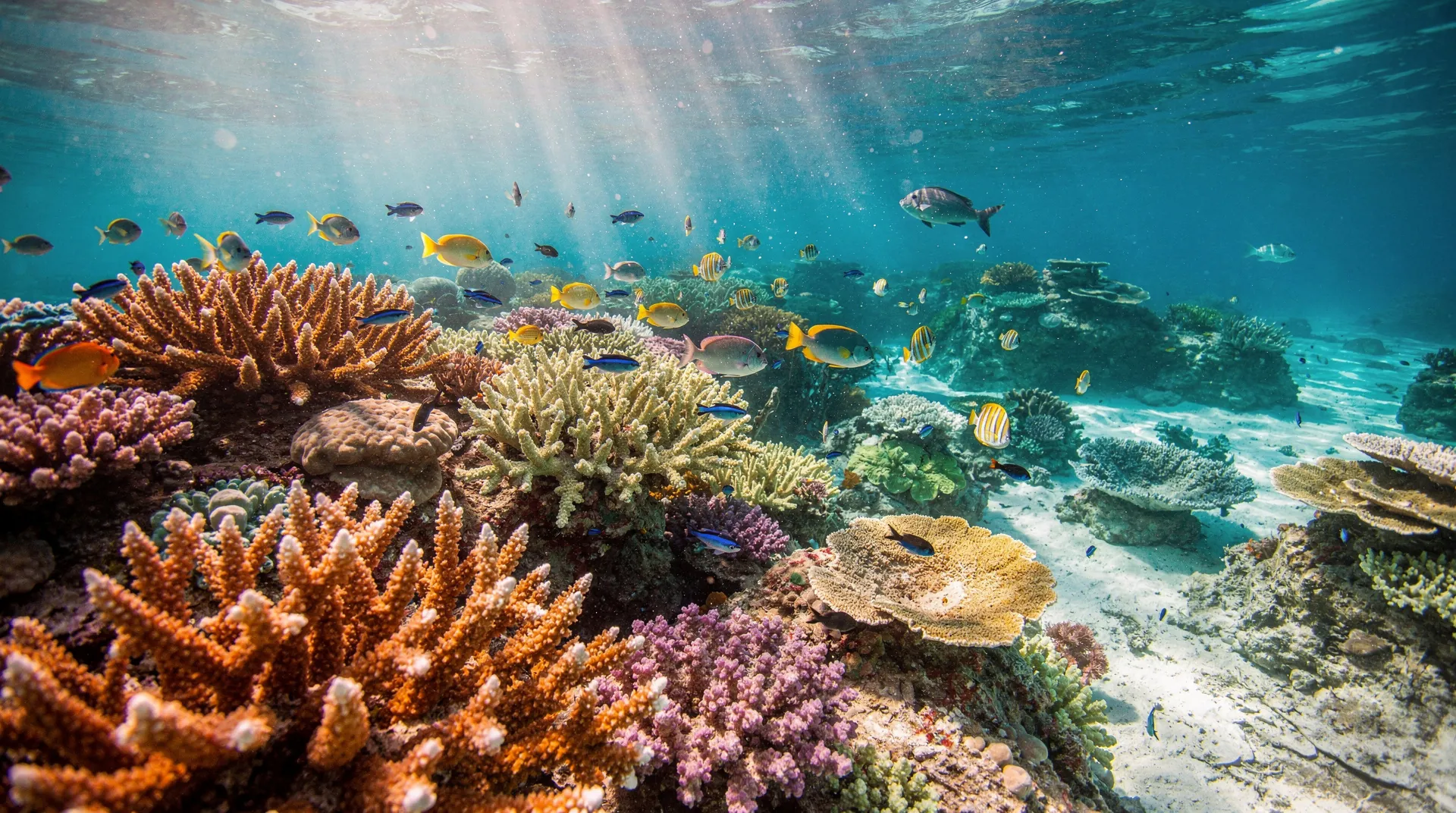
Blue Bay Marine Park: snorkeling, coral and biodiversity in southeast Mauritius
Updated: August 2026
Can you snorkel on your own at Blue Bay Marine Park?
Yes, snorkeling from Blue Bay beach is free and open to everyone. Some deeper, more distant areas are best reached by boat. The park is protected — no anchoring, no collecting coral, and no disturbing wildlife are allowed.
At a glance
| Where | Southeast Mauritius, Blue Bay beach, a few kilometres from Mahebourg |
| Price | Snorkeling from the beach is free; equipment rental about 200 rupees/hour; boat excursions are paid |
| Time needed | 2 to 3 hours for beach snorkeling, half a day for a boat excursion |
| Getting there | By car from the airport (about 10 km) or from your southeast accommodation |
| Best time | May to November for the best visibility, year-round for swimming |
Blue Bay Marine Park: Mauritius’s finest coral reef
Blue Bay Marine Park is the most celebrated diving and snorkeling site in Mauritius. Classified a protected marine area since 2000, it covers around 353 hectares of lagoon in the southeast of the island, between Blue Bay beach and the outer coral barrier. The park is home to one of the best-preserved coral ecosystems in the western Indian Ocean — a rare distinction in a world where more than half of the planet’s coral reefs have already been destroyed or severely damaged.
The exceptional quality of Blue Bay’s coral is down to several factors: the moderate depth of the lagoon (3 to 15 metres in the main areas), the clarity of the water, relatively low human pressure thanks to its protected status, and the particular geography of this naturally sheltered bay. The result is centuries-old massive coral colonies sitting alongside colourful branching coral gardens, and an unusually rich associated marine life.
Blue Bay is located in the southeast of the island, a few kilometres from Mahebourg and Ile aux Aigrettes. Combining these three sites over a day or two makes for one of the best nature experiences Mauritius has to offer.
The marine park’s biodiversity
The coral
Blue Bay Marine Park hosts a remarkable diversity of coral for the region. More than 38 species of hard coral and a dozen species of soft coral have been recorded here. The most spectacular formations are the massive Porites — huge boulders of compact coral that can reach 3 metres in diameter, representing centuries of growth at just a few millimetres a year.
Branching coral (Acropora) forms dense gardens in the shallower areas, providing shelter and food for a multitude of small fish species. Table corals in horizontal layers are striking in their size and architecture. The diversity of shapes, textures and colours — from pink to purple, via yellow, brown and green — creates underwater scenery of exceptional beauty.
Coral bleaching events (caused by climate change and abnormally warm waters) have affected Blue Bay like every reef on the planet. The years 1998 and 2016 caused significant damage in the park. But the resilience of coral in an area protected from direct fishing pressure and anchoring has allowed a strong recovery, and Blue Bay’s coral is today in better condition than most reefs in the region.
The fish
More than 72 species of fish have been recorded in the marine park. Even a short snorkel in Blue Bay lets you easily spot parrotfish nibbling at the coral, dense schools of blue surgeonfish, striped butterflyfish, clownfish tucked into their anemones (the famous “Nemo”), damselfish aggressively defending their territory, and numerous species of camouflaged scorpionfish and lionfish resting on the seabed.
Larger species are present too: sizeable grouper in the deeper areas, solitary barracuda, jacks hunting in fast-moving schools, and occasionally blacktip reef sharks (Carcharhinus melanopterus), recognisable by their black-edged dorsal fin. These sharks are harmless to humans and generally move away as swimmers approach.
Sea turtles (green and hawksbill) regularly visit the park. Watching them glide gracefully among the coral, resting on the seabed or surfacing to breathe, is one of the most moving snorkeling experiences in Mauritius.
Other species
The park is also home to sea cucumbers, long-spined black sea urchins, starfish, camouflaged octopuses, cleaner shrimp and a wide variety of invertebrate species that form the base of the reef ecosystem.
In the seagrass beds that fringe certain parts of the lagoon, pipefish and seahorses hide with remarkable skill.
How to visit the marine park
Snorkeling from the beach
The simplest and cheapest way to discover the marine park is to snorkel straight from Blue Bay beach. The beach itself is beautiful — fine white sand beneath tall casuarina trees — and the coral starts just a few dozen metres from the shore. With a simple mask and snorkel, you can spot dozens of species without going far.
Snorkeling gear can be rented from providers on the beach (about 200 rupees an hour) or bought at sports shops in Mahebourg. If you have your own equipment, bring it — fins let you explore more interesting areas.
The best snorkeling area from the beach is to the left (north side) of the main beach, where the coral starts closer to shore and is denser. Avoid the motorboat lanes, clearly marked by buoys.
Boat excursions
To reach the richest parts of the park — including the dive sites in the reef pass — boat excursions leave daily from the Blue Bay jetty. These trips let you snorkel at 3 to 5 different spots in a single day, including areas not accessible from the beach.
Glass-bottom boats are an interesting alternative for those who don’t want to get in the water: seated in the boat, you watch the coral and fish through the glass floor. It’s a popular option for non-swimmers, young children and older travellers. Visibility from these boats is decent in calm weather, less so when the sea is rough.
For a full-day excursion with snorkeling at the park’s best sites, a Creole lunch and turtle spotting, book a southern excursion from Blue Bay with a quality operator who knows the park’s best spots.
Scuba diving
Blue Bay Marine Park is a top-tier dive site for certified divers. The dive sites in the reef pass and on the outer slope reach depths of 20 to 40 metres and host species that snorkeling doesn’t allow you to see. Our complete guide to snorkeling and diving in Mauritius gives detailed information on dive centres in the area and recommended sites for your level.
Marine park regulations
Blue Bay Marine Park is strictly regulated to protect its ecosystem. Key rules to follow:
Strictly forbidden:
- Anchoring on coral (all boats must use the designated mooring buoys)
- Collecting coral, shells, starfish or any other living or dead organism
- Any form of fishing within park boundaries
- Feeding fish (which alters their natural behaviour and can favour some species over others)
- Touching coral (divers and snorkelers must keep a minimum distance)
- Using chemical sunscreen (choose mineral sunscreens based on zinc oxide instead)
What’s allowed:
- Snorkeling from the beach or from licensed boats
- Diving with licensed centres
- Motorboat navigation in marked channels
- Traditional fishing in designated zones outside the park’s core
Violations of these rules are enforced by rangers from the Mauritian government’s Fisheries Division, who patrol the park regularly.
What to bring to make the most of the park
Your own mask and snorkel, if you have them, rather than renting on site — the comfort and fit of gear you already know makes a real difference for a long session.
Mineral sunscreen based on zinc oxide only. Standard chemical sunscreens contain UV filters (oxybenzone, octinoxate) that contribute to coral bleaching and are banned in the park — many travellers aren’t aware of this and get turned away or fined.
Water shoes for walking on the sand and rocky areas near the beach, where sea urchins or, more rarely, venomous stonefish sometimes hide.
A UV-protective rash guard (lycra) for long snorkeling sessions — the tropical sun at this latitude burns your back very quickly, even in the water, and many travellers underestimate this risk.
A waterproof pouch for your phone if you want to take photos from the surface, or a dedicated waterproof camera for quality underwater shots.
Protected wildlife: how to behave around turtles and reef sharks
Observing Blue Bay’s iconic wildlife calls for a few commonsense rules that every visitor should know, beyond the park’s official regulations.
Around a sea turtle: keep a distance of at least 3 metres, never touch it and never block its path to the surface — turtles need to surface regularly to breathe, and the stress of being chased can exhaust them. Never feed them under any circumstances.
Around a blacktip reef shark: these small sharks (generally 1 to 1.5 metres) are harmless to humans and consistently swim away as swimmers approach. Stay calm, don’t chase them for a photo, and let them move off naturally — the vast majority of visitors only ever see one from a distance anyway.
Best season to visit Blue Bay
Blue Bay Marine Park can be visited year-round, but conditions vary significantly by season.
Dry season (May to November): Ideal conditions. Calm sea, excellent visibility (15 to 25 metres), pleasant water temperature (23-25°C). This is the recommended period for snorkeling and diving. The southeast coast is generally less affected by trade winds than the north or west during these months.
Rainy season (December to April): Visibility can drop at times (suspended sediment after rain), sea sometimes rough. Cyclones, though rare, can temporarily close the park. Outside of weather events, the park remains visitable and the water temperature (26-29°C) is very pleasant.
Our guide to weather in Mauritius covers each season’s climate in detail and how to plan your water activities accordingly.
Combining Blue Bay with nearby sites
Blue Bay sits in a southeast region of Mauritius that’s exceptionally rich in natural and cultural sites. A few kilometres away, Ile aux Aigrettes offers a unique wildlife conservation experience. Mahebourg and its history museum are 5 minutes away. Pointe d’Esny, one of the finest beaches in the south, is within walking distance of Blue Bay.
For the perfect southeast day: visit Ile aux Aigrettes in the morning, lunch in Mahebourg, then an afternoon of snorkeling at Blue Bay. Our guide to 7-day itineraries in Mauritius includes this route as part of a complete programme.
To get to the area from Plaisance airport (just 10 kilometres away), a private airport transfer will take you straight to your Blue Bay accommodation. Our guide to where to stay in Mauritius covers the best places to stay in the area, from luxury to budget.
Blue Bay is, along with Le Morne and Belle Mare, one of Mauritius’s most beautiful beach destinations. Its status as a protected marine park gives it something extra that plain sandy beaches can’t offer: here, the sea is alive, extraordinarily diverse, and every dip into these crystal-clear waters is an encounter with an underwater world whose richness leaves lasting memories.
To explore the south of the island in depth, our guide to car rental in Mauritius is essential. Our budget guide for a trip to Mauritius and our guide to beaches in Mauritius round out your preparation for a trip to the southeast.