
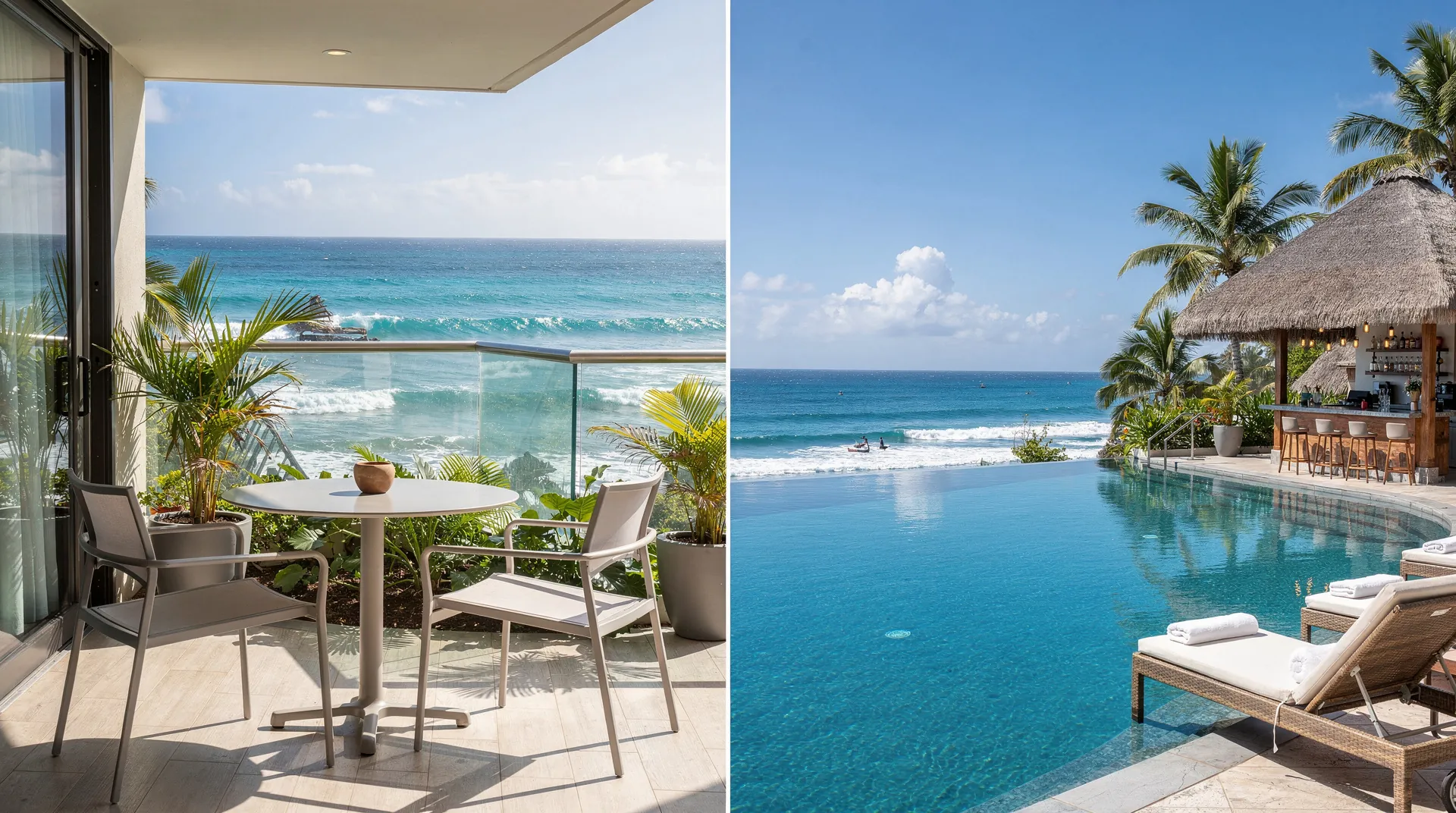
Airbnb or hotel in Mauritius: we tested both, here's our verdict
Updated: July 2024
The old debate, Mauritius edition
When planning a trip to Mauritius, the question of accommodation is central — and not just because it takes up a large chunk of the budget. The type of accommodation you choose shapes much of the trip itself: what you eat, where you spend your evenings, how much you interact with locals.
I’ve tried both options in Mauritius, several times, in different setups. As a couple, then as a family. Different parts of the island. Different price ranges. Here’s my honest verdict, no sugarcoating. For a full overview of accommodation options in Mauritius, our guide to where to stay in Mauritius is the reference.
At a glance
| Hotel, typical budget | €150-300/night (4-star), €300+ (5-star) |
| Airbnb/villa, typical budget | €50-130/night depending on area and standard |
| Best value for Airbnb | stays of over a week, families or groups |
| When to book | early for high season (July-August, December-January) |
| Best time to go | May to December, avoiding January-February |
Hotels in Mauritius: what they offer
The strengths
Logistical simplicity. Arriving exhausted after an 11-hour flight and finding a room ready, a pool, a bar and a buffet — it’s comfortable and frictionless. No worrying about cleaning, linens or organisation. You unpack your bags and you’re off. This is even smoother if you’ve booked a private airport-to-hotel transfer waiting for you right after baggage claim.
Beach access. Most of Mauritius’s big hotels sit directly on the lagoon, with their own beach access, loungers, mats, snorkelling gear for rent, and boats on hand. This proximity to the sea is a real asset, especially for families with young children. Our guide to where to stay with a family identifies the hotels best equipped to welcome kids.
The services. Concierge, spa, in-house restaurants, entertainment, kids clubs, organised excursions — an all-inclusive resort is a well-oiled machine that covers nearly every need without you ever having to leave the grounds. For romantic getaways, spa treatments and private beach dinners are hard to replicate in an Airbnb.
Safety (especially for families). Hotels offer an enclosed, supervised environment. For families with young children, that’s real peace of mind.
The weaknesses
The price. A 4-star hotel in high season in Mauritius easily costs between €150 and €300 a night. A 5-star, between €300 and €700 and up. That’s a serious budget, leaving less room for activities, dining out or excursions. Our Mauritius budget guide compares the different options.
The confinement. In an all-inclusive, everything nudges you to stay put — meals are already paid for, the pool is right there, the bar is open. The result: many travellers spend 10 days barely leaving their hotel grounds and go home with a very partial view of the island. They miss the markets, the local food scene and the more authentic areas.
The tourist bubble. Large hotels are parallel worlds to the real island. The food, the atmosphere, the interactions — everything is tailored to an international clientele. You lose sight of the real Mauritius.
Visible inequality. The north and west coasts of Mauritius are dotted with five-star resorts sitting right next to modest Mauritian villages. The contrast can be uncomfortable.
Airbnb in Mauritius: what it offers
The strengths
Value for money. For the price of a decent hotel room, you can often rent an entire apartment with a kitchen, a terrace and a private pool. The maths work especially well for longer stays (over a week) and for families or groups. Check our article on the real budget for a trip to Mauritius to see how the numbers compare in practice.
The freedom of a kitchen. Having a kitchen changes everything. Breakfast at your own pace, with produce from the local market. Quick lunches whipped up in five minutes. Improvised dinners with whatever you brought back from the market in Port-Louis or Mahebourg. And above all, the chance to save significantly on your food budget.
Contact with local life. Staying in an apartment or house in a real neighbourhood also means seeing Mauritius from the inside. Neighbours who greet you in the morning, the bakery down the street, the local market a 10-minute walk away — small experiences that give your trip a texture guidebooks simply can’t plan for you.
The flexibility. No fixed mealtimes, no standard 3pm check-in, no strict 11am checkout. Every rental has its own rules, but overall Airbnb offers far more flexibility than a hotel.
The weaknesses
The risk of a gap between the listing and reality. Anyone who’s used Airbnb more than ten times has been disappointed at least once. In Mauritius, Airbnb listings are plentiful but quality varies a lot. Read recent reviews carefully and ask specific questions before booking.
No service. No housekeeping, no 24-hour front desk, no concierge. If the air conditioning breaks down at midnight, you’re on your own with the owner’s WhatsApp number and however responsive they happen to be.
Distance from activities. Some Airbnbs sit in residential areas well away from the beach or restaurants. Without a car, that can become a real hassle. Always check the exact location before booking. Our guide to car rental in Mauritius offers advice on getting around from different areas.
Logistical complexity. Picking up a key somewhere, checking the inventory, end-of-stay cleaning sometimes left to the renter — Airbnb demands more personal effort than a hotel.
Our experiences compared
Experience 1: couple, 7 nights in a 4-star hotel, north coast (Grand Baie)
Beautiful setting, flawless service, beach 50 metres away. Half-board meals were decent but unremarkable. We went out for dinner 5 nights out of 7, which somewhat cancelled out the half-board benefit. A pleasant stay, but with a sense of being in a bubble. Cost: €1,800 for 7 nights, breakfasts and dinners included.
Experience 2: couple, 10 nights in an Airbnb apartment, Flic-en-Flac
Apartment with a kitchen, terrace and shared pool, a 5-minute walk from the beach. The owner lived on site (on the ground floor), friendly and available. We cooked 5 nights out of 10, ate at a local restaurant the other evenings. Total freedom, immersion in the neighbourhood, chats with the neighbours. Flic-en-Flac in an Airbnb is the best of both worlds — beach within walking distance, local life right at the door. Cost: €650 for 10 nights.
Experience 3: family of 4 (kids aged 5 and 9), 5 nights in a hotel in Trou-aux-Biches
The kids club and the secured pool were worth their weight in gold. The kids were busy and happy. The buffet meals covered the children’s varied tastes well. The staff were attentive to families. Cost: €2,200 for 5 nights, all meals included. For families with young children, the secured pool and kids club are often the deciding factor — our family itinerary takes these needs into account.
Experience 4: family of 4, 5 nights in an Airbnb villa, Chamarel
Villa with a tropical garden, fully equipped kitchen, two bedrooms, barbecue. The kids loved playing in the garden with the owner’s cats. We did our shopping at the Quatre Bornes market. Close to Chamarel and its Seven Coloured Earths. Cost: €500 for 5 nights. Significant savings on food thanks to the kitchen.
Our verdict by traveller profile
Choose a hotel if:
- You’re travelling as a couple for a romantic, luxurious stay — our guide to where to stay as a couple identifies the most romantic properties
- You have very young children and want a secure setup
- This is your first trip to Mauritius and you’d rather have the peace of mind of a familiar format
- You have the budget and total relaxation is your top priority — our guide to where to stay in luxury covers the most exclusive resorts
- You’re only staying a week and want to make the most of your downtime
Choose Airbnb if:
- You’re after the best value for money
- You’re independent and enjoy organising your own days
- You’re staying more than a week (the savings grow with the length of stay)
- You’re travelling in a group (family or friends) — villas are often available at unbeatable rates
- You want to feel like you’re on the island, not in a resort
- You have a car (which offsets the distance from amenities)
The hybrid alternatives
Between chain hotels and Airbnb, there’s a third path that’s often overlooked: guesthouses and table d’hôtes run by Mauritian families. These properties (usually 3 to 8 rooms) offer the warmth of a homestay along with a level of service and comfort close to that of a small hotel.
Prices are generally in the middle range (€40 to €80 a night for a room with breakfast), the owners are a goldmine of information on the area and the best local spots, and the homemade breakfasts outshine any hotel buffet. It’s often my favourite recommendation for anyone who wants the best of both worlds.
Our guide to where to stay in Mauritius includes these properties in its selection. For families, also check our guide to where to stay with a family, which features guesthouses especially suited to children.
Getting around depending on your accommodation choice
Your choice of accommodation directly affects your mobility needs. An all-inclusive coastal hotel often lets you get through your stay without a car, using shuttles and organised excursions arranged through reception. An Airbnb outside the tourist areas, on the other hand, makes a rental car nearly essential for reaching beaches and restaurants without relying on taxis. Our guide to car rental in Mauritius and our car-free itinerary help you plan around this before booking.
Also think about the area: an Airbnb apartment in Grand Baie or Flic-en-Flac, right in the centre, stays walkable for most essentials — often the best compromise for those who want Airbnb’s freedom without the hassle of a car.
What it changes for your overall budget
Beyond the nightly rate, your choice of accommodation has a knock-on effect on your entire trip budget. An Airbnb with a kitchen lets you cut dining costs noticeably by cooking some meals yourself, while a half-board or all-inclusive hotel smooths out the food budget but leaves less room for exploring local restaurants. Our guide to the real budget for 10 days in Mauritius breaks down these differences item by item, and our general Mauritius budget guide helps you estimate your total envelope depending on the option you choose.
The final word
There’s no right or wrong answer. Your choice should match what you’re looking for from this trip. What would be a shame is choosing by default — because “that’s what people do in Mauritius” or because it’s what the travel agent offered.
Think about how you experience your holidays. Do you need service and comfort, or would you rather have freedom and immersion? Are you a holiday cook, or someone who wants everything ready on arrival? Are you travelling solo, as a couple, or as a family?
The answer to these questions will point you to your ideal accommodation in Mauritius. And whatever option you choose, the island will find a way to surprise you — that’s its greatest quality.