
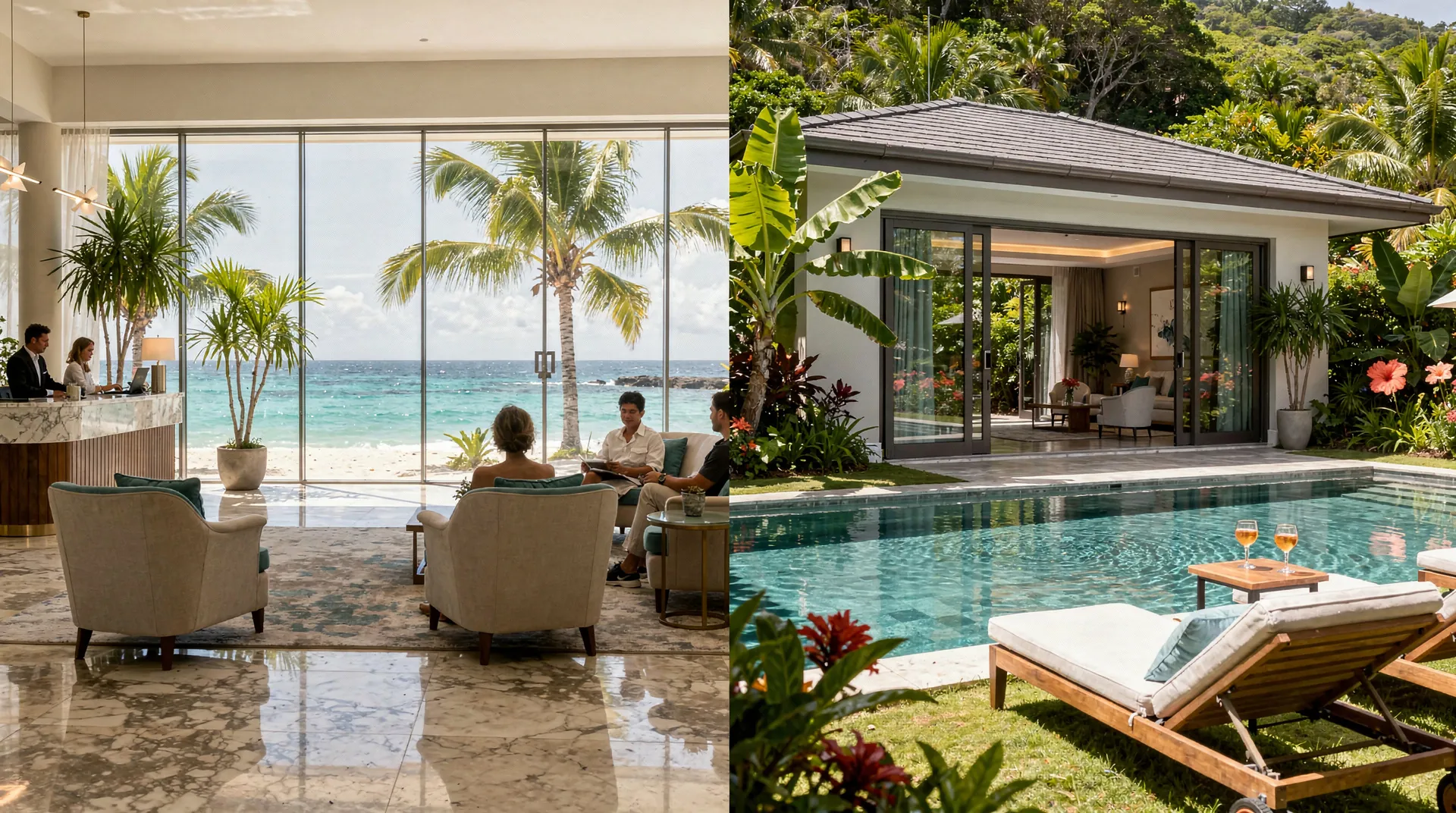
Hotel vs villa in Mauritius: a comparison to help you choose
Updated: August 2026
Is it better to book a hotel or a villa in Mauritius?
A hotel suits couples on a romantic getaway and first-time visitors who want services included. A villa is better suited to families with children, groups of friends and longer stays. From 4 people upward, a villa is often cheaper per head than an equivalent hotel.
Hotel or villa: the first decision for a successful trip
Before you even choose your holiday area, compare beaches or plan excursions, there’s one fundamental decision to make: will your accommodation be a hotel or a private villa? This choice shapes everything else about your trip — your freedom, your spending, your interactions with people, your children’s comfort, and even how you eat.
In Mauritius, both options are well developed and of good quality. The hotel scene is among the best in the Indian Ocean. The holiday villa market is abundant, with thousands of properties available by the week or month, from small garden villas with a pool to luxury estates overlooking the lagoon. Choosing between the two means asking yourself honestly what you want, who’s travelling with you, and what your budget is.
This guide will help you decide. For guides dedicated to each option, see our pages on hotels in Mauritius and villas in Mauritius.
At a glance
| Criteria | Hotel | Villa |
|---|---|---|
| Best for | Couples, short stays, first-time visitors | Families, groups of 4 or more, long stays |
| Indicative budget | About €150 to €900 per night depending on the standard | About €150 to €500 per night for the whole villa (3 bedrooms) |
| Recommended booking window | As soon as possible in high season (July-August, year-end holidays) | 2 to 4 months ahead in high season, later in low season |
| Autonomy required | Low: services included | High: groceries, cooking, logistics to manage |
| Well-served areas | Grand Baie, Belle Mare, Le Morne | Tamarin, Flic-en-Flac, residential areas in the north |
The hotel in Mauritius: the advantages
Included services — the hotel’s biggest strength
This is the hotel’s main strength: you arrive, put your bags down, and everything is organised. Breakfast ready every morning, fresh beach towels, a well-maintained pool, reception on hand for requests. For travellers who don’t want to think about logistics and want to enjoy their holiday 100% from day one, this is invaluable.
In Mauritius’s large resorts, the services go even further: a concierge who arranges excursions, valet parking, a kids’ club, a spa with a full treatment menu, and several restaurants on site. Everything is designed so you never need to leave the property. For travellers who paid for “all-inclusive,” this is exactly what they’re looking for. Our guide to all-inclusive packages covers the best resorts of this type.
Private beach access and included water sports
Most beachfront hotels in Mauritius include non-motorised water sports in the room rate: kayaking, windsurfing, paddleboarding, snorkelling from the beach, equipment provided. This is a real financial advantage over a villa, where this equipment must be rented separately or sourced from outside providers.
The one excursion neither hotels nor villas include is the catamaran day trip — worth booking separately whatever kind of traveller you are: book a catamaran day trip to Ile aux Cerfs.
Beach access through a hotel also guarantees reserved sun loungers and parasols — a welcome comfort in high season, when public beaches get busier. The good resorts in Belle Mare or Le Morne offer a complete beach experience without ever leaving the property.
Hassle-free dining
At a hotel — especially on an all-inclusive or half-board plan — the question of what to eat is solved. You sit down, choose from the menu or buffet, and it’s served. For travellers who don’t want to shop for groceries or cook, this is the ideal setup. Mauritius’s large resorts often run several restaurants to avoid monotony: fine dining, world cuisine, beach grill, poolside snacks. Mauritian cuisine is generally well represented.
Security and round-the-clock service
Hotels offer 24-hour security, assistance if something goes wrong, and a reassuring structure for travellers unfamiliar with the destination. In the event of a cyclone, large hotels have well-rehearsed emergency protocols and buildings constructed to cyclone-resistant standards — which is far from always the case for villas. For families with infants or people who don’t want to worry about anything, this is a valuable comfort.
The hotel in Mauritius: the drawbacks
The cost in high season
Mauritius’s large hotels charge rates in high season (July-August, Christmas-New Year) that can feel steep: €500 to €900 a night for a 5-star, €200 to €400 for a well-located 4-star. For a family of 4, the accommodation budget for a week can reach €2,000 to €6,000, not counting meals if the plan isn’t all-inclusive. Our Mauritius budget guide puts these figures in context.
Limited space for families
A hotel room, however spacious, is still just a room. For a family with two children, sharing 35 to 50 m² for 10 days can start to feel cramped — especially if the children keep different schedules (naps, timings). Some hotels offer family suites or villas within their complex, but at even higher rates.
The standardised atmosphere
Large international resorts tend to blur the differences between countries. Whichever continent you’re staying on, you find the same international buffets, the same infinity pools, the same formatted service. For a traveller who wants the authentic Mauritian experience — Creole cooking, markets, local beaches — this standardisation can be disappointing. It’s one of the strongest arguments in favour of the villa.
The villa in Mauritius: the advantages
Space and freedom — the deciding factor
This is the first, and often the deciding, argument in favour of a villa: space. A 3-bedroom villa offers 150 to 300 m² of living space, with a lounge, kitchen, several bathrooms, terrace, garden and private pool. For a family with children or a group of friends, the difference in quality of life compared to adjoining hotel rooms is considerable and often the deal-breaker.
Children can run freely around the garden and pool without worrying about resort rules or disturbing other guests. Adults can eat whenever they like, play music, throw together an impromptu barbecue, or stay swimming in the pool at 11pm — without bothering anyone. This freedom is invaluable for families who have ever tried to manage overexcited kids in a hotel corridor.
Value for money for groups
From 4 people upward, a villa becomes very good value. A 3-bedroom villa with a pool in Tamarin or Flic-en-Flac rents for between €250 and €500 a night depending on the season and amenities. Split between 6 people, that works out at €40-85 per person per night — often cheaper than a mid-range hotel room, for a far bigger space.
For groups of friends celebrating a birthday, a hen party or a family reunion, a villa is almost always more affordable and more sociable than booking several hotel rooms and having to gather in the corridor or the bar to chat.
Immersion in local life
A villa in a Mauritian residential neighbourhood puts local life within reach. You shop at the Mahebourg or Flacq market, discover the neighbourhood snack stalls, chat with your neighbours, and see how Mauritians really live day to day. This immersion is impossible in a resort tucked away on its private beach. For travellers who want to understand Mauritian culture beyond the hotel buffet, it’s precious.
Cooking your own way
With a fully equipped kitchen, you can handle your own breakfasts (local fruit, fresh bread from the village bakery), lunches based on what you bought at the market, and even dinners if you feel like cooking. Local markets are an excellent source of fresh fruit, vegetables, the catch of the day and spices, at prices well below tourist restaurants. For families with children who have specific eating habits, or travellers with particular dietary needs, home cooking is a welcome source of peace of mind.
The villa in Mauritius: the drawbacks
Logistics you handle yourself
A villa means autonomy, but also responsibility. If the air conditioning breaks down, if there’s a problem with the pool, if you need a taxi or excursion recommendations, there’s no 24-hour reception to call. Some owners or agencies are very responsive and easy to reach; others less so. Checking the owner’s availability and reading recent reviews on their responsiveness to problems is essential before booking.
You also need to handle laundry, prepare meals and do the shopping — tasks a hotel takes off your hands entirely. For travellers on a short stay who want to make the most of every hour, this logistics can be a burden.
Beach access isn’t guaranteed
A villa a 10-minute walk from the sea is comfortable for a self-sufficient adult. For a family with a pushchair, parasol, cool box and beach toys, that daily walk can quickly become a repeated chore. Villas directly on the beachfront do exist in Mauritius, but they’re rare and very expensive. Check the actual distance to the beach in reviews and photos — listings sometimes say “close to the beach” for distances that in reality require a car.
No hotel services
No spa on site, no restaurant staff, no kids’ club, no built-in water sports centre. Activities have to be organised outside the property and on the holidaymakers’ own initiative. For travellers who want everything without leaving their accommodation, a hotel remains far more convenient.
When to choose a hotel
A hotel is the right call for couples on a honeymoon or anniversary trip who want to be pampered and enjoy every service without effort, first-time visitors who don’t want to deal with logistics on an unfamiliar island, travellers staying under 5 days who want to make the most of every hour, older travellers or those with reduced mobility who benefit from constant staff assistance, and all-inclusive packages, where the whole point is having everything covered in a fixed price.
When to choose a villa
A villa is the best choice for families with children who need space, a private pool and freedom over their schedule, groups of 4 or more who calculate their budget per head, stays of 10 days or longer where the freedom to organise your own time is worth its weight in gold, travellers seeking local authenticity who want to shop at markets, cook and live like temporary locals, and remote workers who need a good internet connection and a quiet workspace. Our guide to long stays and remote work in Mauritius covers the best areas for this profile.
How much you actually save with a villa, by group size
The per-head math changes everything. For 2 people, a 4-star hotel room at €250 a night works out at €125 per person — an equally comfortable villa sized for 2 barely exists at a lower price, so the hotel stays competitive. For 4 people, a 2-bedroom villa at €300 a night drops to €75 per head, already well below the price of a standard hotel room.
For 6 to 8 people in a 4-bedroom villa at €450-550 a night, the cost per head falls to €55-90, often 40 to 50% below the equivalent 4-star hotel rate. The tipping point is generally around 4 people: below that, the hotel stays competitive; above it, the villa wins out almost every time. Our Mauritius budget guide helps you fine-tune these estimates for your exact profile.
Villa or hotel depending on the length of your stay
The length of your stay also tips the balance. On a short 3-5 day trip, a villa’s logistics (shopping, cleaning, the occasional technical hiccup) take up proportionally more of the total stay: a hotel, where everything is ready on arrival, maximises actual holiday time. Beyond 10 days, that logistics becomes negligible relative to the total length, and the villa’s advantages (cost, space, freedom of pace) take over. For a 10-day-plus itinerary, a villa also lets you unpack once and use an actual fridge rather than the minibar, which matters for families with young children.
A special case: travelling with a baby or young children
With an infant or a toddler, a villa offers an often underrated advantage: being able to manage naps and meals without restaurant hours to work around, having real space to hang laundry and sterilise bottles, and enjoying a private pool for safety (provided it’s fenced or supervised at all times). A hotel remains a good option if you want a supervised kids’ club or would rather not deal with meals. See our guide to Mauritius with a family and our family itinerary to refine your choice based on your children’s ages.
A third way: villas within resorts
Several large Mauritian resorts offer “villas” within the hotel complex: standalone units with a private pool and garden, but with access to all the hotel’s services (restaurants, spa, beach, kids’ club). It’s a hybrid format that combines a villa’s space with a hotel’s service.
Lux Le Morne, Heritage, Beachcomber and a few others offer this kind of option. The price reflects it: often above €600-800 a night. But for well-off families who don’t want to choose between freedom and service, it’s the ideal solution.
Summary comparison table
Comfort for 2 people: advantage hotel (service, beach, restaurant)
Comfort for 4 or more people: advantage villa (space, cost per head)
Budget for 6 people: clear advantage villa (sometimes 50% cheaper per head)
Included water sports: advantage hotel
Freedom of schedule: advantage villa
Cooking and local markets: advantage villa
Security and assistance: advantage hotel
Cultural immersion: advantage villa
Romantic honeymoon: advantage hotel (service and setting)
Family holidays with children: advantage villa (space and private pool)
Verdict
There’s no universal answer. To sum it up: choose a hotel if there are 2 of you and you’re after romance and effortless service. Choose a villa if there are 4 of you or more, or if you want freedom and local immersion.
For families with children, a villa is almost always the right call from a week-long stay onward: the space, private pool and freedom of schedule easily outweigh the lack of services. For couples without children on a short romantic getaway, a quality hotel remains the ideal setting.
And don’t overlook the hybrid resort-villa format if your budget allows: it’s often the best of both worlds, with the space of a villa and the services of a large resort. Whatever accommodation you choose, a private transfer from the airport is far less stressful than an improvised taxi at arrivals: book your private airport-to-accommodation transfer.